Locations:





Cutaneous complications common post-transplant
Advertisement
Cleveland Clinic is a non-profit academic medical center. Advertising on our site helps support our mission. We do not endorse non-Cleveland Clinic products or services. Policy
As use of lung transplant (LT) becomes more common, pulmonologists should be aware of post-transplant dermatologic complications. In a recent pictorial review in CHEST, my colleagues and I describe the pathogenesis, epidemiological characteristics and clinical manifestations of dermatologic complications found in lung transplant recipients. Here I will focus on malignant melanoma (MM).
The pooled relative risk of MM in transplant recipients is 2.71, and that risk increases with longer and more intense immunosuppression as well as male sex, age and azathioprine use. Melanoma can be transmitted from donor to recipient even after curative resection, leading some to question whether melanoma survivors should be eligible donors.
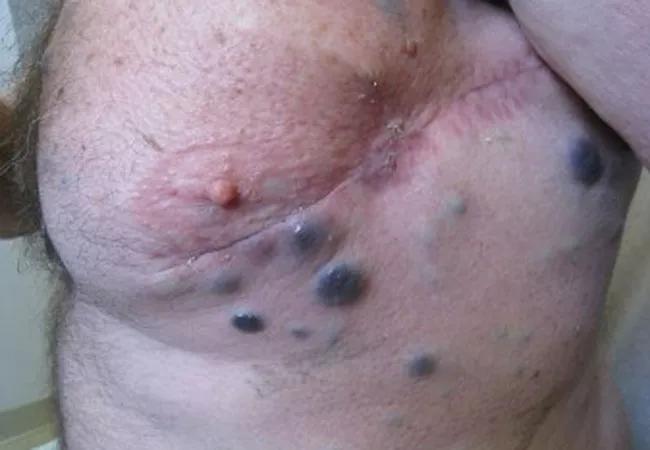
Image content: This image is available to view online.
View image online (https://assets.clevelandclinic.org/transform/52e1ad07-e74f-4c24-b690-e2365e503b02/19pul076-fig-1_650x450_jpg)
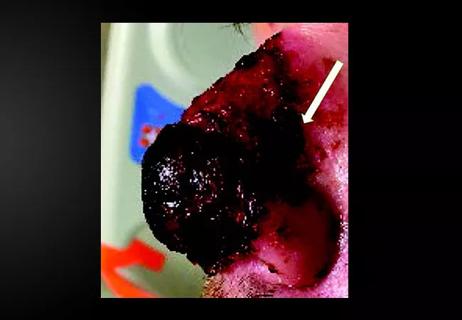
The patient above developed local cutaneous MM after a renal transplant. All solid organ transplant recipients are subject to increased risk.
Because melanomas are often overlooked, despite the many systems developed to identify them clinically, patients with higher risk should be screened regularly and educated about the importance and of skin surveillance and proper application of UV protection. I urge any transplant pulmonologist to incorporate counseling, treatment, education and referral to dermatology into their post-transplant visits. Early treatment for suspicious lesions is crucial, especially in this population.
Dr. Mehta is staff in the Department of Pulmonary Medicine.
Images are republished with permission from CHEST.
Advertisement
Advertisement

Here is the awesome subtitle.

Consider secondary syphilis in the differential of annular lesions
Persistent rectal pain leads to diffuse pustules
Techniques are borrowed from rhinoplasty, malar augmentation and others

Two cases — both tremendously different in their level of complexity — illustrate the core principles of nasal reconstruction
Stress and immunosuppression can trigger reactivation of latent virus

Low-dose, monitored prescription therapy demonstrates success
 Search