Locations:





Not all changes on imaging require detraining or quitting the sport

Image content: This image is available to view online.
View image online (https://assets.clevelandclinic.org/transform/90c715fc-2f34-45d7-8980-99c97a9959c7/AthletesHeart-690x380_jpg)
The Athlete's Heart
On a hot summer day, a young African-American competitive cyclist grew dizzy with maximal exertion while training. His performance dropped. Examination by a cardiologist revealed a normal ECG, but his echocardiogram was concerning for hypertrabeculation at the left ventricular (LV) apex. Metabolic stress testing showed good exercise capacity. MRI confirmed a heavily trabeculated left ventricle but normal LV function. The ratio of noncompacted to compacted myocardium was >2.3:1. He was diagnosed with LV noncompaction, commenced on a low-dose beta-blocker and disqualified from competitive sports.
Advertisement
Cleveland Clinic is a non-profit academic medical center. Advertising on our site helps support our mission. We do not endorse non-Cleveland Clinic products or services. Policy
He sought a second opinion from Cleveland Clinic and was referred to Dermot Phelan, MD, PhD, Director of the Sports Cardiology Center. Prominent LV trabeculations were confirmed, but there were no other features concerning for LV noncompaction: no scar on MRI, no abrupt transition zone from normal to thin compacted myocardium, normal strain and torsion, and no family history of cardiomyopathy.
Dr. Phelan determined that the changes were a normal variant often seen in athletes, particularly those of African-American descent, and that the dizziness was not cardiac in origin. He diagnosed “athlete’s heart” and gave the patient permission to resume competitive cycling.
Every year, about 100 U.S. athletes — student, amateur and professional — die of sudden cardiac death. Each fatality brings renewed interest in preventing such tragedies through early identification of underlying pathologies. Yet the methodologies and guidelines used to ascertain risk in young, asymptomatic individuals are weak, as are those for differentiating effects of strenuous exercise on the heart from potentially lethal heart diseases.
At Cleveland Clinic’s Sports Cardiology Center, multiple specialists focus on the health of amateur and pro athletes of all ages. The team, led by Dr. Phelan, a cardiac imaging specialist, includes:
Advertisement
The center works with the Cleveland Clinic Center for Sports Health in the Department of Orthopaedic Surgery, which provides care for Cleveland’s professional baseball and basketball teams and conducts health screenings for high school and college teams.
“When our colleagues see athletes with concerning symptoms such as fainting, dyspnea, chest pain or a drop in performance — or if an athlete has a murmur or a worrisome family history — they refer to us for evaluation,” says Dr. Phelan.
Specialists at the Sports Cardiology Center face two challenges on a regular basis:
In both cases, the athlete’s future — and sometimes life —depends on the findings.
Athletes are subject to the same diseases and anomalies that can cause sudden cardiac death or heart failure in the general population. However, their hearts also undergo physiologic changes from the stresses caused by regular strenuous exertion, resulting in the nonpathological entity known as athlete’s heart. Dr. Phelan knows which tests differentiate exertion-induced physiologic changes from those produced by potentially lethal pathologies.
“These sports-related changes to the heart are often particular to age, race, sex and type of sport,” he says. “All can have completely different ranges of normal. Most patients attending cardiology outpatient clinics are older and may be inactive, so when physicians encounter an enlarged ventricle wall or cavity, they naturally think it’s a real problem. But if the patient is an athlete, the findings may simply be normal structural changes caused by ongoing stress to the heart.”
Advertisement
Because the prevalence of heart diseases in athletes is very low, choosing the appropriate tests for asymptomatic patients requires unique skills and expertise, as well as an understanding of the demands of the sport and training techniques.
“The probability of accurately identifying the pathology is highly dependent on the test’s specificity,” says Dr. Phelan. “We are cautious in interpreting test results, because the vast majority of positive findings in asymptomatic athletes are false positives. Understanding that leads one to do further testing and integrate the results for a full overview. We rarely rely on a single test.”
Diagnosing heart disease in symptomatic athletes requires a different approach. “We assess the patient and see if our findings relate to the symptoms,” he says. “A careful history will tell us whether we should be worrying.”
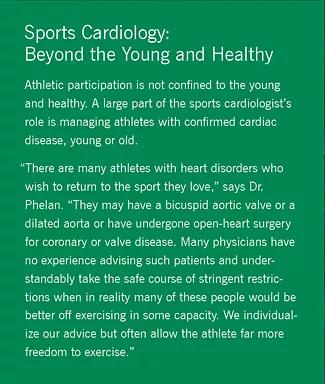
Image content: This image is available to view online.
View image online (https://assets.clevelandclinic.org/transform/23523dc6-0250-464a-b698-7b37ab8c8107/AthletesHeart-sm_jpg)
Once a diagnosis is made or an underlying problem corrected, cardiac exercise physiologist Gordon Blackburn, PhD, designs an individualized exercise program that’s safe for the athlete and effective for the sport. “Our primary goal is to protect the heart, whether the patient is cleared to return to competition and training or directed toward noncompetitive activities,” Dr. Blackburn explains.
Existing guidelines for treating athletes are limited and based primarily on expert opinion. Without supportive data, they tend to err toward caution and often advise detraining or quitting the sport. Experience enables Dr. Phelan to know when it’s safe to go outside the guidelines. “Guidelines are not firm rules,” he says. “Detraining has been shown to work in small published studies, but it’s rarely necessary.”
Advertisement
Sports cardiology expertise can be invaluable in controversial areas, such as whether an athlete with a defibrillator or LV noncompaction can return to play. “We discuss the pros and cons with the athlete and make a decision together,” says Dr. Phelan.
The accumulation of test results and treatment outcomes is helping build a body of evidence that can eventually be used to rewrite the guidelines — likely with a major impact on how competitive athletes of all ages are managed. “The next five years should bring more robust data on what’s safe and who should and shouldn’t be allowed to train,” Dr. Phelan concludes.
Advertisement
Advertisement
A sampling of outcome and volume data from our Heart & Vascular Institute
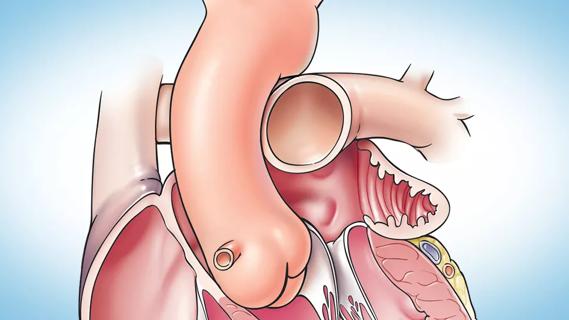
Concomitant AF ablation and LAA occlusion strongly endorsed during elective heart surgery
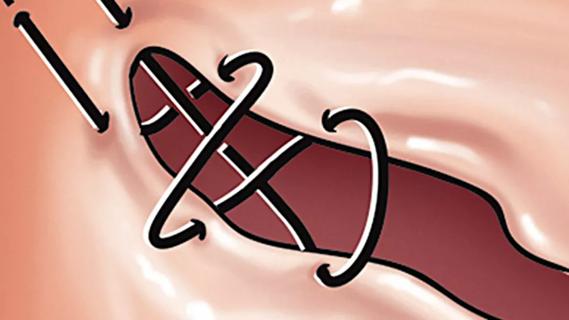
Large retrospective study supports its addition to BAV repair toolbox at expert centers
Young age, solid tumor, high uptake on PET and KRAS mutation signal risk, suggest need for lobectomy
Surprise findings argue for caution about testosterone use in men at risk for fracture
Residual AR related to severe preoperative AR increases risk of progression, need for reoperation

Findings support emphasis on markers of frailty related to, but not dependent on, age
Provides option for patients previously deemed anatomically unsuitable
 Search