Locations:





Noninvasive assessment of carotid artery plaque composition
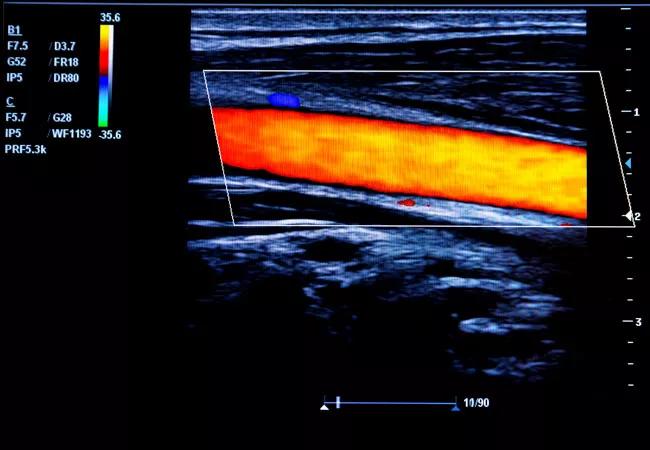
Image content: This image is available to view online.
View image online (https://assets.clevelandclinic.org/transform/2f8b4c3f-c571-4ede-a97b-3f48e4ede379/20-LRI-052-AssessStrokeRisk-650x450_jpg)
Ultrasound image of the carotid artery
Ischemic stroke (blockage of blood flow in the brain) makes up nearly 90% of CVAs. Although the degree of the blockage and the size of the plaque are important, a research team from Cleveland Clinic’s Department of Biomedical Engineering, led by D. Geoffrey Vince, PhD, believes that composition is a much better measure of plaque vulnerability (likelihood of causing a stroke) and risk of future stroke.
Advertisement
Cleveland Clinic is a non-profit academic medical center. Advertising on our site helps support our mission. We do not endorse non-Cleveland Clinic products or services. Policy
Dr. Vince has received a four-year, $4 million grant from the Department of Defense to study the relationship between the composition of carotid artery plaque and the risk of a future cerebrovascular accident (CVA) (i.e., stroke).
Currently, carotid artery plaque composition is determined using magnetic resonance imaging, which can be costly and is not always available. With this grant, the researchers will investigate the combined power of ultrasound together with a new machine learning algorithm to better, and noninvasively, assess plaque composition.
In this study, 1,500 patients with carotid artery stenosis from Cleveland Clinic and the Louis Stokes Cleveland Veterans Affairs Medical Center will undergo ultrasound of their carotid arteries. In tandem, a new program called the Compositional Analysis System by Machine (CASM) learning algorithm will create three-dimensional reconstructions of the plaques. The investigators will test the CASM algorithm’s ability to accurately determine the degree of stenosis and predict the precise plaque composition.
This new method to measure plaque composition would be much less expensive and easily accessible to all patients. Ultimately, the goal of the research is to gain approval from the Food and Drug Administration to use the CASM algorithm for the clinical assessment of stroke risk.
“We feel that there is a need for a non-invasive point-of-care tool to determine plaque composition,” Dr. Vince says. “With the CASM algorithm, we believe we can improve risk assessment and monitoring of carotid plaque. Our goal is to have this algorithm integrated into everyday clinical use.”
Advertisement
The study will also look for any association between diabetes and the non-invasive ultrasonic measure of carotid plaque composition. Diabetes is a significant risk factor for atherosclerotic carotid stenosis. Diabetic patients may have plaque that is softer and more pliable, thus increasing the likelihood of an ischemic stroke (as compared to non-diabetic patients with similar amounts of plaque).
The investigators believe CASM may enable clinicians to better monitor patients who are taking medications for diabetes and assess their effects on the composition of carotid artery plaque.
“This research is especially significant for the healthcare and well-being of veterans,” comments Dr. Vince. “We know that about 20% of veterans have diabetes, and smoking rates are especially high among vets—both of which contribute to CVA risk. We are excited to collaborate with our colleagues from the VA to help provide care to this population.”
Dr. Vince is the Lois Kennedy Endowed Chair in Biomedical Engineering and Applied Therapeutics.
Photo: Ultrasound image of the carotid artery. CASM will create three-dimensional reconstructions of plaques found in ultrasonic images like these.
*Please note: this article originally appeared here.
Advertisement
Advertisement


International collaboration is most genetically diverse study of the disease to date

Preclinical work promises large-scale data with minimal bias to inform development of clinical tests

Matching SNOMED Term with Curated Post. Please do not touch this post or any of its categories/snomed terms, thank you!

Matching Primary -> Secondary SNOMED Term with Curated Post. Please do not touch this post or any of its categories/snomed terms, thank you!
Cleveland Clinic researchers pursue answers on basic science and clinical fronts

Study suggests sex-specific pathways show potential for sex-specific therapeutic approaches

Cleveland Clinic launches Quantum Innovation Catalyzer Program to help start-up companies access advanced research technology
 Search