Locations:





Prior-night polysomnography predicts results from mean sleep latency testing
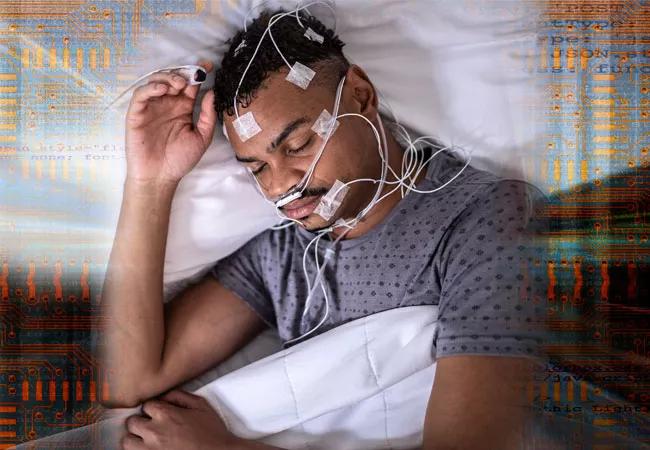
Image content: This image is available to view online.
View image online (https://assets.clevelandclinic.org/transform/32b7cec7-28f0-4ec6-8f3b-16c844009c61/23-NEU-4084416-CQD-Hero-650x450-1_jpg)
man undergoing polysomnography against machine learning background
Artificial intelligence methods can help predict how a patient will perform on the multiple sleep latency test (MSLT) based on variables from their overnight polysomnography (PSG) test. These methods may one day enable identification of central hypersomnolence disorders directly from overnight PSG alone.
Advertisement
Cleveland Clinic is a non-profit academic medical center. Advertising on our site helps support our mission. We do not endorse non-Cleveland Clinic products or services. Policy
So concludes a Cleveland Clinic team of investigators who derived predictive algorithms using a variety of machine learning techniques on a large volume of PSG data. Their research was recently described in a poster and abstract at the SLEEP 2023 joint annual meeting of the American Academy of Sleep Medicine and the Sleep Research Society.
“Using machine learning to create algorithms to diagnose conditions can potentially help save patients time and conserve healthcare resources by allowing patients to forgo additional testing,” says lead investigator Matheus Araujo, PhD, project staff with the Sleep Disorders Center at Cleveland Clinic, who presented the research. “Conversely, such algorithms may also indicate that a patient who was not scheduled for additional testing may actually need it.”
The central hypersomnolence disorders of narcolepsy and idiopathic hypersomnia are typically diagnosed using two sleep studies:
Advertisement
The study explored the use of machine learning to predict MSLT mean sleep latency and SOREMP results based on data from prior-night PSGs and other patient factors. Data were available from 802 PSGs/MSLTs from 796 patients (75% female; mean age, 34 years) performed at Cleveland Clinic between 2012 and 2022. Among the 802 MSLTs, 343 had mean sleep latency of 8 minutes or less and 234 had at least two SOREMPs.
Thirty-nine PSG variables, patient scores on the Epworth Sleepiness Scale (ESS; a patient-administered eight-question test assessing daytime sleepiness) and demographic data were analyzed with five machine learning methods: logistic regression, support vector machine, multilayer perceptron, random forest and XGBoost. Performance of these models was measured in terms of AUC-ROC, with possible scores ranging from 0 to 1. A perfect model has a score of 1, and 0.5 indicates the model is no better than chance.
Two methods proved most useful for predicting MSLT results, as detailed below:
Advertisement
Dr. Araujo says the research team is pursuing further validation of the machine learning algorithms to determine whether an MSLT can be forgone following PSG for diagnosing a central hypersomnolence disorder. He adds that more data are needed to ensure that results are valid for different genders, age groups and racial groups before the algorithms are ready for clinical use.
A similar promising study using artificial intelligence is currently being conducted under the leadership of Reena Mehra, MD, MS, Director of Sleep Disorders Research at Cleveland Clinic. The research, conducted in collaboration with IBM, is using machine learning techniques to try to predict cardiovascular outcomes from PSG data.
“Because sleep studies gather so much patient data, there is a great potential for development of useful machine learning models,” Dr. Araujo emphasizes. “By delving deep into the data, we hope to find meaningful clinical information that is not apparent from simple review of test results.”
Advertisement
Advertisement

New study advances understanding of patient-defined goals
Testing options and therapies are expanding for this poorly understood sleep disorder
Real-world claims data and tissue culture studies set the stage for randomized clinical testing
Digital subtraction angiography remains central to assessment of ‘benign’ PMSAH

Cleveland Clinic neuromuscular specialist shares insights on AI in his field and beyond
Findings challenge dogma that microglia are exclusively destructive regardless of location in brain
Neurology is especially well positioned for opportunities to enhance clinical care and medical training
New review distills insights from studies over the past decade
 Search