Locations:





Findings could ultimately help identify candidates for early myectomy
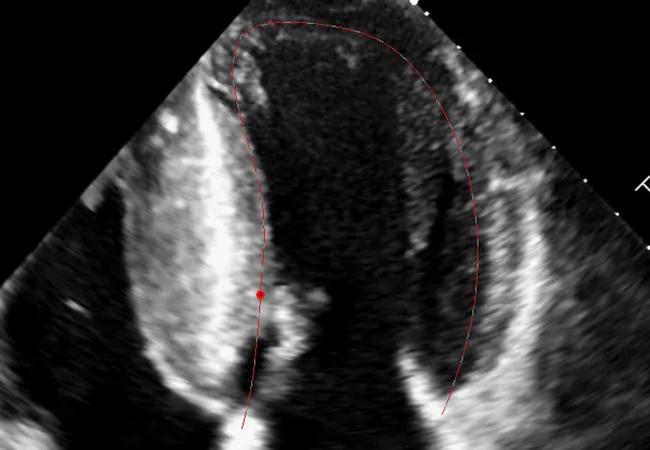
Image content: This image is available to view online.
View image online (https://assets.clevelandclinic.org/transform/79cfccb6-6d4c-49aa-aada-f3a7146d74e5/17-HRT-4638-Strain-HOCM-CQD-Feat_jpg)
LV Strain May Offer Independent Prognostic Utility in Obstructive Hypertrophic Cardiomyopathy
Abnormal left ventricular global longitudinal strain (LV-GLS) appears to help identify at-risk patients with obstructive hypertrophic cardiomyopathy (HCM) who may benefit from earlier myectomy.
Advertisement
Cleveland Clinic is a non-profit academic medical center. Advertising on our site helps support our mission. We do not endorse non-Cleveland Clinic products or services. Policy
That’s a key implication of a large observational study by Cleveland Clinic researchers designed to determine whether LV-GLS offers incremental prognostic utility for patients with obstructive HCM but preserved LV ejection fraction. The study was published by the Journal of the American Heart Association in late 2017.
“Recent data suggest that LV strain provides quantitative assessment of LV contractile function, which is more sensitive than LV ejection fraction,” says principal author Milind Desai, MD, Professor of Medicine at Cleveland Clinic Lerner College of Medicine and a Cleveland Clinic cardiologist. “It may seem intuitive that LV strain could offer incremental utility in patients with HCM, but prognostic data on the role of LV strain in HCM patients are scarce.”
So he and colleagues studied 1,019 adults with documented HCM and preserved LV ejection fraction evaluated at Cleveland Clinic from 2001 to 2011. They excluded patients with maximal LV outflow tract gradient less than 30 mmHg, bundle branch block or atrial fibrillation, past pacemaker or cardiac surgery, and obstructive coronary artery disease. All patients underwent comprehensive resting echocardiograms; LV-GLS was measured retrospectively.
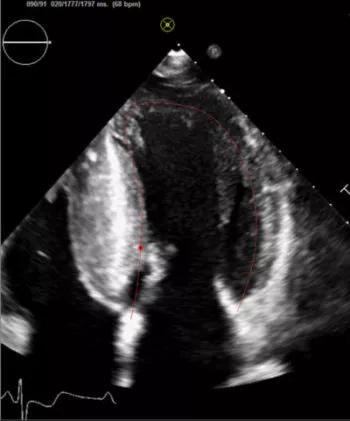
Image content: This image is available to view online.
View image online (https://assets.clevelandclinic.org/transform/6a6a910e-b379-4d0d-ad53-2df5b8d3f3b9/17-HRT-4638-Strain-HOCM-CQD-Inset-1-e1517433701651_jpg)
An example of left ventricular global longitudinal strain measurement from the study.
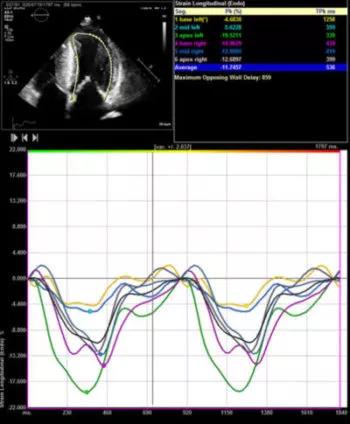
Image content: This image is available to view online.
View image online (https://assets.clevelandclinic.org/transform/45cf0c4b-6ae6-4431-8274-359dab0bb522/17-HRT-4638-Strain-HOCM-CQD-Inset-2-e1517433719617_jpg)
Over a mean follow-up of 9.4 years, 7 percent of patients (n = 69) experienced the primary composite end point of cardiac death (n = 62) or appropriate implantable cardioverter-defibrillator (ICD) discharge (n = 7). During the same follow-up period, 66 percent of patients underwent myectomy, 20 percent had an ICD implanted and 16 percent developed atrial fibrillation.
Advertisement
Multivariable regression analysis showed the following factors to be associated with significantly worse outcomes on the primary end point (P < .01):
In contrast, myectomy was associated with significantly improved outcomes.
“We have shown that LV-GLS provides incremental prognostic utility for long-term adverse events in a large group of adults with HCM and preserved LV ejection fraction,” says Dr. Desai. “Additionally, myectomy was associated with improved long-term survival, which is consistent with prior reports by our group and others.”
He says a few other findings of the analysis are noteworthy:
“Because the cohort with worse-than-median LV strain who hadn’t undergone myectomy had significantly worse outcomes, this suggests we may be able to identify at-risk patients with obstructive HCM who stand to benefit from earlier surgery, before the onset of symptoms or LV dysfunction,” notes Dr. Desai.
He adds that a small subset of HCM patients with severely reduced LV-GLS (i.e., worse than –7 percent) appear to decline clinically despite surgical repair of LV outflow tract obstruction. “These patients may eventually require further risk stratification and, in some cases, heart transplantation,” he says.
Advertisement
Because the study is a single-center retrospective analysis, its findings require prospective validation, Dr. Desai notes.
Advertisement
Advertisement
A sampling of outcome and volume data from our Heart & Vascular Institute
Concomitant AF ablation and LAA occlusion strongly endorsed during elective heart surgery
Large retrospective study supports its addition to BAV repair toolbox at expert centers
Young age, solid tumor, high uptake on PET and KRAS mutation signal risk, suggest need for lobectomy
Surprise findings argue for caution about testosterone use in men at risk for fracture
Residual AR related to severe preoperative AR increases risk of progression, need for reoperation

Findings support emphasis on markers of frailty related to, but not dependent on, age
Provides option for patients previously deemed anatomically unsuitable
 Search