Locations:





Outcomes from more than 1,000 surgical patients over 15 years
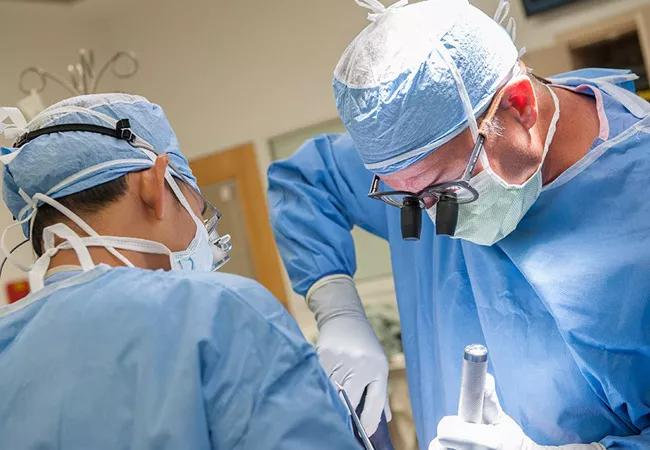
Image content: This image is available to view online.
View image online (https://assets.clevelandclinic.org/transform/a0f53f47-d363-409f-a61a-84ec5c8be4a2/16-NEU-1793-Outcomes-650x450_jpg)
16-neu-1793-outcomes-650×450
Neurosurgeons in Cleveland Clinic’s Epilepsy Center performed 422 epilepsy surgeries in adult and pediatric patients in 2015, continuing the center’s standing as one of the world’s most active programs of its kind.
Advertisement
Cleveland Clinic is a non-profit academic medical center. Advertising on our site helps support our mission. We do not endorse non-Cleveland Clinic products or services. Policy
A pillar of the program’s success at drawing patients has been a commitment to tracking, reporting and careful analysis of outcomes over many years. Analyses of seizure outcomes following three types of epilepsy surgery over a recent 15-year period reveal some commonalities and differences in patients’ long-term chances of achieving and maintaining seizure freedom according to surgery type. Those seizure outcomes are detailed in the graphs below, with outcomes classified using the widely accepted Engel classification of seizure freedom (seizure-free = Engel class I).
Temporal lobe resection is the most commonly performed surgical procedure for medically intractable epilepsy. As reflected below, more than 65 percent of adult and pediatric patients undergoing this operation at Cleveland Clinic during the 15-year analysis period have remained seizure-free a decade or more after surgery.
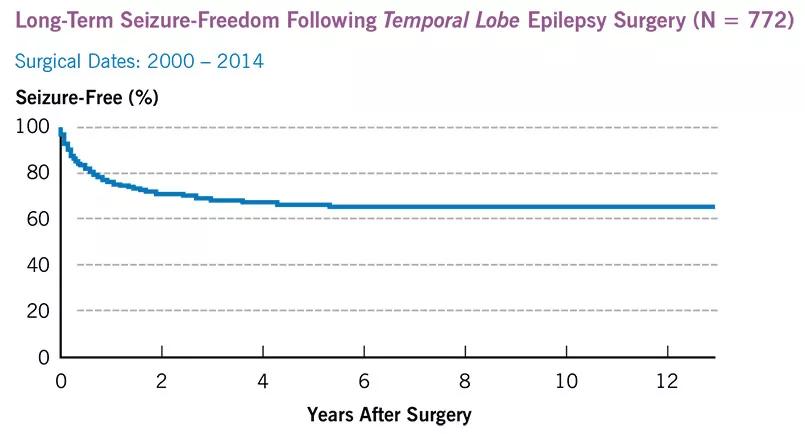
Image content: This image is available to view online.
View image online (https://assets.clevelandclinic.org/transform/4c38f7d8-d406-47c7-8f27-1f09b8938c38/16-NEU-1793-Outcomes-inset1_jpg)
Although traditionally considered the most challenging type of epilepsy surgery, frontal lobe resection is the second most commonly performed operation for medically intractable epilepsy. As shown below, approximately 50 percent of Cleveland Clinic patients remain seizure-free out to eight years after surgery, although the percentage drops to approximately 35 percent beginning at nine years.
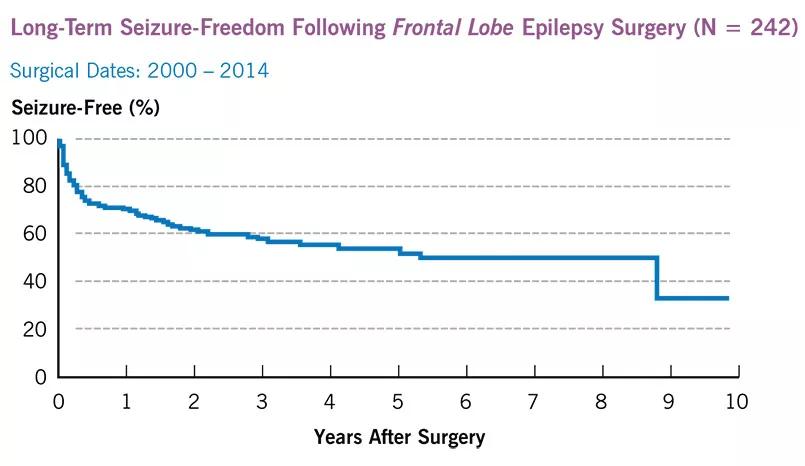
Image content: This image is available to view online.
View image online (https://assets.clevelandclinic.org/transform/5717a937-22b7-40fc-9198-fbc6e51191de/16-NEU-1793-Outcomes-inset2_jpg)
Posterior quadrant resection is used in cases of intractable epilepsy involving the posterior temporal, parietal and/or occipital regions. As detailed in the graph, approximately 60 percent of Cleveland Clinic patients undergoing this procedure remain seizure-free out to 12 years following surgery.
Advertisement
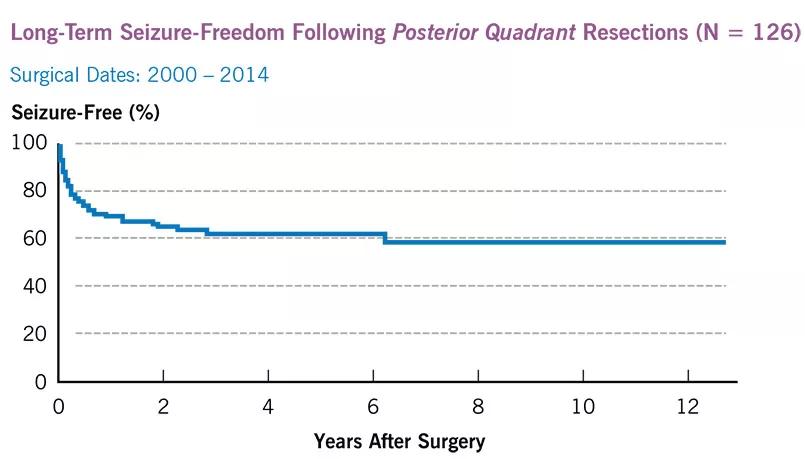
Image content: This image is available to view online.
View image online (https://assets.clevelandclinic.org/transform/36f06042-122c-4cff-8088-c147e66d4ea4/16-NEU-1793-Outcomes-inset3_jpg)
These data represent just a sampling of the epilepsy outcomes reported in Cleveland Clinic’s newly released 2015 Neurological Institute Outcomes Book, the latest in a series of comprehensive outcomes compendiums issued each year by more than a dozen of Cleveland Clinic’s clinical institutes. The publication shares a wealth of volume statistics, procedural outcomes and patient-reported outcomes across the full range of brain and spine care, from epilepsy to movement disorders to stroke.
This long-standing Cleveland Clinic outcomes reporting initiative is designed to help inform external clinicians’ potential referral or consultation decisions. At the same time, the process of outcomes collection and analysis behind the books guides Cleveland Clinic’s continuous improvement efforts and yields data to generate new research questions.
To check out the online version of the 2015 Neurological Institute Outcomes Book, click here.
Advertisement
Advertisement

New study advances understanding of patient-defined goals
Testing options and therapies are expanding for this poorly understood sleep disorder
Real-world claims data and tissue culture studies set the stage for randomized clinical testing
Digital subtraction angiography remains central to assessment of ‘benign’ PMSAH

Cleveland Clinic neuromuscular specialist shares insights on AI in his field and beyond
Findings challenge dogma that microglia are exclusively destructive regardless of location in brain
Neurology is especially well positioned for opportunities to enhance clinical care and medical training
New review distills insights from studies over the past decade
 Search