Locations:





Changes save time and money and reduce stress
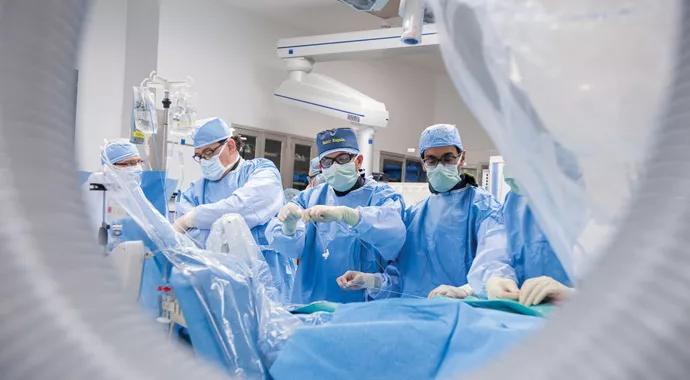
Image content: This image is available to view online.
View image online (https://assets.clevelandclinic.org/transform/ff4e4971-4a13-4551-802e-057f8cfd11c0/CathLab-690x380_jpg)
Lessons in Improving Cath Lab Efficiency
By Samir Kapadia, MD, and Scott Hantz, BSN, RN, EMT-P
Advertisement
Cleveland Clinic is a non-profit academic medical center. Advertising on our site helps support our mission. We do not endorse non-Cleveland Clinic products or services. Policy
About five years ago, we noticed that growth in patient complexity and the proportion of new catheter-based procedures meant our cases were taking increasingly longer to complete. Our catheter (cath) labs were continually running overtime, raising costs and wearing down our personnel. We wanted to lower our costs without compromising patient care. This meant we had to make our cath labs run more efficiently.
We began by taking a close look at all aspects of cath lab operations, from the time the patient arrived for a procedure through completion of the procedure and on to preparations for the next patient. We recorded the activities of all personnel and analyzed them for inefficiencies. This enabled us to identify two areas for improvement: increasing the number of cases that start on time and shortening the turnaround time between cases.
We employed a Six Sigma approach to improving our processes. By instituting a series of protocols and procedures that increased efficiency, we improved the average start time for the first case by 25 minutes and the average turnaround time by 30 minutes. Today we do 40 to 50 cath cases a day in six or seven rooms on Cleveland Clinic’s main campus and generally finish on time. Here we present the basics about how this was accomplished.
The cath labs begin operations at 7:30 a.m., but in 2013, the average case was not starting until 8:06 a.m. We took a multipronged approach to improving this start time by obtaining consent from the first scheduled patient on the evening before the procedure and by alerting patient transportation to pick the patient up a few minutes early. If the first scheduled patient was delayed for any reason, we took the first patient who was ready. Since the nurses drive the start time, we appointed a room charge nurse in each lab. Nearly 92 percent of our cases now start by 7:30 a.m.
Advertisement
Our time audit revealed that nursing teams relied on volunteers to complete each task needed to prepare the room. We changed this process by assigning specific functions to specific nurses. This improved the speed with which tasks were accomplished.
We replaced a low-tech patient tracking system that relied on phone calls and handwritten notes with a web-based monitoring system designed by one of our medical students and customized by Siemens. The system tracks every patient’s location and displays the information on monitors in every room and the physician’s office. This allows everyone to know where a patient is located at all times; we know when a patient has been moved and when a room has been vacated.
Nine actions that must be taken to prepare a patient for catheterization were identified. When any action fails to be done in a timely manner, the system alerts the person charged with that task. When we break scrub, a colored light signals that it’s time for the next patient to say goodbye to his or her family.
This system has allowed us to shorten the average turnaround time to 15.1 minutes — nearly our goal of 15 minutes. We feel this goal can be achieved, but we continue to deliberate how we can better adapt to emergencies, cancellations and other unexpected interruptions in flow.
Non ST-segment elevation myocardial infarction (NSTEMI) patients arriving in the emergency department (ED) are brought into the cath lab for emergent percutaneous coronary intervention. American College of Cardiology guidelines allow a maximum door-to-balloon time of 90 minutes from the time of arrival to the time blood flow is restored. We were accomplishing this task in 75 minutes, but we felt we could do better.
Advertisement
Streamlining this process was complicated, because so many people are involved in these cases. Basically, we instituted a protocol standardizing who the ED should call when a patient needs catheterization, how this patent should be prepped, and how the cath lab should prepare for the patient’s arrival. This process enabled us to reduce the door-to-balloon time to 47 minutes — a savings of nearly 30 minutes.
Our new efficiencies have had a large impact on personnel costs by reducing overtime in the cath lab from 5.1 percent to 3.4 percent. Other cost savings have been incurred by obtaining contracts for high-ticket items and reducing costs for frequently used items.
Additionally, we added the cost of each item to the ordering system in order to increase awareness. Perhaps more importantly, we have minimized waste by paying more careful attention to expiration dates. Now when our night nurses on call in the cath lab have down time, they go through supplies and place items about to expire on top so that these items can be used before those with later expiration dates.
Starting on time and gaining 30 minutes a day between patients has shortened our days in the cath lab by three to four hours. Multiply this savings by six to seven rooms per day and the impact becomes apparent. In addition to saving money, more reasonable working days have improved morale among physicians and nurses alike. We also believe it lessens the chance of making fatigue-related mistakes.
The cath lab in your hospital may not be handling the same volume of patients as Cleveland Clinic. Nevertheless, you might find that making your cath lab run more efficiently produces substantial benefits in cost savings and morale. The process requires that physician and nurse leaders to work together for mutual benefit. In our experience, the results were well worth the trouble.
Advertisement
Samir Kapadia, MD, is Section Head of Invasive/Interventional Cardiology at Cleveland Clinic and Director of the Sones Cardiac Catheterization Laboratories. Scott Hantz, BSN, RN, EMT-P, is the Nurse Manager there.
Advertisement
Advertisement

A sampling of outcome and volume data from our Heart & Vascular Institute
Concomitant AF ablation and LAA occlusion strongly endorsed during elective heart surgery
Large retrospective study supports its addition to BAV repair toolbox at expert centers
Young age, solid tumor, high uptake on PET and KRAS mutation signal risk, suggest need for lobectomy
Surprise findings argue for caution about testosterone use in men at risk for fracture
Residual AR related to severe preoperative AR increases risk of progression, need for reoperation

Findings support emphasis on markers of frailty related to, but not dependent on, age
Provides option for patients previously deemed anatomically unsuitable
 Search