Locations:





Propensity-matched analysis shows safety edge over transvenous devices
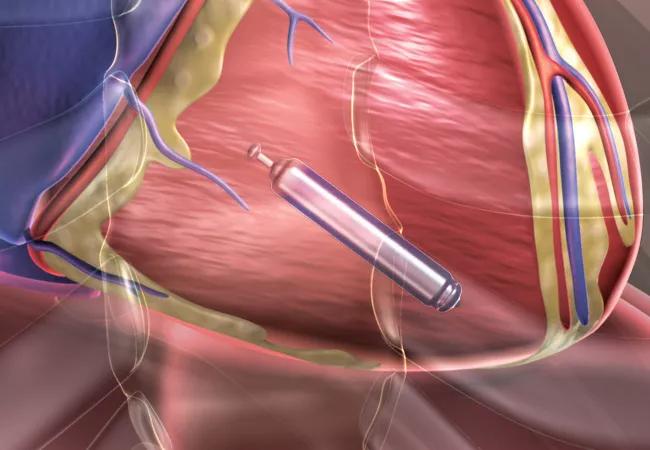
Image content: This image is available to view online.
View image online (https://assets.clevelandclinic.org/transform/eaac72ac-e928-46a9-8bc0-6b1f46e31c5f/18-HRT-4737-Leadless-pacemaker-650x450_jpg)
18-HRT-4737-Leadless pacemaker-650×450
Acute and mid-term complications are significantly reduced with a leadless cardiac pacemaker compared with traditional transvenous pacemakers, and the reduction is driven largely by an absence of infectious and lead-/pocket-related complications with leadless pacemaker therapy.
Advertisement
Cleveland Clinic is a non-profit academic medical center. Advertising on our site helps support our mission. We do not endorse non-Cleveland Clinic products or services. Policy
That’s the conclusion of the first direct safety comparison to date between leadless and transvenous pacemakers, but the finding is tempered by an excess of uncommon but serious pericardial effusions in patients receiving a leadless device.
“Encouragingly, all of the lead- and pocket-related mid-term complications seen with transvenous pacemakers were completely eliminated in patients getting a leadless pacemaker,” says Cleveland Clinic cardiologist Daniel Cantillon, MD, lead author of the study, which is published in the July 2018 issue of Heart Rhythm. “It’s concerning that a few of the patients who had pericardial effusion after receiving a leadless device required surgery, but we expect that this and other acute complications will diminish with greater operator experience and device refinements.”
The study was a propensity score-matched analysis comparing safety data with the leadless cardiac pacemaker (LCP) Nanostim from the LEADLESS II IDE study against complication rates with transvenous pacemakers (TVPs) in a matched cohort obtained from a large U.S. real-world insurance claims database from Truven Health MarketScan.
LEADLESS II is a prospective, nonrandomized, multicenter clinical trial in which patients with indications for permanent single-chamber ventricular pacing received the Nanostim device. Its interim results were published in the New England Journal of Medicine in 2015, and data in the current analysis reflect extended follow-up.
Patients in the real-world TVP cohort received single-chamber pacemakers between April 2010 and March 2014. Pacemaker-related complications were identified using inpatient and outpatient billing codes starting on the day of TVP implantation.
Advertisement
Short-term (≤ 1 month) and mid-term (1-18 months) complications were compared between the LCP cohort (n = 718) and a propensity score-matched subgroup of the TVP cohort (n = 1,436).
Compared with the TVP cohort, patients in the LCP cohort had fewer complications overall (hazard ratio = 0.44; 95% CI, 0.32-0.60), including fewer in the short term (5.8 percent vs. 9.4 percent; P = .01) and the mid-term (0.56 percent vs. 4.9 percent; P < .001).
Notably, in both short- and mid-term time frames, a number of relatively frequent TVP complications were entirely absent from the LCP cohort, including lead-related, pocket-related and infectious events.
“This suggests that leadless pacemaker technology has done what it was intended to do — successfully target the most common sources of traditional pacemaker complications over the past five decades,” says Dr. Cantillon, who is a LEADLESS II coinvestigator and Cleveland Clinic’s Research Director for Cardiac Electrophysiology and Pacing.
Rates of several complications — vascular events, electrode dislodgement and generator complications — were statistically comparable between the LCP and TVP groups. One event, pericardial effusion, was significantly more common in the LCP group (1.53 percent vs. 0.35 percent; P = .005).
“Although pericardial effusions were uncommon, they were serious, requiring surgery in three of the seven patients with leadless pacemakers who developed them,” says Dr. Cantillon. “This suggests more traumatic tearing-type injuries that need to be addressed in future refinements of leadless device technology, as well as by improvements in operator technique.” On the latter point, he notes that the complication rate fell from 6.8 percent to 3.6 percent in the LEADLESS II trial after individual operators completed 10 implantations.
Advertisement
Future device refinements are expected in the second-generation Nanostim LCP, which is currently under regulatory review, Dr. Cantillon notes. Even further refinements are promised by emerging leadless technologies, he adds, including dual-chamber leadless pacemakers (currently in animal testing) as well as leadless cardiac resynchronization therapy devices and leadless implantable cardioverter-defibrillators (ICDs).
The first of the new technologies is likely to be the world’s first leadless permanent pacemaker/ICD combination, which will be tested in the MODULAR ATP trial, a combined North America/Europe IDE study for which Dr. Cantillon serves as lead investigator. Study activation is expected in mid-2019.
Advertisement
Advertisement

A sampling of outcome and volume data from our Heart & Vascular Institute
Concomitant AF ablation and LAA occlusion strongly endorsed during elective heart surgery
Large retrospective study supports its addition to BAV repair toolbox at expert centers
Young age, solid tumor, high uptake on PET and KRAS mutation signal risk, suggest need for lobectomy
Surprise findings argue for caution about testosterone use in men at risk for fracture
Residual AR related to severe preoperative AR increases risk of progression, need for reoperation

Findings support emphasis on markers of frailty related to, but not dependent on, age
Provides option for patients previously deemed anatomically unsuitable
 Search