Locations:





Removing faulty or infected device leads is complex — and growing more common
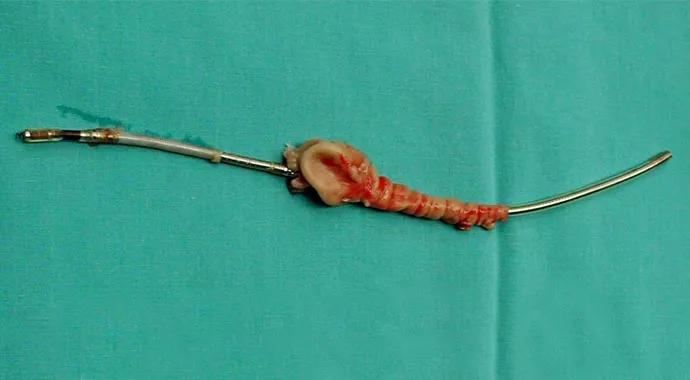
Image content: This image is available to view online.
View image online (https://assets.clevelandclinic.org/transform/fa1b80ee-f839-49d5-8d5c-3377648c3ab1/Leads-690x380_jpg)
Leads-690×380
As indications for cardiac pacemakers and implantable cardioverter-defibrillators (ICDs) increase, ever more patients are requiring lead extraction for complications or replacement of the leads for these implanted electronic devices. An estimated 10,000 to 15,000 transvenous lead extractions are now performed yearly worldwide. Complications requiring lead removal (Figure) are varied and include infection, lead malfunction or breakage, and vein occlusion. Additionally, lead removal is needed when leads become dislodged or are no longer needed.
Advertisement
Cleveland Clinic is a non-profit academic medical center. Advertising on our site helps support our mission. We do not endorse non-Cleveland Clinic products or services. Policy
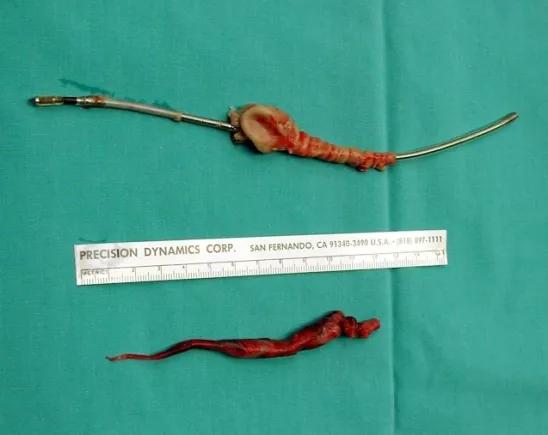
Image content: This image is available to view online.
View image online (https://assets.clevelandclinic.org/transform/6c754613-5675-4e5c-be46-ac877f689b51/lead-extract_jpg)
Figure. Large vegetation on a right ventricular ICD lead removed at the time of surgery with a second large embolized vegetation removed from the pulmonary artery.
Yet lead extraction is complex, and recent years have seen a parallel increase in patients whose extraction procedures have failed or were improperly performed — or in whom infection has been treated incompletely. As a major cardiac referral center, Cleveland Clinic sees a large number of these patients.
Averaging 250 lead extractions a year for the past 15 years, Cleveland Clinic’s lead extraction team has developed unsurpassed expertise in performing difficult and complex extractions. In a newly published study of 5,521 leads removed in 2,999 transvenous extraction procedures at Cleveland Clinic from August 1996 to August 2011, the team reported the following outcomes in a complex patient population with multiple comorbidities:
“Quality is related to volume. You must have a multidisciplinary team that performs lead extractions consistently and often,” says the study’s senior author, Cleveland Clinic electrophysiologist Bruce Wilkoff, MD, who has been performing lead extractions since 1988 and heads the lead extraction team. The team comprises clinicians from cardiology, nursing, anesthesiology, infectious disease and cardiothoracic surgery.
Advertisement
Although the rate of lead infection is only 1 in 100 patient-years, infection is associated with significant morbidity and mortality.
“Infection is extremely serious and should not be dismissed,” says Steven Gordon, MD, Chairman of the Department of Infectious Disease and a lead extraction team member. He plays a key role in the diagnosis of infection and management of infected patients and in determining when reimplantation is safe.
Incomplete or improper treatment of infection is common. “Antibiotics alone will not cure a device infection, which will return when treatment is stopped unless both device and leads are removed,” says electrophysiologist Khaldoun Tarakji, MD, MPH, another team member.
Infection is a class I indication for lead extraction. Patients can present with pocket infection or endovascular infection; in either case, the entire system must be removed since any remaining lead will act as a nidus for infection and cause relapse. Once the infection is cleared, a new system can be implanted on the opposite side.
Febrile patients with an intact pocket who present in the emergency department or in a different hospital system often are given multiple courses of antibiotics before the possibility of device infection arises. Dr. Gordon advises physicians to have a low threshold for evaluating these patients.
“They are at high risk for bacteremia,” he says. “When any patient with a device presents with a staph infection or fever, assume the device is involved until proven otherwise.”
Advertisement
Although some physicians hesitate to operate on extremely sick patients, the mortality rate for lead extraction is minimal compared with the risks posed by infection. “Major complications of transvenous lead extraction occur in about 1.4 percent of patients,” says Dr. Wilkoff, “and the procedure carries a 0.3 percent risk of death. In contrast, the mortality risk with infection is very high.”
Antibiotics are often required for six weeks after extraction of the system.
The decision to remove a malfunctioning lead is less clear and should be made on an individualized basis.
“If the patient is old or frail, the risks of extraction are weighed against the risks of capping and ignoring the lead and simply adding a new lead,” says Dr. Tarakji. “In younger patients, dealing with multiple leads over time might become problematic, so lead removal should be considered.”
Regardless of the factors involved, the patient should be involved in the decision. “Sometimes we see patients who’ve had multiple leads added over the years to stand in for malfunctioning leads but who have never been given the option of having the abandoned leads removed,” Dr. Tarakji notes.
Complications of lead removal occur most commonly with older leads, which can become anchored by fibrous tissue and require dissection from the venous wall and myocardium. In these cases, major vascular injury or cardiac perforation — although rare — carries significant in-hospital mortality.
A recently published study of 5,973 leads extracted during 3,258 consecutive procedures at Cleveland Clinic found that 25 patients (0.8 percent) experienced catastrophic complications requiring emergent intervention. Of those 25 patients, 64 percent were able to be rescued with immediate response and surgical or endovascular intervention.
Advertisement
As a result of this experience, Cleveland Clinic has made available during extraction cases an “endovascular intervention cart” with equipment needed for such interventions.
“Catastrophic complications are uncommon but can happen at any point during lead extraction,” says Dr. Tarakji. “Experience-based preparation for responding to them is of utmost importance.”
Contact Dr. Wilkoff at wilkofb@ccf.org and Dr. Gordon at gordons@ccf.org.
Advertisement
Advertisement

A sampling of outcome and volume data from our Heart & Vascular Institute
Concomitant AF ablation and LAA occlusion strongly endorsed during elective heart surgery
Large retrospective study supports its addition to BAV repair toolbox at expert centers
Young age, solid tumor, high uptake on PET and KRAS mutation signal risk, suggest need for lobectomy
Surprise findings argue for caution about testosterone use in men at risk for fracture
Residual AR related to severe preoperative AR increases risk of progression, need for reoperation

Findings support emphasis on markers of frailty related to, but not dependent on, age
Provides option for patients previously deemed anatomically unsuitable
 Search