Locations:





 Search
Cleveland Clinic program sees record patient volume growth
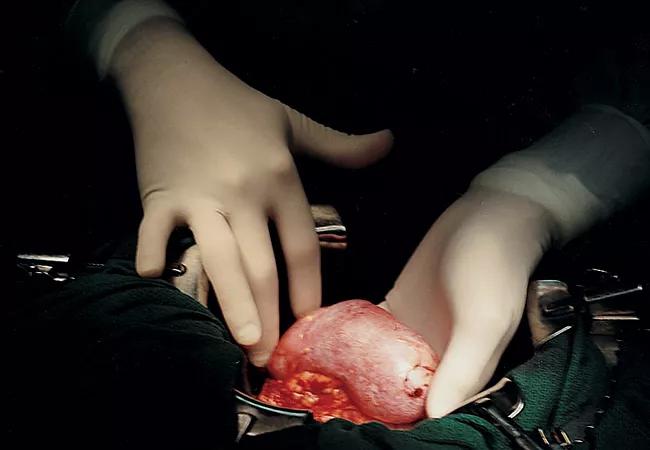
Image content: This image is available to view online.
View image online (https://assets.clevelandclinic.org/transform/a4a287f7-2eae-4c42-9aa0-bd1485e67295/650x450-Kidney-Transplant_jpg)
650×450-kidney-transplant
A focused and dedicated team of healthcare professionals in Cleveland Clinic’s Kidney Transplant Program continues to achieve improvements in patient outcomes, as well as growth in the program’s volume.
Advertisement
Cleveland Clinic is a non-profit academic medical center. Advertising on our site helps support our mission. We do not endorse non-Cleveland Clinic products or services. Policy
“From the very first contact with our patients, our team is focusing on every aspect of their care,” says Alvin Wee, MD, MBA, Surgical Director of the Glickman Urological & Kidney Institute program. “Each of our patients receives an enhanced level of care through frequent visits before and after the transplant procedure.”
“Pre-transplant preparation begins with a comprehensive evaluation, which is performed in one day and includes meetings with the multidisciplinary transplant team, followed by laboratory testing and imaging,” explains Dr. Emilio Poggio, the kidney transplant program’s Medical Director. “Furthermore, our virtual visit program is available before the procedure to out-of-state transplant patients or those who live far from our campus.”
Cleveland Clinic surgeons performed 182 kidney transplants in 2018, the most in the program’s 56-year history and a 30-percent increase in volume compared with 2017. The 131 deceased-donor transplants in 2018 also was a program record, reflecting a 70 percent volume increase.
A portion of the transplant program’s growth is attributable to an increase in kidney swaps performed in 2018, including the enterprise’s first three-way kidney swap, and West Virginia’s first kidney swap, performed at Cleveland Clinic’s affiliate program in Charleston, West Virginia.
The continuity of care provided in the scope of the program has proven critical to transplant success.
“If patients see a large number of doctors throughout their transplant journey, important details may be overlooked and the patient may fall through the cracks,” says Dr. Wee. “In order to ensure continuity of care, our patients see a limited number of physicians. This way, we are allowing those physicians to become very familiar with the unique aspects and challenges of each case.”
Advertisement
The dedication and meticulous attention to detail of the transplant team have led to decreased length of hospital stay.
“Our average length of stay after living-donor transplant is three days, which is considerably lower than the national average of five days,” says Dr. Wee. “For deceased-donor transplants, the average length of stay at Cleveland Clinic is three to four days. We know that there is no better place to recover from surgery than home, and our aim is to get the patients discharged as soon as they are ready.”
Another outcome metric, delayed graft function (DGF), is a prognostic factor for the longevity of the allograft and is defined as dialysis requirement within one week after transplant.
“The national average for DGF is approximately 30 percent, while at Cleveland Clinic we had a 4 percent DGF rate in 2018,” Dr. Wee says.
The low incidence of DGF combined with enhanced level of care ensure that the readmission rate for kidney transplant patients at Cleveland Clinic remains low.
“Our readmission rate in 2018 reached an all-time low of 14 percent, which is approximately 50 percent lower than the national average,” Dr. Wee says. “Because we see the patients often, we are able to correct little problems before they turn into big, difficult-to-manage medical issues.”
During the follow-up period, transplant patients are managed by post-transplant coordinators and the transplant surgeon according to a predefined care plan.
“For the first month, the patients are seen twice a week, after which their care is transferred to a transplant nephrologist,” says Dr. Poggio. “As the patients continue to improve, they are seen less frequently.”
Advertisement
Advertisement

Clinicians should individualize dosing practices based on patient risk factors and preferences
Pioneering and refining the approach in pyeloplasty, nephrectomy and more
Fully-automated process uses preop CT, baseline GFR to estimate post-nephrectomy renal function
Could mean earlier treatment, but also could have negative effects

Unlike earlier pills, new drugs do not cause liver toxicity
Male factors play a role in about half of all infertility cases, yet men often are not evaluated
Surgeons choreograph nearly simultaneous procedures, sharing one robot between two patients

Identifying barriers in the renal genetic assessment of Black patients