Locations:





JACC opinion piece advocates a one-year “interventional intensivist” pathway
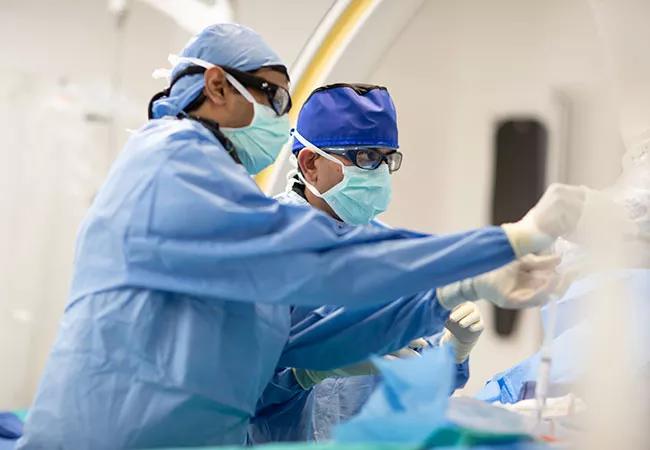
Image content: This image is available to view online.
View image online (https://assets.clevelandclinic.org/transform/9625903d-3738-4134-8ed8-9a7564fc196f/20-HVI-1915455-inerventional-cardiology-training-650x450-1_jpg)
20-HVI-1915455 inerventional-cardiology-training-650×450
As cardiac intensive care units (CICUs) increasingly are populated with patients who have multiple comorbidities, more training for interventional cardiologists in critical care medicine is essential. So asserts a recent expert opinion piece in the Journal of the American College of Cardiology (2020;75[23]:2984-2988). The three co-authors — cardiologists from different institutions — call for developing and instituting a novel training pathway that combines interventional cardiology and critical care medicine in a single one-year fellowship.
Advertisement
Cleveland Clinic is a non-profit academic medical center. Advertising on our site helps support our mission. We do not endorse non-Cleveland Clinic products or services. Policy
“More and more, a cardiac condition is not even the main reason a patient is in the CICU,” says corresponding author Ankur Kalra, MD, of Cleveland’s Clinic Section of Invasive and Interventional Cardiology. “It is incumbent upon the profession to provide adequate training so that cardiologists staffing these units can effectively care for today’s patients.”
The article points out that as people with serious health problems are living longer, CICU staff are increasingly confronted with septic shock, liver failure, gastrointestinal hemorrhage and other life-threatening conditions. To care for their patients, cardiologists must now be proficient in a variety of procedures beyond what is traditionally provided in their training, such as airway/ventilator management. With the COVID-19 pandemic, the need for a broader critical care medicine skill set has become even clearer.
The authors note that current possible pathways to critical care for interventional cardiologists emphasize training in the care of complex patients admitted with heart failure and cardiogenic shock. As such, they are focused primarily on the treatment of heart failure — covering temporary mechanical circulatory support devices, durable left ventricular assist devices and heart transplantation — with less consistent coverage of airway/ventilator management and noncardiac critical illness. Moreover, these options involve two-year fellowship programs, which potentially pose personal, logistical and financial burdens that may dissuade candidates.
Advertisement
The article proposes a single-year interventional intensivist fellowship that incorporates the key skills needed for an interventional cardiologist with those essential for noncardiac critical care, including airway/ventilator management.
“The goal is to ensure that trainees gain the skills and knowledge to be eligible for board certification in both interventional cardiology and critical care medicine,” explains Dr. Kalra. He adds that implantation of durable ventricular assist devices and heart transplantation would not be included in the pathway.
As envisioned, the proposed interventional intensivist pathway would have trainees rotate through medical, neurologic and cardiothoracic surgical ICUs and anesthesia, and then serve as junior attendings in the CICU.
The editorial brings up several issues to consider, including the following:
Advertisement
Dr. Kalra notes that the interventional intensivist pathway is still theoretical and has not yet been tested in the real world. “Nevertheless, it is clear that cardiologists staffing CICUs today need to gain competence in critical care medicine,” he adds. “Different paths may be taken to best obtain this knowledge, and it is essential that we now start the discussion around what those paths should look like.”
“Emerging pathways for training the critical care cardiologist of the future highlight the heterogeneity of an evolving cardiac intensive care unit,” observes Penelope Rampersad, MD, MSc, Quality Improvement Officer for Cleveland Clinic’s Cardiac Intensive Care Unit and Heart Failure Intensive Care Unit. “There is no prescriptive skill set that will allow today’s cardiologist to meet all of their patients’ needs. Rather, teams of care need to be cultivated to serve this extremely complex patient population.”
“The acquisition of critical care skills is best achieved by completion of a dedicated critical care fellowship after rigorous general cardiovascular training,” adds Venu Menon, MD, Director of Cleveland Clinic’s Cardiac Intensive Care Unit and Cardiovascular Fellowship Program. “This may be further supplemented by an additional year of focus in an area like heart failure or coronary intervention. Ultimately, the focus should be on mastery and unique expertise in the care of the critically ill cardiac patient and the desire to spend a large proportion of one’s career within the confines of a tertiary-care dedicated and closed cardiac intensive care unit.”
Advertisement
Advertisement
A sampling of outcome and volume data from our Heart & Vascular Institute
Concomitant AF ablation and LAA occlusion strongly endorsed during elective heart surgery
Large retrospective study supports its addition to BAV repair toolbox at expert centers
Young age, solid tumor, high uptake on PET and KRAS mutation signal risk, suggest need for lobectomy
Surprise findings argue for caution about testosterone use in men at risk for fracture
Residual AR related to severe preoperative AR increases risk of progression, need for reoperation
Findings support emphasis on markers of frailty related to, but not dependent on, age
Provides option for patients previously deemed anatomically unsuitable
 Search