Locations:





 Search
Predicting outcomes for a male infertility treatment
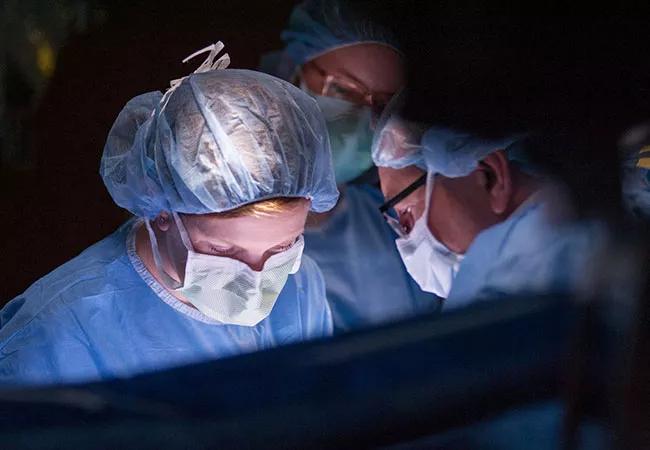
Image content: This image is available to view online.
View image online (https://assets.clevelandclinic.org/transform/f2d8a3ab-abf2-49a9-bc05-be0eb10dbc38/650x450-Vij-Surgery_jpg)
650×450-Vij-Surgery
There are relatively few options for men with nonobstructive azoospermia (NOA), a severe form of infertility where no sperm is present in the ejaculate, but new data may help men decide if surgery is the right treatment for them.
Advertisement
Cleveland Clinic is a non-profit academic medical center. Advertising on our site helps support our mission. We do not endorse non-Cleveland Clinic products or services. Policy
Currently, the primary intervention to treat NOA is microdissection testicular sperm extraction (mTESE), a procedure where surgeons carefully search the testicle for small quantities of sperm using an operating microscope.
Scott Lundy, MD, PhD, a fifth-year resident in Cleveland Clinic’s Glickman Urological and Kidney Institute and first-author of a new study notes, “The surgery itself is not a major undertaking for the patient, but sperm is found in about half of men who undergo the procedure. The trouble is we do not know ahead of time who is likely to have a positive outcome.” Complicating the decision-making process for couples is the fact that this surgery is generally not covered by insurance.
Dr. Lundy led a retrospective review of 118 men who underwent a total of 129 mTESE procedures at Cleveland Clinic from 2012 to 2018. The overall sperm retrieval rate was 57%. Univariate analysis showed an association between semen pH and successful sperm retrieval (p=0.035). The multivariable analysis identified semen volume, semen pH levels and follicle-stimulating hormone (FSH) as predictors of successful sperm retrieval.
“While this is not the first study to examine predictive outcomes of mTESE, it is the first, to our knowledge, to explore pH levels as a clinical variable,” says Sarah Vij, MD, urologist in Cleveland Clinic’s Glickman Urological and Kidney Institute and senior author of the study.
In fact, this finding surprised the team. “We can’t quite explain that yet. We are conducting basic science studies to look at the microbiome and other areas that might provide a casual explanation or mechanism,” she says.
Advertisement
What is understood is that some combination of those three characteristics – semen volume, semen pH levels and FSH – combined together provide modest predictive value on whether or not this surgery will be successful.
With this data, the team produced a predictive nomogram and made the calculator publicly available. Right now it’s being piloted by providers across the country, and the feedback has been positive. Dr. Lundy hopes this can be another tool for patients and clinicians.
“The predictive model is a tool to support the clinical decision-making process during what is typically a difficult time men and their families,” he says. “It should be used in a clinical context, where the patient and provider can individualize care.”
In the same way the PSA test has improved risk calculations for prostate cancer, the investigators hope this model will project the likelihood of sperm retrieval through mTESE.
Dr. Lundy, who plans to publish the results of this study later this year, notes that understanding the underlying pathology is equally important to identify clinical variables. This study lays a framework for investigating pH levels at a mechanistic level.
For example, the physicians believe bacteria, fungi or viruses may play a role in predisposing some men to infertility issues. The investigators are in the process of analyzing data from a prospective trial designed to differentiate gut microbiota of fertile and non-fertile men.
“We see so many young men who struggle mightily with infertility issues. It’s an issue that deserves our attention and resources,” he says.
Advertisement
Advertisement

Clinicians should individualize dosing practices based on patient risk factors and preferences
Pioneering and refining the approach in pyeloplasty, nephrectomy and more
Fully-automated process uses preop CT, baseline GFR to estimate post-nephrectomy renal function

Could mean earlier treatment, but also could have negative effects

Unlike earlier pills, new drugs do not cause liver toxicity
Male factors play a role in about half of all infertility cases, yet men often are not evaluated
Surgeons choreograph nearly simultaneous procedures, sharing one robot between two patients

Identifying barriers in the renal genetic assessment of Black patients