Locations:





Persistently active vasculitis may play a role

Image content: This image is available to view online.
View image online (https://assets.clevelandclinic.org/transform/c37f67bc-cec3-4174-9948-cbb476831d70/15-RHE-518-Hajj-Ali-Hero-Image-690x380pxl_jpg)
15-RHE-518-Hajj-Ali-Hero-Image-690x380pxl
Advertisement
Cleveland Clinic is a non-profit academic medical center. Advertising on our site helps support our mission. We do not endorse non-Cleveland Clinic products or services. Policy
Granulomatosis with polyangiitis (GPA; Wegener’s) is characterized by necrotizing granulomatous inflammation and vasculitis of the small and medium-size blood vessels. Although survival of patients with GPA has improved with immunosuppressive therapy, atherosclerosis has emerged as a significant GPA-associated morbidity that is independent of traditional cardiovascular risk factors. Coronary artery disease, stroke and peripheral arterial occlusive disease occur more frequently in patients with GPA than in healthy controls.
The link between GPA and atherosclerosis is not well characterized at a mechanistic level, but it raises the possibility that persistently active vasculitis, or nonspecific inflammation, plays a role in early atherosclerosis.
An increasing body of evidence suggests that, in the course of systemic inflammation, cell-derived microparticles may be prognostic markers for thrombosis, atherosclerotic vascular disease and systemic inflammation. Microparticles are membrane-bound vesicles that bud off normal cells, including leukocytes, platelets and vascular endothelial cells, during activation or apoptosis (Figure 1).
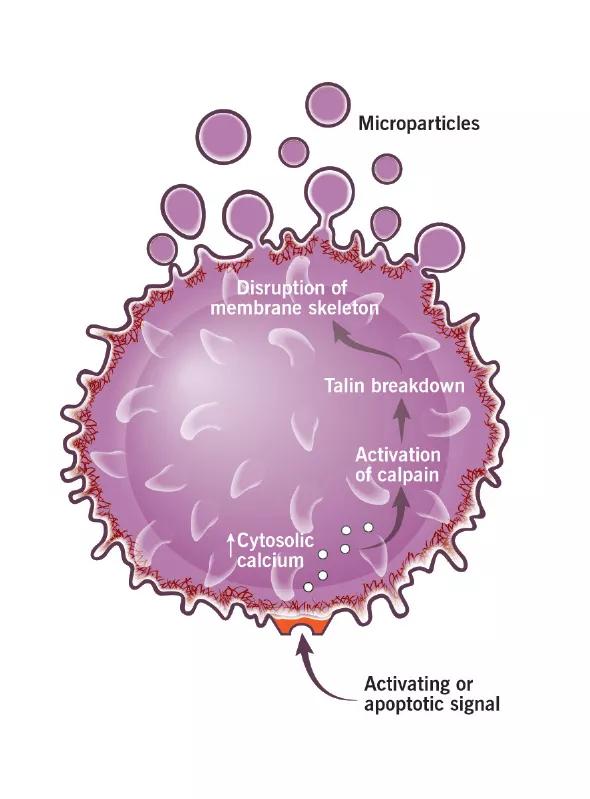
Image content: This image is available to view online.
View image online (https://assets.clevelandclinic.org/transform/4a600228-0ae6-46bb-b2be-ec77d13cc81a/15-RHE-518-Hajj-Ali-Inset-Image-01-590pxl-width_jpg)
Elevated levels of circulating microparticles have been shown to be associated with cardiovascular risk and are indicative of a poor clinical outcome. Circulating microparticle counts are increased in patients with cardiovascular risk factors. Moreover, microparticle counts are an independent marker of subclinical carotid atherosclerosis in asymptomatic subjects and may be more valuable for mortality prognosis than usual biological markers of myocardial infarction are. In addition, several studies point to microparticles as effectors of vascular wall inflammation.
Advertisement
Microparticles may contain pro-inflammatory mediators, such as IL-1, and can interact directly with activated vascular endothelial cells, triggering monocyte arrest in inflamed and atherosclerotic endothelium. Furthermore, microparticles can interact directly with platelets through the CD36 receptor (Figure 2). This raises the prospect of a novel mechanism for platelet-dependent monocyte recruitment in inflammation and atherosclerosis.
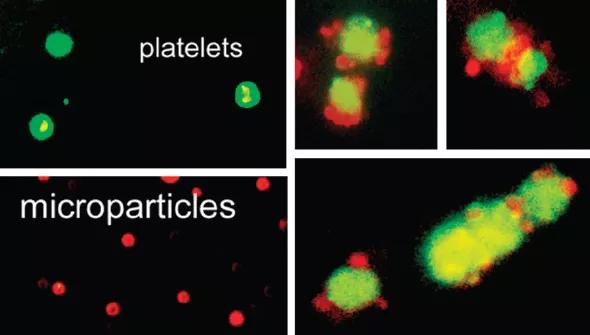
Image content: This image is available to view online.
View image online (https://assets.clevelandclinic.org/transform/6b3a3e6c-6c18-457d-b451-dbb06eb8a7d5/15-RHE-518-Hajj-Ali-Inset-Image-02-590pxl-width_jpg)
In rheumatic conditions such as rheumatoid arthritis, systemic lupus erythematosus, systemic vasculitides and specifically GPA, microparticle counts potentially can serve as important markers of disease activity.
In keeping with its overall mission, Cleveland Clinic’s Center for Vasculitis Care and Research is studying the relationship between inflammatory disease in GPA and the development of atherosclerosis, with the aim of better understanding the pathogenesis of atherosclerosis in GPA. Our research findings have suggested that (1) the recurrent inflammatory burst that occurs during each relapse in patients with GPA may have a direct role in the pathogenesis of atherosclerosis, and (2) levels of circulating microparticles are elevated during relapse and correlate with platelet reactivity.1
We recently further assessed the role of microparticles and their interaction with platelets and vascular endothelial cells in the pathogenesis of atherosclerosis in GPA.2 Microparticles isolated from plasma of GPA patients were added at various ratios to human dermal microvascular endothelial cells (huDMVEC) and incubated for timed periods. Cells were then detached, washed, resuspended in buffer and analyzed by immunofluorescence flow cytometry with anti-ICAM-1 IgG to detect endothelial cell activation. An isotope-matched control IgG was used as control. In addition, fluorescently tagged normal human platelets were incubated with GPA patient-derived microparticles (at a microparticle-to-platelet ratio of 10-to 1), and platelet activation was detected by flow cytometry with PAC-1, an antibody to the activated form of the α2bß3 integrin.
Advertisement
This study found that:
These findings demonstrate that microparticles isolated from the plasma of GPA patients can activate platelets and vascular endothelial cells. This suggests a possible role for microparticles as an interface between inflammation and atherothrombosis in GPA ‒ a possibility that we look forward to evaluating in future investigations.
Dr. Hajj-Ali is a staff physician in the Center for Vasculitis Care and Research, Department of Rheumatic and Immunologic Diseases, with a special interest in systemic vasculitides and central nervous system vasculitis
Advertisement
Advertisement

Treatment strategies require understanding of pathomechanisms
Education, prevention strategies and monitoring serves this at-risk group
Treatment for scleroderma can sometimes cause esophageal symptoms

Lupus Clinic providers collaborate to advance treatment and understanding

Older Psoriasis Patients May Experience Quicker Transition

Cleveland Clinic’s Rheumatic Lung Disease program treats patients with complex conditions

Symptoms complement one another

E-coaching program is tailored for those with the disease
 Search