Locations:





Rapid acceptance reveals multiple advantages, challenges
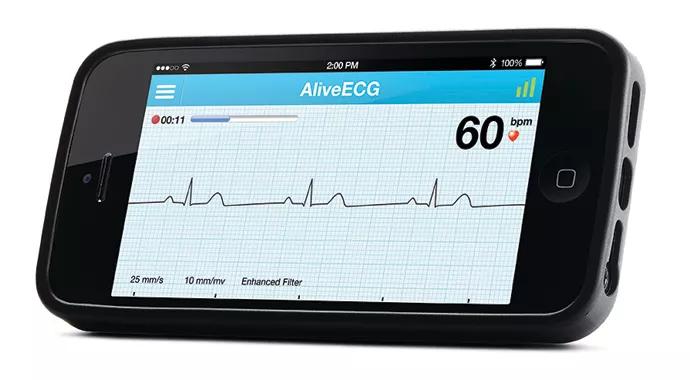
Image content: This image is available to view online.
View image online (https://assets.clevelandclinic.org/transform/3e3916a2-7da8-44d1-a544-901d5fd9d757/AliveCor_Frt_690x380_jpg)
AliveCor_Frt_690x380
Advertisement
Cleveland Clinic is a non-profit academic medical center. Advertising on our site helps support our mission. We do not endorse non-Cleveland Clinic products or services. Policy
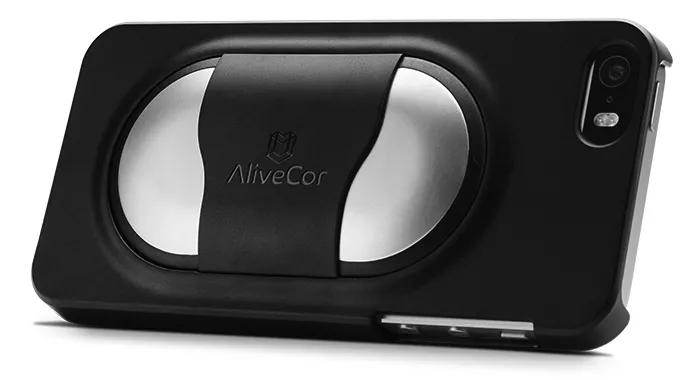
Image content: This image is available to view online.
View image online (https://assets.clevelandclinic.org/transform/41936d70-f64e-48d2-a3a6-81cbf85dd711/AliveCor_Case_690x380_jpg)
Alivecor smartphone case.
With more than 60 percent of U.S. residents currently using a smartphone, it is only natural that various healthcare applications (“apps”) and attachments have been developed for this booming market. New apps aimed at the cardiac sector have a variety of capabilities that include measuring blood pressure and pulse, blood glucose levels, pulse oximetry and heart rhythms. Easy to use and available without a prescription, these products are changing the way medicine is practiced.
However, the rise in popularity of smartphone healthcare apps has revealed some serious unresolved issues. Take the AliveCor Heart Monitor, for example. The mobile heart monitor incorporates electrodes into a smartphone case. Patients record their ECGs by simply placing their fingers on the pads. The tracings can then be viewed, downloaded, emailed, uploaded to the cloud and shared with their physician.
In the iTransmit study, performed at Cleveland Clinic, this healthcare app was compared with a traditional transtelephonic monitor (TTM) in patients with atrial fibrillation who had undergone ablation. AliveCor identified atrial fibrillation/flutter with 100 percent sensitivity and 95 percent specificity. Patients found it easy to use and preferred it over TTM 97 percent to 6 percent.
Nevertheless, the ability to perform a task with accuracy is only one part of a complex process that has been incompletely defined for smartphone apps. “There is no clear mechanism for getting the data to physicians, and issues surrounding modes of transmission, data storage, confidentiality and privacy, and physician reimbursement are examples of challenges we are facing as a medical community,” says Cleveland Clinic electrophysiologist Khaldoun Tarakji, MD, MPH.
Advertisement
Yet interactive medical apps may have potential benefits beyond those of conventional medical testing. Patient enthusiasm itself may help improve compliance. Perhaps because patients select the apps themselves and use them at their convenience, users tend to feel more involved in their health care. With the AliveCor app, “Patients can see their recordings and learn to recognize noisy ones. This engages them, and a more engaged patient is a more compliant patient,” says Dr. Tarakji.
Simple convenience is another bonus. Heart monitor apps and mobile heart monitors called ECG Check send their data wirelessly, which enables patients to use the device from nearly any location in the world.
And whereas the use of a traditional event recorder is generally restricted, mobile heart monitors can be used whenever needed and for any amount of time. This makes them an attractive option for monitoring patients with random episodes of atrial fibrillation.
“They may also be useful for following ablation patients beyond the normal length of time,” says Dr. Tarakji, who served as principal investigator of the iTransmit study.
With an aging population and ailing healthcare system, personal healthcare devices may prove to be an affordable way to achieve better patient care. However, the medical community will need to embrace these devices with the same enthusiasm that patients do. This means ensuring that the apps provide accurate information, data transmission and storage to comply with HIPAA requirements and that physicians are reimbursed for reading data that arrives by email, making clinical decisions and counseling patients accordingly.
Advertisement
“We must adopt the technologies that prove to be feasible, beneficial and cost effective and embed them into clinical practice. In order to accomplish this, we must conduct more studies to assess their value,” says Dr. Tarakji.
“Collaboration between the medical community, technological industry, and insurance companies is needed before we can use these products effectively, securely and efficiently.”
Photos courtesy of © 2014 AliveCor, Inc
Advertisement
Advertisement
A sampling of outcome and volume data from our Heart & Vascular Institute
Concomitant AF ablation and LAA occlusion strongly endorsed during elective heart surgery

Large retrospective study supports its addition to BAV repair toolbox at expert centers

Young age, solid tumor, high uptake on PET and KRAS mutation signal risk, suggest need for lobectomy
Surprise findings argue for caution about testosterone use in men at risk for fracture
Residual AR related to severe preoperative AR increases risk of progression, need for reoperation

Findings support emphasis on markers of frailty related to, but not dependent on, age

Provides option for patients previously deemed anatomically unsuitable
 Search