Locations:





Pre-recorded audio messages reduce readmissions and more
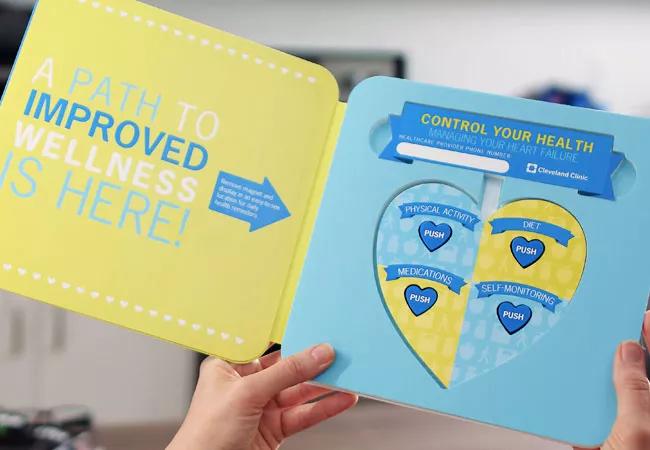
Image content: This image is available to view online.
View image online (https://assets.clevelandclinic.org/transform/75955b9c-4f5b-48e2-ab13-3fd3ed242d74/20-NUR-2036316-NancyHeartCard-CQD_650x450_jpg)
20-NUR-2036316-NancyHeartCard-CQD_650x450
By Nancy Albert, PhD, CCNS, CHFN, CCRN, NE-BC, FAHA, FCCM, FHFSA, FAAN, Associate Chief Nursing Officer, Office of Nursing Research and Innovation, and Clinical Nurse Specialist, George M. and Linda H. Kaufman Center for Heart Failure, Cleveland Clinic Main Campus.
Advertisement
Cleveland Clinic is a non-profit academic medical center. Advertising on our site helps support our mission. We do not endorse non-Cleveland Clinic products or services. Policy
Heart failure is a complex condition, and when heart failure patients are hospitalized, even though the plan of care is reviewed many times, patients and families may miss important content. This is especially true when patients are being discharged, as the process can be both distracting and overwhelming.
When Cleveland Clinic informatics colleagues developed an innovative way to communicate imperative at-home care to patients and their families, we were excited to assess its value in patients being discharged with a heart failure exacerbation. Ultimately, the goal was to help ensure that patients with heart failure have consistent information they need to properly care for themselves when transitioning from hospital to home. In collaboration with American Greetings, we developed an information card that plays pre-recorded audio messages focused on patient self-care. The messages are actionable, can be replayed again and again, and can be shared with family and other caregivers.
The card is known as MyROAD®, which means My Recorded On-Demand Audio Discharge Instructions. With four brief and concise featured messages, it includes consistent instructions that are easy for patients to understand and follow. It may help to answer frequently asked questions about their condition, as topics include not only what to do, but also how to do it.
Upon opening the card, an audio recording of a 35-second general statement is automatically triggered. The statement informs the patient about the card’s four buttons, which cover important information regarding heart failure care. Each button delivers a 35-to-40-second message on one of the following heart failure specific topics:
Advertisement
By carrying out specific physical activity, diet, medication and self-monitoring behaviors, patients can improve their health and reduce the need for future emergency department (ED) visits and hospitalization.
The card’s magnetic center can be removed and placed on a refrigerator or other magnetic surface to reinforce healthy behaviors for long-term self-care.
To gauge the card’s effectiveness, a randomized controlled research trial was completed. Participants resembled community patients living with heart failure. In total, data were analyzed on 997 patients (average age 72.8 years, 58.7 percent male) who were hospitalized with heart failure at four sites in Northeast Ohio.
Prior to discharge, patients either received standard care or standard care with the MyROAD® audio card and a demonstration on how to operate it. Patients were encouraged to keep the card visible and share it with family members. Patients were followed at 30, 45, 90 and 180 days after hospital discharge. Both patient groups were similar in demographics, medical history and heart failure factors. A sampling of study findings indicated:
Advertisement
The effect of the MyROAD® information card intervention was generally consistent across most specified subgroups. Looking forward, my colleagues and I hope that these results spur other innovative methods for enhancing discharge information and early home care. At this time, more research is needed to learn how we can optimize information messages to further decrease post-discharge healthcare utilization.
NOTE: This research was presented at the American Heart Association’s Scientific Sessions 2020. Co-authors include Kathy Ray, BRMP, James F. Bena, MS, Shannon L. Morrison, MS, Mary Marino, BSN, RN, and Celia Painter, BSN, RN.
Advertisement
Advertisement

Nurses play key role in comprehensive lifetime treatment program
Customized bots improve speed, efficiency by streamlining daily clinical, clerical tasks
Nurses play pivotal role in patients’ ability to recover in the comfort of their own homes
New protocol reduces costs, increases patient and caregiver satisfaction
Advocating for patient safety is imperative in fast-paced surgical settings
M-Power program improves the perinatal experience for people who have survived abuse

Advice for those pursuing a WOC nursing career
Veteran nurse shares his experience as a caregiver and community volunteer
 Search