Locations:





New digital tool allows parents to self-schedule fracture care for their children
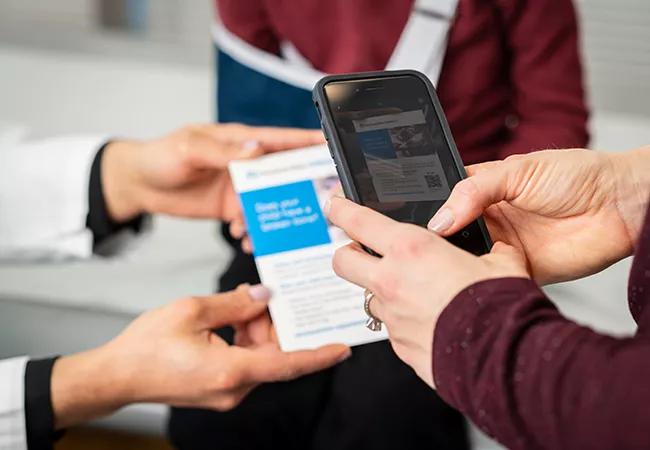
Image content: This image is available to view online.
View image online (https://assets.clevelandclinic.org/transform/6d71fe9b-ea74-438e-936d-c901b4819ac7/ORI_2451108_650x450_jpg)
ORI_Lucko_2609609_Pediatric Self Scheduling Fracture program
The field of orthopaedics is known for being innovative, always working to improve patient experiences and outcomes, from the initial evaluation through the episode of care. Connecting patients to that care is the first step in any orthopaedic journey, says Dominic King, DO, a sports medicine physician in the Department of Orthopaedic Surgery at Cleveland Clinic.
Advertisement
Cleveland Clinic is a non-profit academic medical center. Advertising on our site helps support our mission. We do not endorse non-Cleveland Clinic products or services. Policy
“Orthopaedic providers do an excellent job — once patients are connected to them,” he says. “Access challenges are actually medical issues, not simply call center or phone triage issues. We need to view access challenges as any other patient condition. We need to listen to the symptoms, associate those symptoms with specific problems and collect the right data to develop solutions to improve access to care.”
Over the past several years, Cleveland Clinic has introduced new ways to improve orthopaedic patients’ access to care. These efforts, part of a larger transformation of musculoskeletal care operations, have been championed by a multispecialty, multisite cross section of Cleveland Clinic’s care teams and operational stakeholders. The Orthopaedic Informatics Working Group (OIWG), together since early 2019, meets every other week to evaluate patients’ journeys and plan process improvements.
“Our OIWG is relentlessly focused on ensuring that our technologies support the care of our patients,” says Dr. King, manager of the OIWG.
For example, postoperative follow-up should be scheduled automatically when a patient has a joint replacement, says Jonathan Schaffer, MD, MBA, of Cleveland Clinic’s Center for Adult Reconstruction and founding member of the OIWG.
“By including participation with all who collaborate in the episode of care, our OIWG is able to make changes incorporating insights from orthopaedics, care teams in our call center, other clinical institutes and patient experience,” he says. “These different groups are coming out of their silos to collaborate and make sweeping and sustainable advances in our patient care processes, starting with appointment scheduling for pediatric patients with fractures.”
Advertisement
One of the first innovations developed and instituted by the OIWG is a web-based appointment-scheduling and triage tool for use by parents or caregivers of children with fractures. Parents are directed to the webpage via a QR code displayed on cast carts, in emergency rooms and on after-visit summary documents.
Parents scan the QR code and are directed to a brief online questionnaire about the fracture and availability of X-rays. Based on their answers, they may be directed to schedule an in-person or virtual orthopaedic consultation, selecting from a list of available providers, locations, dates and times — often the same day or next day. No phone calls are necessary.
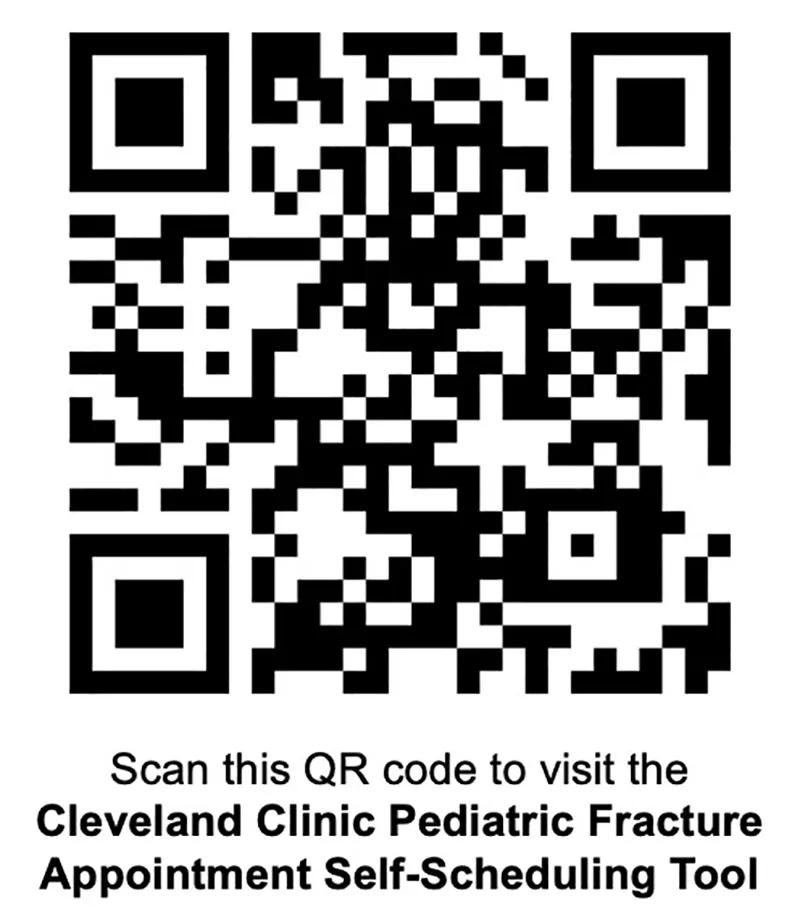
Image content: This image is available to view online.
View image online (https://assets.clevelandclinic.org/transform/6097fa2e-cf4c-4cc4-b805-4f2b9537e66c/21-ORI-2451108-CQD-QRinset_jpg)
“Having a fracture can be a stressful event for a pediatric patient and even more for their caregiver,” says Ryan Goodwin, MD, MBA, Director of Cleveland Clinic’s Center for Pediatric & Adolescent Orthopaedic Surgery. “WebSTAT [the Pediatric Fracture Web Scheduling, Triage and Access Tool] has been a great collaborative effort, providing real-time access to the right provider at the right place and right time.”
Introduced in May 2020, WebSTAT now receives 150-200 visits per month. Approximately 80% of those visitors successfully use the self-scheduling tool to make an appointment with a pediatric orthopaedic provider, removing friction from the appointment-scheduling process.
“Parents and families love having immediate access using the WebSTAT tool,” says Judith Welsh, MD, Associate Chief Experience Officer at Cleveland Clinic. “It takes so much stress out of a scary situation. It’s also reassuring for acute care providers who want to ensure the highest quality care for our young patients.”
Advertisement
Undertaking access improvements of this magnitude isn’t hard, say Drs. Schaffer and King. They just require widespread collaboration.
“Orthopaedics can’t improve access in a vacuum,” notes Dr. Schaffer. “Addressing access challenges is a big issue, bigger than a single department. Each OIWG team member brings a different perspective to the table, and all of these perspectives combined yield a complete picture leading to an optimal solution.”
According to Dr. King, “Access is an extension of our medical practices. Clinical teams need to actively manage their access process just as they actively manage their patients’ care. The OIWG continues to engage and transform care processes that improve our patient and provider experiences.”
Advertisement
Advertisement
Biologic approaches, growing implants and more
Study reports zero infections in nearly 300 patients
How to diagnose and treat crystalline arthropathy after knee replacement
Study finds that fracture and infection are rare
Center will coordinate, interpret and archive imaging data for all multicenter trials conducted by the foundation’s Osteoarthritis Clinical Trial Network

Reduced narcotic use is the latest on the list of robotic surgery advantages
Cleveland Clinic specialists offer annual refresher on upper extremity fundamentals
Cleveland Clinic orthopaedic surgeons share their best tips, most challenging cases and biggest misperceptions
 Search