Locations:





Primary care cohort presents projects
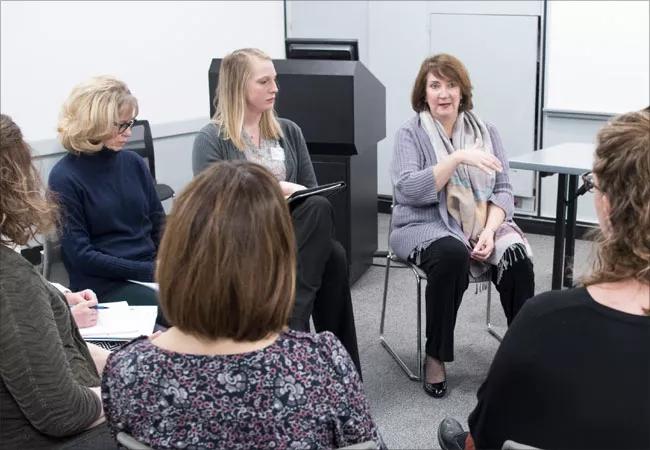
Image content: This image is available to view online.
View image online (https://assets.clevelandclinic.org/transform/ffeec848-eeeb-49db-ab68-a441bae425b1/18-NUR-4083-nurseTrainingAPR-650x450_jpg)
18-NUR-4083-nurseTrainingAPR-650×450
In December, five Advanced Practice Registered Nurses (APRNs) and Physician Assistants (PAs) completed Cleveland Clinic’s one-year Transition to Practice onboarding program for the primary care specialty. The program offers standardized system-wide onboarding for all new graduate APRN and PA hires in a variety of specialties, ranging from critical care to oncology. “It enhances the transition from graduation to full productivity in clinical practice,” says Anne Vanderbilt, MSN, APRN, CNS, CNP, Director of Advanced Practice Nursing at Cleveland Clinic.
Advertisement
Cleveland Clinic is a non-profit academic medical center. Advertising on our site helps support our mission. We do not endorse non-Cleveland Clinic products or services. Policy
A critical component of the Transition to Practice – Primary Care program is a culminating independent development project, which aims to help advanced practice providers develop and increase their knowledge and skill in one of the following areas: research, quality improvement, volunteerism or education.
“The independent development project starts them on the journey of their own professional development, and it helps them see the larger picture and mission of Cleveland Clinic,” says Vanderbilt. “Our purpose is to not only care for patients, but to educate those who serve, investigate problems and serve the community.”
Participants in the Transition to Practice – Primary Care program spend most of their time in clinical practice, working side by side with another advanced practice provider or physician for the first three months, then gradually seeing patients independently. The APRNs and PAs also meet with Vanderbilt once a week for a half day during the first six months of the program for a variety of learning activities, including case studies and simulations. They work on their independent development projects during the second six months of the Transition to Practice program.
During the program completion ceremony in December, the advanced practice providers presented the following five projects to one another, advanced practice leaders and their physician colleagues:
Advertisement
Megan Purcell, APRN, volunteered at North Coast Health Ministry (now called Neighborhood Family Practice North Coast Community Health Center) one Saturday a month. While there, she created an extensive dental resource list for the clinical team to distribute to patients. The list is also utilized at Cleveland Clinic’s Lakewood Family Medicine – Rockport, where she cares for patients.
“I frequently see patients who lack routine dental care or develop dental issues as a result of the expense associated with paying for dental care out of pocket,” says Purcell. “This project was developed in an effort to improve overall patient care and health outcomes by increasing awareness about programs that can help with everything from routine dental cleanings to more advanced dental needs.”
Although the project is complete, Purcell plans to continue volunteering at Neighborhood Family Practice North Coast Community Health Center. She believes that completing an independent development project helped her and her peers enhance their practice as APRNs.
“Many of the projects were derived from areas of personal interest and gave us an outlet to demonstrate our leadership skills by initiating and developing a project at our practice locations,” she says.
Advertisement
Advertisement
Nurses play key role in comprehensive lifetime treatment program
Customized bots improve speed, efficiency by streamlining daily clinical, clerical tasks
Nurses play pivotal role in patients’ ability to recover in the comfort of their own homes
New protocol reduces costs, increases patient and caregiver satisfaction

Advocating for patient safety is imperative in fast-paced surgical settings

M-Power program improves the perinatal experience for people who have survived abuse

Advice for those pursuing a WOC nursing career

Veteran nurse shares his experience as a caregiver and community volunteer
 Search