Locations:





May help identify those who’d benefit from intensified treatment
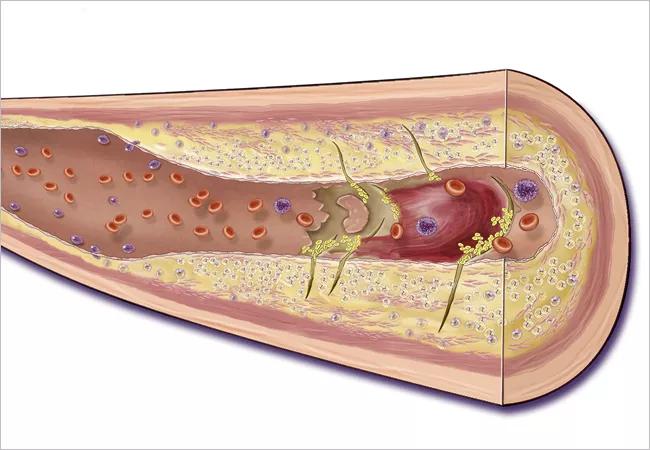
Image content: This image is available to view online.
View image online (https://assets.clevelandclinic.org/transform/519ba15d-e3d6-485d-8368-d48a5c11b675/19-HRT-307_Puri-study-of-serial-CRP-after-ACS_CQD_2_650x450_jpg)
Coronary artery that is beset by a good deal of atherosclerosis
Serial measurements of high-sensitivity C-reactive protein (hsCRP) following acute coronary syndrome (ACS) may help identify patients at higher risk for morbidity and mortality, a Cleveland Clinic-led group of researchers has found.
Advertisement
Cleveland Clinic is a non-profit academic medical center. Advertising on our site helps support our mission. We do not endorse non-Cleveland Clinic products or services. Policy
In a secondary analysis of the Vascular Inflammation Suppression to Treat Acute Coronary Syndrome for 16 weeks (VISTA-16) trial, recently published online by JAMA Cardiology, baseline and longitudinal hsCRP levels were independently associated with increased risk of a major adverse cardiac event (MACE), cardiovascular death and all-cause death during the study period.
“We were looking at whether a rise in inflammation over the short term correlated with having another myocardial infarction or dying, and the answer was yes,” says Cleveland Clinic cardiologist Rishi Puri, MD, PhD, the study’s senior and corresponding author. “Higher CRP at baseline was associated with cardiovascular events and death, as were CRP levels that rose despite optimal medical therapy.”
Residual risk of cardiovascular events or death remains high following ACS, despite coronary revascularization and optimal guideline-directed treatment with antiplatelet and LDL cholesterol-lowering agents. Inflammation is thought to drive this risk, but no effective treatment for such inflammation is commercially available. The secretory phospholipase A2 inhibitor varespladib was developed to meet this need, and it was evaluated in VISTA-16.
VISTA-16 was an international, multicenter clinical trial that randomized 5,145 patients in a double-blind manner to varespladib or placebo on a background of atorvastatin treatment within 96 hours of presentation with ACS. The trial was terminated early due to futility and likely harm from the drug, which was subsequently pulled from development.
Advertisement
VISTA-16 lasted long enough that hsCRP levels were obtained at baseline and at weeks 1, 2, 4, 8 and 16 after randomization in 4,257 patients prior to study termination. This provided enough data for the researchers to determine whether longitudinal increases in hsCRP were independently associated with a greater risk of MACE, all-cause death and cardiovascular death.
“The CANTOS trial of canakinumab elegantly proved that inflammation is causal for atherosclerotic cardiovascular events,” observes Dr. Puri. “Whether changes in inflammation levels over the short-to-medium term following a heart attack are actually meaningful, however, was not clear, since no large-scale clinical data have been available.”
VISTA-16 provided such data. The researchers found that each standard-deviation increment in longitudinal hsCRP concentration was associated with a 15% increased risk of MACE, a 25% increased risk of all-cause death and a 26% increased risk of cardiovascular death.
The association of increasing CRP levels with residual cardiovascular risk may prompt more intensive treatment to lower this risk. In particular, a secondary analysis showed that use of antiplatelet agents (clopidogrel, ticlopidine and prasugrel) was associated with stable or decreasing hsCRP levels.
“Monitoring not only lipids but also hsCRP after ACS may help us better identify patients at increased risk for recurrent cardiovascular events or death,” notes Dr. Puri. “High or increasing CRP levels could be an indication to optimize dual antiplatelet therapy post-ACS, along with high-intensity statin therapy (and possibly PCSK9 inhibitors) and antihypertensive therapy, in addition to instituting measures that are globally beneficial, such as dietary modifications and cardiac rehabilitation/exercise.”
Advertisement
Despite the failure of varespladib, trials of other anti-inflammatory compounds are underway in this setting, suggesting that a direct inflammation-lowering agent may eventually emerge. If and when it becomes available, interest in hsCRP will be heightened, Dr. Puri believes.
“More studies will be required to determine whether initial and serial hsCRP measurements can help guide the use of targeted anti-inflammatory therapies after ACS to further reduce residual CV risk,” he says.
“Elucidating the pathogenic mechanisms underlying the associations between inflammation, lipid levels and atherosclerosis will also be important in helping explain why increasing hsCRP levels are associated with greater mortality,” he concludes.
Advertisement
Advertisement

A sampling of outcome and volume data from our Heart & Vascular Institute
Concomitant AF ablation and LAA occlusion strongly endorsed during elective heart surgery

Large retrospective study supports its addition to BAV repair toolbox at expert centers
Young age, solid tumor, high uptake on PET and KRAS mutation signal risk, suggest need for lobectomy

Surprise findings argue for caution about testosterone use in men at risk for fracture
Residual AR related to severe preoperative AR increases risk of progression, need for reoperation

Findings support emphasis on markers of frailty related to, but not dependent on, age
Provides option for patients previously deemed anatomically unsuitable
 Search