Locations:





Analysis emphasizes need to eliminate regurgitation swiftly, completely
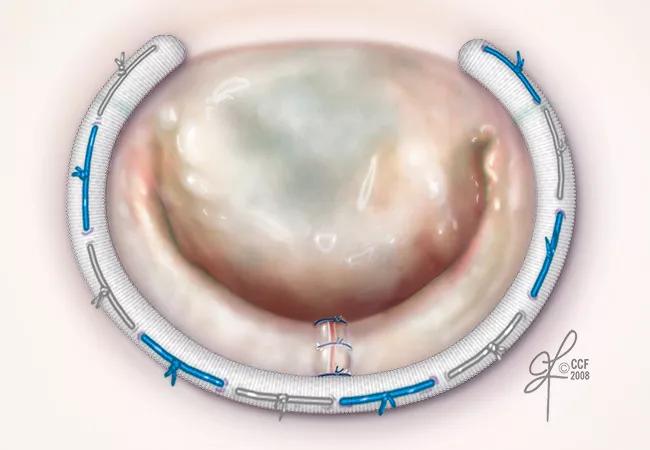
Image content: This image is available to view online.
View image online (https://assets.clevelandclinic.org/transform/4db98d61-0785-4fe8-848d-3ef78ab4238c/650x450-Mitral-Valve-Repair_jpg)
Mitral Valve Repair
A new long-term analysis of degenerative mitral valve repair in 1,218 patients with isolated mitral valve disease concluded that any degree of residual regurgitation increased the risk of adverse left ventricular enlargement and late death.
Advertisement
Cleveland Clinic is a non-profit academic medical center. Advertising on our site helps support our mission. We do not endorse non-Cleveland Clinic products or services. Policy
In the study, published in the Journal of the American College of Cardiology, 13.3 percent of patients experienced recurrent mitral regurgitation over 15 years of follow-up, resulting in reoperation in 6.9 percent of patients. The 15-year mortality rate in the overall cohort was 44 percent.
“Valve repair must be performed to a standard of excellence with near-complete elimination of mitral regurgitation to optimize patient outcomes and diminish the likelihood of recurrent operation,” says Cleveland Clinic cardiothoracic surgeon Rakesh M. Suri, MD, DPhil, the study’s lead author.
“Preventing recurrent mitral regurgitation following repair of degenerative mitral regurgitation is an obsession of the heart team managing these patients, and it’s getting more and more successful over time,” adds senior author Maurice Sarano, MD, from Mayo Clinic. “Our study shows the factors, technical and anatomical, that can lead to recurrent mitral regurgitation and emphasizes the serious outcomes of such a recurrence.”
Mitral valve repair can be a technically challenging operation, even for surgeons who specialize in mitral valve disease. Differences in patient anatomy and in the characteristics of the leaflets themselves make each case unique. Repairing a mitral valve mandates an artistic approach that complements scientific knowledge.
“Mitral valve reconstruction requires the ability to visualize the problem in three dimensions in your mind and then perform a reconstruction according to that mental model, using your imagination to cut, sew, nip and tuck the tissue into a work of art,” explains Dr. Suri. “At the end, the mitral valve must open and close with absolute symmetry once cardiac animation resumes. A perfect repair is a thing of beauty. It takes years of apprenticeship, performing a high volume of cases and working with excellent imagers to perfect the art. If any aspect is not done with technical precision, the end result will not be as robust as needed to confer long-term benefit.”
Advertisement
In the new analysis, a number of factors were independently associated with increased likelihood of recurrent mitral regurgitation following primary mitral valve repair: increasing age, mitral repair performed prior to 1996, hypertension, longer pump time, mild residual regurgitation identified immediately post-repair, bileaflet or anterior leaflet prolapse, absence of leaflet resection and absence of prosthetic annuloplasty band.
Patients included in the study had undergone surgery between 1990 and 2000 at Mayo Clinic. Drs. Suri and Sarano found that the incidence of recurrent mitral regurgitation fell dramatically after the first postoperative year (0.9 per 100 patient-years), particularly in three groups of patients:
The improvements in the first two groups reflect advances in surgical technique that occurred over time, whereas the improvement in the latter group demonstrates how isolated anterior leaflet prolapse remained technically challenging to correct until recently.
Although surgeons have become familiar with the correct placement and tension required in utilizing Gore-Tex neochordae, the chords failed in some patients early in the experience. The authors emphasized that this potential risk has been mitigated over the years by adding an additional loop and/or protecting the knot with a pledget.
In an international registry study published in JAMA in 2013, Dr. Suri and colleagues showed that early surgery was highly beneficial for patients with mitral valve regurgitation due to flail leaflets. Operation within three months of the onset of regurgitation increased 10-year survival rates to 86 percent, compared with 69 percent for medical management. It also reduced heart-failure risk at 10 years (7 percent vs. 23 percent) and five-year mortality (52.6 percent relative reduction).
Advertisement
Despite these recent scientific justifications for mitral valve surgery in most, if not all, patients with severe mitral regurgitation, many cardiologists remain reluctant to refer patients for early surgery. Dr. Suri suggests that some may still be unaware of the long-term hazards of delaying valve repair or influenced by patient or payer pressure to defer surgery.
“A transparent discussion of the risks, benefits and alternatives is of timely importance in light of these new results,” he says. “Failing to acknowledge the proven benefits of early surgery during preoperative counseling ignores the mounting weight of evidence pointing to long-term survival advantages. It becomes ethically challenging to focus on the short-term inconvenience of undergoing surgery when discussion of the long-term and life-enhancing benefits of early repair should take precedence.”
In addition to the personal consequences of delayed repair, postponing surgery magnifies the societal cost of patient care, he notes.
For all initial and repeat mitral valve repairs, Dr. Suri advocates referring patients to a center of excellence. “Mitral repair is not a solo sport; it’s a team effort,” he says. “When experts come together, we select ideal candidates for repair more accurately, quality control is enhanced, and patients obtain the highest-quality and most durable long-term results.”
Following mitral valve repair, close surveillance with echocardiography may be warranted to monitor for signs of recurrent regurgitation. “A reasonable interpretation of the data would indicate that the consequences of failure are so important to long-term clinical outcomes that close surveillance — for the first year in particular — is a sound recommendation,” says Dr. Suri.
Advertisement
Dr. Sarano of Mayo Clinic concurs about the importance of the team effort in this setting. “The team approach in comprehensively assessing mitral regurgitation physiologically and anatomically by 2-D and 3-D echocardiography is key to optimizing the results of mitral valve repair and restoring life expectancy,” he notes.
Advertisement
Advertisement

A sampling of outcome and volume data from our Heart & Vascular Institute

Concomitant AF ablation and LAA occlusion strongly endorsed during elective heart surgery

Large retrospective study supports its addition to BAV repair toolbox at expert centers

Young age, solid tumor, high uptake on PET and KRAS mutation signal risk, suggest need for lobectomy

Surprise findings argue for caution about testosterone use in men at risk for fracture

Residual AR related to severe preoperative AR increases risk of progression, need for reoperation

Findings support emphasis on markers of frailty related to, but not dependent on, age

Provides option for patients previously deemed anatomically unsuitable
 Search