Locations:





Analysis finds no negative effects on any clinical outcomes
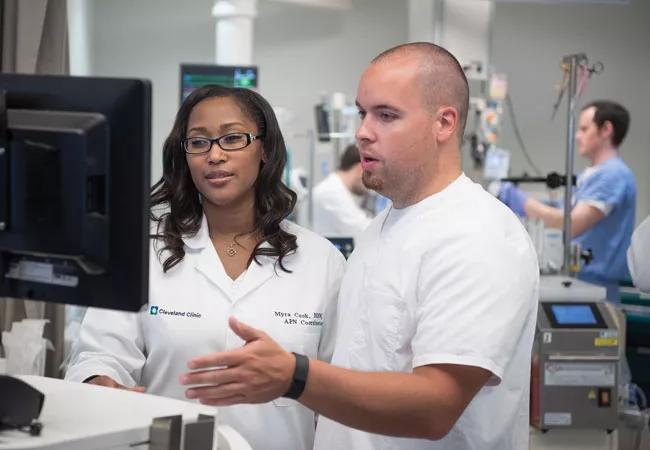
Image content: This image is available to view online.
View image online (https://assets.clevelandclinic.org/transform/81162be8-ccb4-4250-ab1e-7c60789f3361/ICU_650x450_jpg)
ICU_650x450
The first known study of telemedicine-enhanced nighttime staffing of a neurointensive care unit (NICU) found that it is associated with clinical outcomes similar to those of an on-site nocturnal intensivist staffing model, according to a presentation by Joao Gomes, MD, at the Society for Critical Care Medicine’s Critical Care Congress in February 2019.
Advertisement
Cleveland Clinic is a non-profit academic medical center. Advertising on our site helps support our mission. We do not endorse non-Cleveland Clinic products or services. Policy
“Rates of infections, reintubation, readmission and death were similar for both staffing models,” reports Dr. Gomes, Head of the Neurointensive Care Unit in Cleveland Clinic’s Cerebrovascular Center, “but there were significant cost reductions and lower risk of physician burnout with the telemedicine model.”
It has been reported that up to 40 percent of general surgical/medical ICUs in the U.S. have adopted a 24/7 on-site intensivist staffing model, but Dr. Gomes notes that this model is expensive and limited by a shortage of intensivists to meet the demand. In addition, “a number of clinical studies looking at staffing with in-hospital nighttime intensivists versus daytime intensivist staffing have found no significant difference in mortality between the models,” he says.
Dr. Gomes and colleagues performed a single-center observational study over two years. From July 2016 to June 2017, the NICU on Cleveland Clinic’s main campus was staffed by neurointensivists 24/7 with assistance from fellows, advanced practice providers (APPs) and nurses. From July 2017 to June 2018, the staffing model was changed to high-intensity intensivist coverage for 12 hours each day plus 12 hours of telemedicine-enhanced coverage at night with an intensivist on call (nocturnal tele-ICU model).
Under the latter model, when acute events occurred at night, a NICU nurse would call the APPs and fellows on site while another nurse activated tele-ICU equipment (two-way video) to allow the on-call neurointensivist to help guide case management while the patient was being resuscitated or otherwise treated.
Advertisement
Monthly admissions (approximately 140) and patients’ APACHE III scores were similar during the two study periods. Comparative analysis of the two staffing models found statistically comparable results for the following relevant outcomes (first value is for the in-hospital nighttime intensivist model, second value is for the nocturnal tele-ICU model):
In contrast, physician burnout (as measured by the Maslach burnout inventory) was significantly reduced with the tele-ICU model (score of 18 vs. 6.5, P = 0.03), as were monthly costs (average savings of $58,033 per month).
Mortality was also significantly lower under the tele-ICU model (observed:expected ratio of 0.94 vs. 0.62; P = 0.006), although Dr. Gomes says that may have been the result of multiple initiatives implemented over time and not necessarily related to the change in staffing model. “In any case,” he observes, “all measures of interest either remained comparable or improved after we adopted the nighttime telemedicine model.”
Although only six intensivists were followed, Dr. Gomes is encouraged by the results of the study. Indeed, the nocturnal telemedicine model is now standard staffing for the NICUs on Cleveland Clinic’s main campus and at a regional Cleveland Clinic hospital in Northeast Ohio.
Advertisement
The group’s next stage of research will focus on “what happens with this model over time — whether the effects persist and if the utilization rate lessens or remains the same,” Dr. Gomes says. “We hope staff members will continue to take full advantage of the tele-ICU model, because use of video [versus audio alone] can enable neurointensivists to look at the patient’s monitor, examine the patient with staff present in the NICU and even update family members.”
The team is also using the tele-ICU capabilities in their research efforts to explain study protocols to patients interested in enrolling in NICU trials.
Advertisement
Advertisement

New study advances understanding of patient-defined goals
Testing options and therapies are expanding for this poorly understood sleep disorder
Real-world claims data and tissue culture studies set the stage for randomized clinical testing
Digital subtraction angiography remains central to assessment of ‘benign’ PMSAH

Cleveland Clinic neuromuscular specialist shares insights on AI in his field and beyond

Findings challenge dogma that microglia are exclusively destructive regardless of location in brain
Neurology is especially well positioned for opportunities to enhance clinical care and medical training
New review distills insights from studies over the past decade
 Search