Locations:





An up-close look at the result of a rare procedure
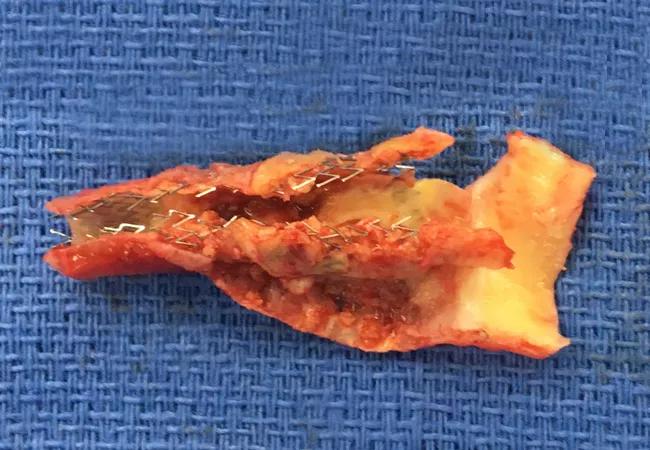
Image content: This image is available to view online.
View image online (https://assets.clevelandclinic.org/transform/69b2290d-3883-4221-85e4-187a5b01b1a7/18-HRT-5546-Farivar-CQD_jpg)
18-HRT-5546-Farivar-CQD
By Behzad Farivar, MD, and Sean Lyden, MD
Advertisement
Cleveland Clinic is a non-profit academic medical center. Advertising on our site helps support our mission. We do not endorse non-Cleveland Clinic products or services. Policy
The resected atherosclerotic carotid artery stent shown above was recently removed from a patient who had undergone a carotid endarterectomy in 1994 and then had a carotid stent placed in 2004 for recurrent carotid stenosis. The earlier procedures were done at outside institutions, but the patient was referred to Cleveland Clinic’s Department of Vascular Surgery at age 63 for greater than 90 percent stenosis within her stent, attributable to atherosclerosis.
We resected her carotid artery, including the stent with atherosclerotic plaque, and did an interposition bypass. This is a complex reoperative procedure that is not commonly performed due to a significant risk of nerve injury and stroke. The patient was at particularly high risk due to significant comorbidities including diabetes, chronic kidney disease and peripheral artery disease. Despite these risks, the danger of stroke was sufficiently great to justify the procedure, and the patient has fared very well since the surgery over one month ago. She has resumed all her activities from before without any limitations. She is now scheduled for routine follow-up at six months with carotid duplex ultrasound surveillance.
Drs. Farivar and Lyden are surgeons in Cleveland Clinic’s Department of Vascular Surgery.
Advertisement
Advertisement

A sampling of outcome and volume data from our Heart & Vascular Institute
Concomitant AF ablation and LAA occlusion strongly endorsed during elective heart surgery
Large retrospective study supports its addition to BAV repair toolbox at expert centers
Young age, solid tumor, high uptake on PET and KRAS mutation signal risk, suggest need for lobectomy
Surprise findings argue for caution about testosterone use in men at risk for fracture
Residual AR related to severe preoperative AR increases risk of progression, need for reoperation

Findings support emphasis on markers of frailty related to, but not dependent on, age
Provides option for patients previously deemed anatomically unsuitable
 Search