Locations:





Thinking outside the box
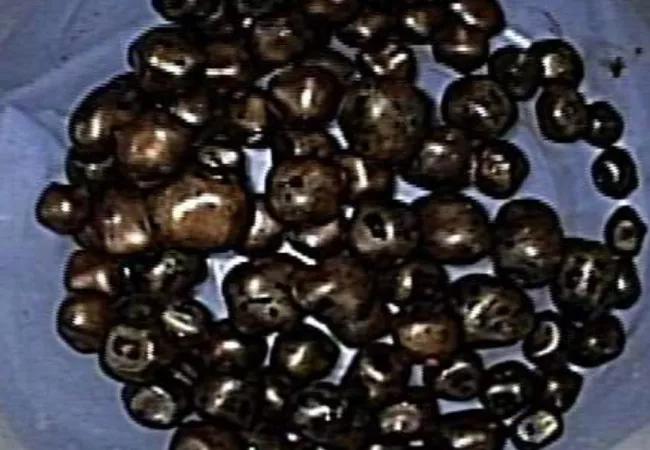
Image content: This image is available to view online.
View image online (https://assets.clevelandclinic.org/transform/3ec50525-08c1-46b1-8ba0-a59e1a9867af/17-DDI-3937-Acute-Calculous-Chole-CQD-Hero_jpg)
17-DDI-3937-Acute-Calculous-Chole-CQD-Hero
Advertisement
Cleveland Clinic is a non-profit academic medical center. Advertising on our site helps support our mission. We do not endorse non-Cleveland Clinic products or services. Policy
Acute calculous cholecystitis (AC) is one of the most common acute surgical conditions requiring hospitalization.
In many cases, the patient is deemed a high-risk surgical candidate and percutaneous transhepatic cholecystostomy (PTHC) placement is performed as a bridge or definitive intervention. In addition, long-term PTHC is offered as a replacement for cholecystectomy in some patients. Frequent tube exchanges apart from complications such as recurrent infection, tube site leak and bleeding results in significant morbidity in this patient population.
We hereby report a case of one of the poor operative risk patients who underwent successful outpatient hybrid endoscopic procedures for complete removal of gall stones and cystic duct stones.
A 47-year-old woman presented with borderline resectable pancreatic adenocarcinoma complicated by obstructive jaundice and cholangitis.
ERCP was attempted, but we failed to gain biliary access. She subsequently underwent successful percutaneous transhepatic internal-external biliary drainage. Her course was further complicated by acute cholecystitis, and a perforated gangrenous gallbladder with perihepatic abscess.
She then underwent PTHC placement, with subsequent multiple PTHC exchanges due to recurrent infections and bile leak. This precluded initiation of neoadjuvant chemotherapy.
The patient was deemed a high-risk surgical candidate for cholecystectomy. As a result, she underwent hybrid percutaneous endoscopic removal of 82 gallstones and cystic duct stones, with complete clearance of stone burden from her gall bladder, cystic duct and common bile duct. She also underwent a concomitant removal of her PTHC drain, biliary drain and placement of metal stent in the bile duct across malignant biliary stricture.
Advertisement
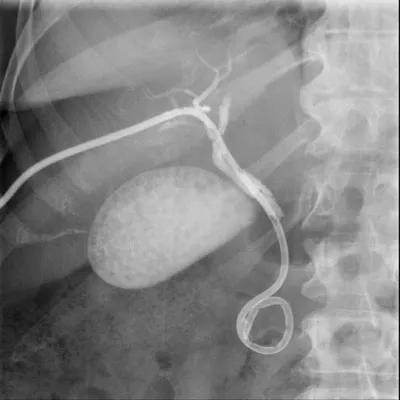
Image content: This image is available to view online.
View image online (https://assets.clevelandclinic.org/transform/d4099fd0-24fe-4e53-9b6f-a81147357b6c/17-DDI-3937-Acute-Calculous-Chole-CQD-Inset-1_jpg)
Percutaneous internal external biliary drainage after failed ERCP for malignant distal biliary stricture. Numerous stones seen in gall bladder.
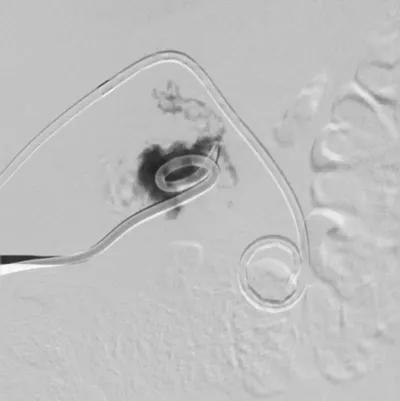
Image content: This image is available to view online.
View image online (https://assets.clevelandclinic.org/transform/7a0e114c-e270-4c17-b154-ae8c38f26a49/17-DDI-3937-Acute-Calculous-Chole-CQD-Inset-2_jpg)
Percutaneous cholecystostomy tube placement for acute calculous cholecystitis with cholecystogram showing numerous filling defects and cystic duct stones.
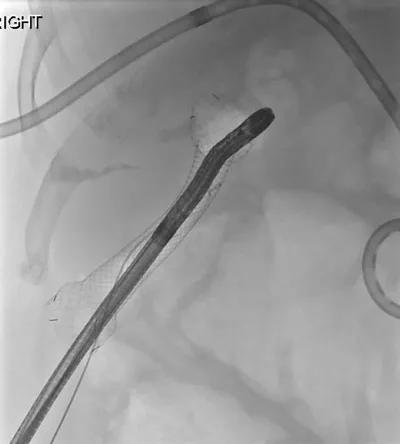
Image content: This image is available to view online.
View image online (https://assets.clevelandclinic.org/transform/b581307b-5ea3-41b2-b5dd-90ecb5b929a6/17-DDI-3937-Acute-Calculous-Chole-CQD-Inset-4_jpg)
Combined percutaneous endoscopic procedure with placement of a 16mm removal metal stent in the gall bladder and passing a standard upper endoscope through it in the gall bladder, with direct endoscopic removal of gall stones with various accessories.
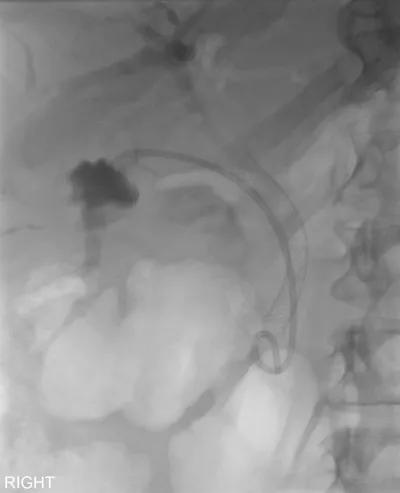
Image content: This image is available to view online.
View image online (https://assets.clevelandclinic.org/transform/bc50a017-5358-4728-a0a6-d269fae4c776/17-DDI-3937-Acute-Calculous-Chole-CQD-Inset-5_jpg)
Endoscopic placement of a metal stent in the bile duct and a plastic stent across the cystic duct, with permanent removal of PTHC and internal external biliary drain.
She remained free of recurrent infectious complications and underwent successful staging diagnostic laparoscopy followed by neoadjuvant chemotherapy.
At two-month follow-up, the patient is doing well and is aiming for a curative Whipple resection.
Reference:
Patel M, Levitin A, Chahal P. Hybrid percutaneous-endoscopic drainage of cholelithiasis and choledocholithiasis. Gastrointest Endosc. 2015 Apr;81(4):1013-4.
Advertisement
Advertisement

Strong patient communication can help clinicians choose the best treatment option
ctDNA should be incorporated into care to help stratify risk pre-operatively and for post-operative surveillance

The importance of raising awareness and taking steps to mitigate these occurrences
New research indicates feasibility and helps identify which patients could benefit

Treating a patient after a complicated hernia repair led to surgical complications and chronic pain
Standardized and collaborative care improves liver transplantations
Fewer incisions and more control for surgeons
Caregiver collaboration and patient education remain critical
 Search