Locations:





Study suggests they help bypass hospital transfers for thrombectomy
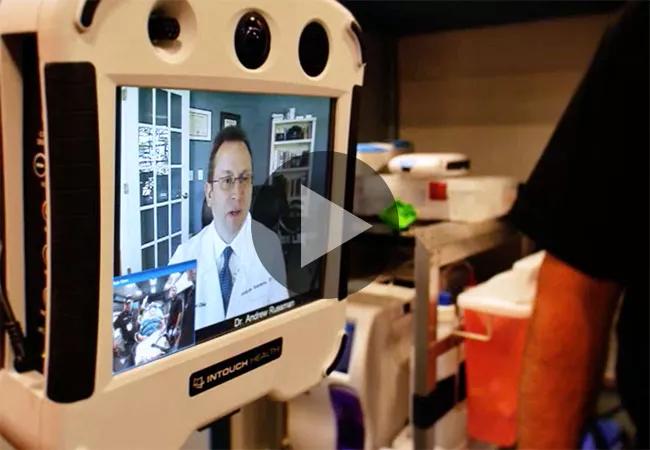
Image content: This image is available to view online.
View image online (https://assets.clevelandclinic.org/transform/9bf8a24e-d5fc-4ea4-8d6e-11a4555929bf/18-NEU-598-Russman-Mobile-Stroke-650x450_jpg)
18-NEU-598-Russman-Mobile-Stroke-650×450
Mobile stroke units have revolutionized many aspects of acute ischemic stroke care where they’ve been adopted, but one little-studied aspect is their potential to help bypass interhospital transfers for thrombectomy in patients with large vessel occlusions.
Advertisement
Cleveland Clinic is a non-profit academic medical center. Advertising on our site helps support our mission. We do not endorse non-Cleveland Clinic products or services. Policy
Cleveland Clinic researchers began to change that with a study presented at the 2018 International Stroke Conference. They retrospectively identified 50 patients who underwent thrombectomy for large vessel occlusion in 2016 or 2017 and analyzed them by mode of transport — i.e., mobile stroke unit (n = 18), conventional ambulance from Primary Stroke Center (PSC) to Comprehensive Stroke Center (CSC) (n = 19) or direct presentation at a CSC (n = 13).
They found that patients transported by mobile stroke unit were more likely to receive IV thrombolysis and had door-to-CT times, door-to-needle times and door-in-door-out times significantly shorter than those for patients initially taken to a PSC and comparable to those for patients taken directly to a CSC.
In this three-minute video, coinvestigator Andrew Russman, DO, discusses the implications of these findings and how they suggest a model where mobile stroke units may increasingly function as “mobile Primary Stroke Centers” to help bypass interhospital transfers for patients requiring thrombectomy.
Video content: This video is available to watch online.
View video online (https://www.youtube.com/embed/jjzjmV5pib0?feature=oembed)
Advertisement
Advertisement

New study advances understanding of patient-defined goals
Testing options and therapies are expanding for this poorly understood sleep disorder
Real-world claims data and tissue culture studies set the stage for randomized clinical testing
Digital subtraction angiography remains central to assessment of ‘benign’ PMSAH

Cleveland Clinic neuromuscular specialist shares insights on AI in his field and beyond
Findings challenge dogma that microglia are exclusively destructive regardless of location in brain
Neurology is especially well positioned for opportunities to enhance clinical care and medical training
New review distills insights from studies over the past decade
 Search