Locations:





 Search
NIH small business grant funds project
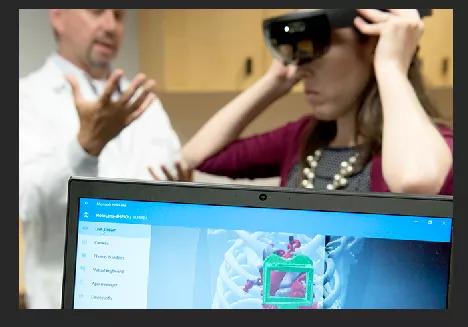
Image content: This image is available to view online.
View image online (https://assets.clevelandclinic.org/transform/f9158f5f-1781-41ce-a145-9e42a54644d6/image001-1_png)
image001 (1)
Karl West, MS, Director of Medical Device Solutions at Cleveland Clinic, and staff member in Lerner Research Institute’s Department of Biomedical Engineering, and Centerline Biomedical, a Cleveland Clinic spin-off company, have been awarded a Small Business Technology Transfer (STTR) award from the National Heart, Lung, and Blood Institute to test a “holographic GPS system for the operating room” that enables 3-D-visualization during minimally invasive procedures.
Advertisement
Cleveland Clinic is a non-profit academic medical center. Advertising on our site helps support our mission. We do not endorse non-Cleveland Clinic products or services. Policy
Stent grafts are commonly used to treat aortic aneurysms by decreasing pressure and blood flow in the damaged parts of the aorta. Despite widespread clinical adoption, however, stent grafts are commonly misplaced. The current standard-of-care placement technique relies on 2-D X-ray fluoroscopy, which leaves surgeons and operating room staff exposed to potentially dangerous radiation. Karl West and industry collaborators believe Centerline Biomedical’s novel Intra-Operative Positioning System (IOPS) technology can mitigate these risks and improve surgical outcomes.
In this study, the researchers will test the IOPS system in both a preclinical model and patient-specific, 3-D printed models. They will use IOPS to control and precisely place the stent graft within the aortic aneurysm or other vascular lesion during minimally invasive surgery. The researchers will use the Microsoft HoloLens — and an application for the mixed reality technology that West previously developed to help surgeons plan, visualize and practice complicated procedures, including Cleveland Clinic’s first full face transplant — to visualize the surgery in true 3-D.
“IOPS stands to improve not only the way routine, minimally invasive endovascular procedures are performed, but also patient outcomes,” said West. In addition to preventing stent graft misplacement and reducing radiation exposure, IOPS developers believe the technology will help streamline surgeries and reduce both time in the operating room and healthcare costs. “We hope this project is the next step towards bringing our technology to full clinical application.”
Advertisement
Centerline Biomedical, for which West also serves as Scientific Advisor and Inventor, was founded in 2014. IOPS — the result of years of collaborative research between Cleveland Clinic vascular surgeons and scientists — was developed by researchers in the Lerner Research and Sydell and Arnold Miller Heart and Vascular institutes, before being licensed to the spin-off and now tested in a preclinical study. The success of Centerline Biomedical illustrates how Cleveland Clinic Innovations, the commercialization arm of Cleveland Clinic, helps physicians and researchers refine and bring innovative ideas and technologies to market, creating companies and growing the workforce and local economy in the process.
NIH STTR grants are one of the largest sources of early-stage capital for technology commercialization. Sixty percent of the nearly quarter of a million dollar award will go to Lerner Research Institute’s Department of Biomedical Engineering, and 40 percent to Centerline Biomedical.
Advertisement
Advertisement


International collaboration is most genetically diverse study of the disease to date

Preclinical work promises large-scale data with minimal bias to inform development of clinical tests

Matching SNOMED Term with Curated Post. Please do not touch this post or any of its categories/snomed terms, thank you!

Matching Primary -> Secondary SNOMED Term with Curated Post. Please do not touch this post or any of its categories/snomed terms, thank you!

Cleveland Clinic researchers pursue answers on basic science and clinical fronts

Study suggests sex-specific pathways show potential for sex-specific therapeutic approaches

Cleveland Clinic launches Quantum Innovation Catalyzer Program to help start-up companies access advanced research technology