Locations:





 Search
7 presentations you shouldn’t miss, and trends to watch for this year
Image content: This image is available to view online.
View image online (https://assets.clevelandclinic.org/transform/d9e8e3f1-cf0a-4079-bd23-3a4c14d31498/17-URL-800-AUA-17-1_CQD-Header_jpg)
17-URL-800 AUA 17 1_CQD Header
Cleveland Clinic Glickman Urological & Kidney Institute will have a major presence at American Urological Association’s 2017 Annual Meeting, with more than 80 oral and poster presentations on wide ranging topics in clinical care and best practices, and basic and clinical research. Department of Urology Chair Edmund Sabanegh, MD, and institute Chair Eric Klein, MD, invite colleagues to take note of and attend the following presentations:
Advertisement
Cleveland Clinic is a non-profit academic medical center. Advertising on our site helps support our mission. We do not endorse non-Cleveland Clinic products or services. Policy
“AUA is a golden opportunity to gain insight into the most important developments in urology from leaders around the world,” Dr. Sabanegh notes. “Many developments and trends warrant our attention this year, but my Cleveland Clinic colleagues and I believe the following have the most potential for our practices.”
Advertisement
“In addition to attending informative oral and poster presentations, being able to share ideas and experiences informally with colleagues from around the world is a tremendously valuable aspect of attending AUA,” Dr. Klein remarks. “Fellowship is another reason to attend AUA, and I look forward to seeing old friends and meeting new colleagues this year in Boston.”
Follow Dr. Klein on Twitter @EricKleinMD and @CleClinicUro, and live-tweet #AUA17 with Cleveland Clinic physicians.
Advertisement
Advertisement

Clinicians should individualize dosing practices based on patient risk factors and preferences
Pioneering and refining the approach in pyeloplasty, nephrectomy and more
Fully-automated process uses preop CT, baseline GFR to estimate post-nephrectomy renal function
Could mean earlier treatment, but also could have negative effects

Unlike earlier pills, new drugs do not cause liver toxicity

Male factors play a role in about half of all infertility cases, yet men often are not evaluated
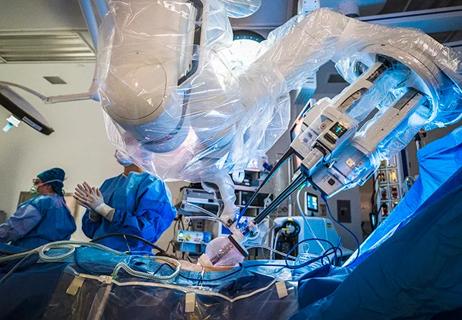
Surgeons choreograph nearly simultaneous procedures, sharing one robot between two patients

Identifying barriers in the renal genetic assessment of Black patients