Locations:





Growing efforts bring this nonatherosclerotic vascular disease out of the shadows
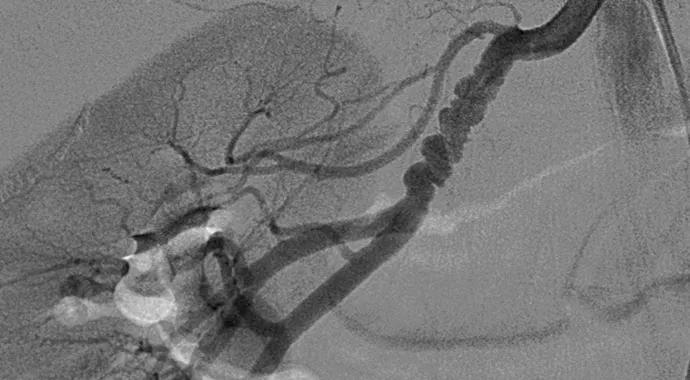
Image content: This image is available to view online.
View image online (https://assets.clevelandclinic.org/transform/098f1df4-d31f-47ab-8ecc-2330e2eea144/FMD-690x380_jpg)
Angiogram images of FMD
When it comes to fibromuscular dysplasia (FMD), Cleveland Clinic vascular medicine specialist Heather Gornik, MD, MHS, has played a key role in several firsts related to the misunderstood condition, including:
Advertisement
Cleveland Clinic is a non-profit academic medical center. Advertising on our site helps support our mission. We do not endorse non-Cleveland Clinic products or services. Policy
However, there is another first related to FMD that Dr. Gornik is less happy about: the fact that she is often the first physician to diagnose FMD in patients who were previously mis- or underdiagnosed.
“Cardiovascular specialists are on the front lines of recognizing and diagnosing FMD,” says Dr. Gornik, Medical Director of Cleveland Clinic’s Noninvasive Vascular Laboratory. “It’s an underrecognized disease that’s more common than many physicians realize.”
FMD is a nonatherosclerotic arterial disease of medium-sized vessels, most commonly the renal and extracranial carotid and vertebral arteries, that leads to arterial stenosis, occlusion, dissection and aneurysm. Although its causes and prevalence are not well understood, it is recognized that more than 90 percent of patients are women, often in their 40s or 50s.
Patients suffering from FMD complain of common symptoms, and often physicians treat the symptoms without connecting them to FMD. Observational findings from the U.S. Registry for Fibromuscular Dysplasia indicate that patients do not have consistent diagnostic signs, making it even more difficult for doctors to recognize FMD. Moreover, some patients with FMD may be completely asymptomatic, with 5.6 percent showing no signs of disease.
Data from the registry suggest an average interval of four years from symptom onset to FMD diagnosis, Dr. Gornik notes. “In light of that, patients understandably become frustrated living with the symptoms without proper treatment,” she adds.
Advertisement
Symptoms of FMD may include early-onset hypertension (starting in the 40s or 50s), poorly controlled hypertension, migraine headaches, dizziness, cervical bruit, neck pain and pulsatile tinnitus (swooshing noise in the ears). According to the U.S. Registry for Fibromuscular Dysplasia, more than one-third of patients with FMD experience pulsatile tinnitus, whereas it remains uncommon in the general population.
Some patients with FMD might be noted to have cervical, abdominal or femoral bruits, although these do not always indicate the presence of disease. In some patients, FMD presents dramatically with a major cardiovascular event, including artery dissection, stroke, myocardial infarction or ruptured aneurysm.
In 2008, Cleveland Clinic’s Sydell and Arnold Miller Family Heart & Vascular Institute started its dedicated clinic for patients with FMD — the first in the world. The clinic was initially held monthly but now meets twice weekly, following about 400 to 500 patients per year who visit for treatment.
The clinic’s multidisciplinary team includes vascular medicine specialists as well as vascular surgeons, nephrologists, neurosurgeons, interventional cardiologists, medical geneticists, radiologists and pathologists. Vascular medicine specialists serve as primary FMD care providers and craft customized care plans, which include routine follow-up and communication with the patient’s primary care physician. “We bring the big-picture perspective,” explains Dr. Gornik. “Our FMD clinic has become a ‘medical home’ for these patients.”
Advertisement
Cleveland Clinic is one of 13 centers participating in the U.S. Registry for Fibromuscular Dysplasia, which is sponsored by the Fibromuscular Dysplasia Society of America and began enrolling patients in 2009.
The registry gives researchers the chance to examine the natural history of FMD and gain better insight into it. “Thanks to the registry, we now know more about FMD than we have in the past, and Cleveland Clinic is proud to be one of its highest-enrolling centers,” says Dr. Gornik. “As we continue to enroll and follow patients, we expect to learn more about the causes of FMD and how to better diagnosis and treat it.”
Advertisement
Advertisement
A sampling of outcome and volume data from our Heart & Vascular Institute
Concomitant AF ablation and LAA occlusion strongly endorsed during elective heart surgery
Large retrospective study supports its addition to BAV repair toolbox at expert centers
Young age, solid tumor, high uptake on PET and KRAS mutation signal risk, suggest need for lobectomy
Surprise findings argue for caution about testosterone use in men at risk for fracture
Residual AR related to severe preoperative AR increases risk of progression, need for reoperation

Findings support emphasis on markers of frailty related to, but not dependent on, age
Provides option for patients previously deemed anatomically unsuitable
 Search