Locations:





Free registration to this CME event for residents, fellows, students
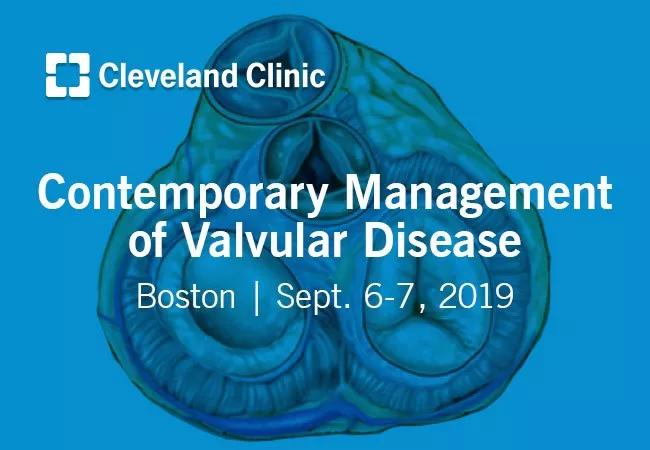
Image content: This image is available to view online.
View image online (https://assets.clevelandclinic.org/transform/bd9cf16b-33ff-4d84-b417-bc7a359f3784/19-HRT-259-heart-valves-650x450_jpg)
19-HRT-259-heart-valves-650×450
For a comprehensive update on the latest in heart valve disease, there’s no better place to be than Boston in early September. That’s where and when Contemporary Management of Valvular Disease: Diagnosis, Imaging and Intervention will happen.
Advertisement
Cleveland Clinic is a non-profit academic medical center. Advertising on our site helps support our mission. We do not endorse non-Cleveland Clinic products or services. Policy
And no one has greater reason to be there than residents, fellows and trainees, who qualify for complimentary registration to this day-and-a-half CME-certified course, slated for Friday, Sept. 6, and Saturday, Sept. 7, at the InterContinental Boston. The event is sponsored by Cleveland Clinic and shares the insights of 15 expert faculty from Cleveland Clinic, Boston Children’s Hospital and other leading U.S. centers.
“Management of heart valve disease is constantly evolving,” says course director Lars Svensson, MD, PhD, Chair of Cleveland Clinic’s Miller Family Heart & Vascular Institute. “We see this in the steady emergence of new techniques, devices and imaging approaches and in the rapid expansion of the evidence base on patient assessment and treatment outcomes from valve interventions. This program is designed to bring together cardiologists, interventionalists, surgeons and other providers to review the latest research and technical advances and assess their likely impact on practice.”
The full-day Friday program is devoted entirely to the mitral valve, beginning with discussions of various imaging modalities in evaluating and quantifying mitral regurgitation and an exploration of the “valve center of excellence” model.
Next comes a detailed survey of degenerative mitral regurgitation, from when and how to intervene to consideration of various special situations, such as Barlow’s valve, managing concomitant tricuspid regurgitation and issues around concurrent atrial fibrillation ablation.
Advertisement
All of Friday afternoon is dedicated to functional mitral regurgitation, with focused explorations of a range of topics from the role of atrial dilatation to integrating other therapies with MitraClip® for functional mitral regurgitation.
The aortic valve takes center stage for much of Saturday morning’s agenda, which is packed with 15- or 20-minute updates on a range of timely subtopics. A few examples:
The final few segments before 12:30 adjournment on Saturday will explore the latest in management of tricuspid regurgitation, including an update on transcatheter therapies.
“Our overarching goal will be to clarify confusion regarding optimal management strategies across the spectrum of valvular disease, whether it’s on choosing between mitral valve repair or replacement or how best to quantify various types of valve disease,” says Dr. Svensson.
Registration information and full course details are at ccfcme.org/bostonvalve2019. Registration is complimentary for students, residents and fellows.
This activity has been approved for AMA PRA Category 1 Credit™.
Advertisement
Advertisement
A sampling of outcome and volume data from our Heart & Vascular Institute
Concomitant AF ablation and LAA occlusion strongly endorsed during elective heart surgery
Large retrospective study supports its addition to BAV repair toolbox at expert centers
Young age, solid tumor, high uptake on PET and KRAS mutation signal risk, suggest need for lobectomy
Surprise findings argue for caution about testosterone use in men at risk for fracture
Residual AR related to severe preoperative AR increases risk of progression, need for reoperation

Findings support emphasis on markers of frailty related to, but not dependent on, age
Provides option for patients previously deemed anatomically unsuitable
 Search