Locations:





Perioperative disadvantages give way to better survival, fewer reinterventions by 5-10 years
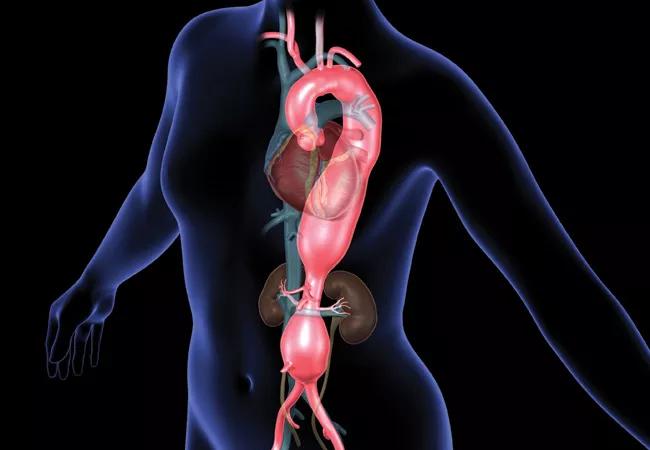
Image content: This image is available to view online.
View image online (https://assets.clevelandclinic.org/transform/65191647-d668-43d8-9287-860614965d7a/21-HVI-2325758_descending-aorta_650x450_jpg)
21-HVI-2325758_descending-aorta_650x450
Open repair of descending thoracic and thoracoabdominal aortic aneurysms achieved acceptable near-term outcomes and superior intermediate-term outcomes relative to endovascular repair, finds a propensity-matched analysis from Cleveland Clinic published in the Annals of Thoracic Surgery.
Advertisement
Cleveland Clinic is a non-profit academic medical center. Advertising on our site helps support our mission. We do not endorse non-Cleveland Clinic products or services. Policy
“Endovascular repair is increasingly used in this setting, extending beyond patients at high risk from open surgery to those at moderate and low risk,” says the study’s lead author, Michael Tong, MD, MBA, of Cleveland Clinic’s Department of Thoracic and Cardiovascular Surgery. “This trend is fueled by patients’ preference for the less-invasive nature of endovascular repair despite open repair being the gold standard for these aneurysms. Yet while early results with endovascular repair have been good, later outcomes have not been well described.”
To help fill the data void, he and colleagues analyzed all 1,053 patients who underwent repair of descending thoracic or thoracoabdominal (Crawford extent I, II or III) aortic aneurysms at Cleveland Clinic from January 2000 to January 2010. Of these, 457 (43.4%) had open repair and 596 (56.6%) had endovascular repair.
To best match patient characteristics for comparing clinical outcomes out to 10 years, the researchers performed propensity-score matching. The resulting 278 well-matched pairs represented 61% of possible pairs.
Comparison of the matched cohorts revealed statistically similar in-hospital outcomes with regard to the following:
In contrast, patients receiving open repair had higher rates of acute kidney failure (8.6% vs. 3.3%; P = 0.008) and prolonged ventilation (46.0% vs. 6.3%; P < 0.0001) as well as a longer median ICU stay (5 vs. 3 days; P < 0.0001) and a longer median postoperative hospital stay (11 vs. 6 days; P < 0.0001).
Advertisement
Comparison of the matched cohorts revealed significantly higher rates of 10-year survival with open repair versus endovascular repair (P < 0.0001). Survival rates were as follows:
Freedom from aortic reintervention was higher in the open repair group than in the endovascular repair group at 1 year (99% vs. 96%, respectively), 5 years (98% vs. 88%) and 10 years (96% vs. 79%) (P < 0.0001).
Within the endovascular repair cohort, average aorta size declined in the first two postoperative years and then slowly increased but failed to recover to normal range.
“After the early hazard phase, we found a survival advantage with open repair compared to endovascular repair,” Dr. Tong says. He and his co-investigators write that the reasons for the divergence in mortality over time may be associated with patient selection and device failure.
“These data are consistent with open infrarenal aortic repair outcomes, in which early benefits are lost over the long term due to the need for late reinterventions and progression of aortic disease,” says study co-author Sean Lyden, MD, Chair of Vascular Surgery at Cleveland Clinic. “We also need to remember that patients undergoing endovascular repair of thoracoabdominal aneurysms at our institution were treated in the context of a physician-sponsored IDE study in which patients were deemed high risk for open repair by our surgeons. This led to a large number being dropped from analysis after propensity matching, whereas use of approved thoracic stent-grafts allowed landing in suboptimal aortic zones and achievement of early success.”
Advertisement
He adds that endovascular repair, when done optimally, should put more residual aorta at risk since the device has to land 2 cm above and below the aneurysmal area, in contrast to open surgery, where a suture line can be made right at the junction of the diseased and non-diseased areas.
The investigators note that the experience reflected in this study underscores two key lessons. One is the importance of meticulous spinal cord protection during open repair. “We were gratified to find no difference in paraplegia or paralysis in our series, in contrast to prior reports,” says Dr. Tong. “This is a testament to advances in spinal cord protection during open aorta surgery in recent decades. All of our patients who undergo procedures on the thoracoabdominal aorta receive cerebrospinal fluid drainage.”
Another lesson is the priority to be given to landing zones. “Patients with devices landing in the arch with coverage of branch vessels undergo arch vessel revascularization,” Dr. Lyden says. “And our cardiac teams increasingly perform elephant trunk and frozen elephant trunk procedures to augment the landing zones of descending aortic stent-grafts.”
In their study report, the authors note that endovascular repairs in this patient population increased by 60% from 1998 to 2007 while open repair volume growth was flat. “Despite our findings, the trend toward greater endovascular repair is likely to continue,” Dr. Tong observes. “So we emphasize that rigorous lifelong follow-up is imperative for patients who undergo endovascular repair, with planning for intervention in those demonstrating aneurysm sac growth. And our findings argue for open surgery in patients with poor landing zones and in young patients with low surgical risk and long life expectancy.”
Advertisement
Advertisement
A sampling of outcome and volume data from our Heart & Vascular Institute
Concomitant AF ablation and LAA occlusion strongly endorsed during elective heart surgery
Large retrospective study supports its addition to BAV repair toolbox at expert centers
Young age, solid tumor, high uptake on PET and KRAS mutation signal risk, suggest need for lobectomy
Surprise findings argue for caution about testosterone use in men at risk for fracture
Residual AR related to severe preoperative AR increases risk of progression, need for reoperation
Findings support emphasis on markers of frailty related to, but not dependent on, age
Provides option for patients previously deemed anatomically unsuitable
 Search