Locations:





Enrollment underway for pioneering trial of new stimulation strategy
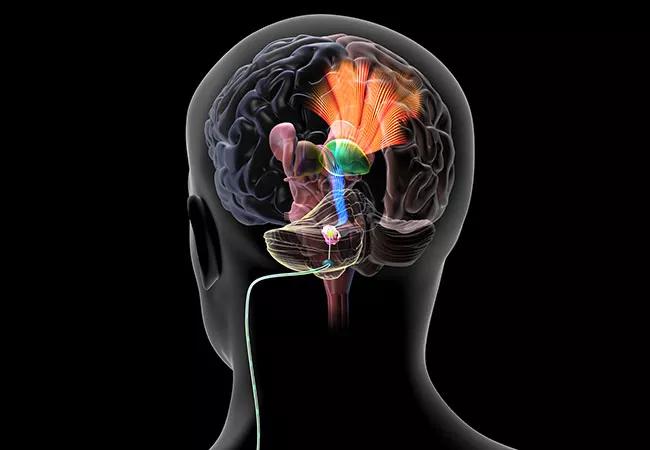
Image content: This image is available to view online.
View image online (https://assets.clevelandclinic.org/transform/8afed4f3-fddd-418b-8074-1491602604df/16-NEU-2598-Machado-650x450_jpg)
16-neu-2598-machado-650×450
Can neuromodulation be used effectively to recover neurological function, such as in paralysis?
Advertisement
Cleveland Clinic is a non-profit academic medical center. Advertising on our site helps support our mission. We do not endorse non-Cleveland Clinic products or services. Policy
That’s among the key research questions being explored in a Cleveland Clinic first: a new clinical trial testing deep brain stimulation (DBS) as rehabilitative therapy for stroke survivors. The trial, launched in 2016 (a DBS device was implanted in the first patient in December), was awarded nearly $5 million in funding from the NIH’s Brain Research through Advancing Innovative Neurotechnologies (BRAIN) initiative.
“When we use DBS for a movement disorder, we’re attempting to suppress a positive symptom, such as tremor or rigidity, that is overlaid on top of normal function,” explains lead investigator Andre Machado, MD, PhD. “In contrast, in this trial we are attempting for the first time to use DBS to help recover a function that’s been lost — i.e., motor function on the paretic side of a stroke survivor’s body.”
The study will examine a novel strategy — stimulation of the dentatothalamocortical pathway to enhance excitability and plasticity in spared cerebral cortical regions — with the aim of promoting recovery of motor function.
“Our primary hypothesis is that by applying DBS to the connections between the cerebellum and cerebral cortex, we can facilitate the plasticity that occurs in the cortex around the stroke and thereby promote recovery of function beyond what physical therapy alone can do,” Dr. Machado notes.
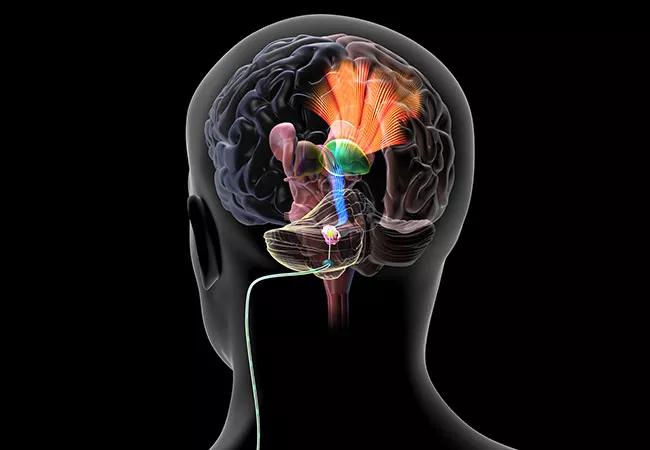
Image content: This image is available to view online.
View image online (https://assets.clevelandclinic.org/transform/8afed4f3-fddd-418b-8074-1491602604df/16-NEU-2598-Machado-650x450_jpg)
Illustration showing a DBS lead implanted in the cerebellar dentate nucleus for treatment of post-stroke motor deficits. Low-frequency stimulation is predicted to enhance neural activity across the ascending, excitatory dentatothalamic pathways (blue) and, in turn, thalamocortical pathways (red/yellow), thereby increasing cerebral cortical excitability and enhancing functional reorganization across spared perilesional cortex.
Advertisement
The study builds on more than a decade of Cleveland Clinic preclinical research. “We know that deep cerebellar stimulation promotes motor recovery in a preclinical model of cortical stroke,” says Kenneth Baker, PhD, of Cleveland Clinic’s Department of Neurosciences. “Our goal is to advance this therapy to promote recovery of motor function in humans. This has the potential to be a significant advancement for the field.
Trial enrollment is underway, and the first patient was implanted with her DBS device Dec. 19, 2016, with plans to begin stimulation in conjunction with physical therapy in the early months of 2017 (see details here). Candidates are patients with severe residual hemiparesis from an ischemic stroke 12 to 24 months previously despite physical therapy. Primary aims include:
“We need more and better options to help the many patients who remain chronically disabled after a stroke,” says Dr. Machado. “The opportunity here is to explore a new avenue that may improve their long-term rehabilitative outcomes.”
Advertisement
Advertisement

New study advances understanding of patient-defined goals
Testing options and therapies are expanding for this poorly understood sleep disorder
Real-world claims data and tissue culture studies set the stage for randomized clinical testing
Digital subtraction angiography remains central to assessment of ‘benign’ PMSAH

Cleveland Clinic neuromuscular specialist shares insights on AI in his field and beyond
Findings challenge dogma that microglia are exclusively destructive regardless of location in brain
Neurology is especially well positioned for opportunities to enhance clinical care and medical training
New review distills insights from studies over the past decade
 Search