Locations:





Guidelines mark 30 years of internal thoracic artery as gold standard
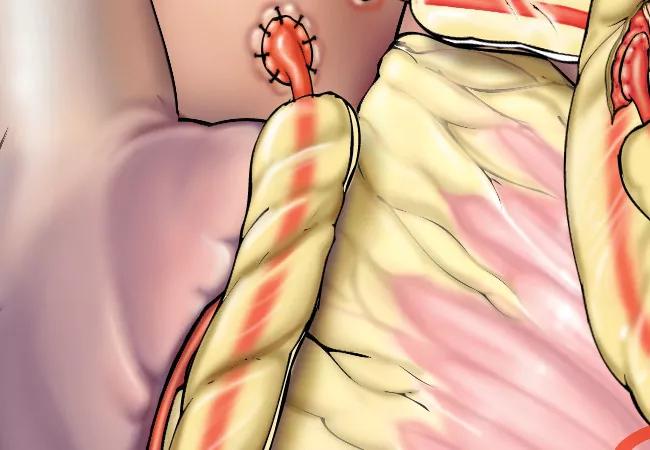
Image content: This image is available to view online.
View image online (https://assets.clevelandclinic.org/transform/167bbbfe-56cb-4c5b-9b74-711c20ef6472/16-HRT-375-CABG-Graft-Guidelines-CQD-650x450_jpg)
16-HRT-375-CABG-Graft-Guidelines-CQD-650×450
As we approach the midpoint of 2016, it’s a good time to note that this is a milestone year in coronary artery bypass graft surgery (CABG) in at least two respects:
Advertisement
Cleveland Clinic is a non-profit academic medical center. Advertising on our site helps support our mission. We do not endorse non-Cleveland Clinic products or services. Policy
The two developments are linked by the fact that two Cleveland Clinic cardiothoracic surgeons — Joseph Sabik, MD, and Faisal Bakaeen, MD — were invited to serve as co-authors of the new STS guidelines, which reflect continued refinements of CABG in the tradition of their predecessors who published the pivotal NEJM paper.
“In the years following this 1986 NEJM publication, Cleveland Clinic surgeons have continued to improve surgical coronary revascularization and have published numerous papers supporting the use of two internal thoracic arteries instead of just one,” says Dr. Bakaeen. “They have demonstrated that bilateral internal thoracic artery grafting was associated with improved survival and freedom from recurrent ischemic events — and that these benefits became more prominent with time.”
The new guidelines were developed by an expert writing group convened by the STS to conduct a systematic literature review assessing how choice of arterial conduits for CABG can affect outcomes and then translate the findings to recommendations for clinical practice.
The resulting guidelines, published in Annals of Thoracic Surgery in February, were described in an accompanying editorial as part of a long-overdue effort to “shift from telling us when to operate to guiding us in how best to do so.”
The new guidelines distinguish themselves from previous CABG-related guideline documents — such as a 2011 guideline from the American College of Cardiology (ACC) Foundation/American Heart Association (AHA); a 2014 focused update from the ACC, AHA, STS, American Association for Thoracic Surgery and other societies; and 2014 guidelines from the European Society of Cardiology and European Association for Cardio-Thoracic Surgery — in at least several notable ways:
Advertisement
1) Recommending use of an internal thoracic artery (ITA), rather than specifically the left ITA, for bypassing the left anterior descending coronary artery (LAD). This point recognizes that right and left ITAs have comparable patency when grafted to the LAD.
2) Recommending consideration of a second arterial conduit — either the right ITA or radial artery — as an adjunct to the left ITA in appropriate patients.This point reflects the inconclusiveness of evidence distinguishing patency and outcomes after right ITA versus radial artery grafting.
3) Recommending consideration of bilateral ITA grafting for patients without excessive risk of sternal wound infection.The guidelines also endorse use of a skeletonized harvest technique, smoking cessation, glycemic control and enhanced sternal stabilization to further reduce sternal infection risk.
4) Endorsing consideration of a radial artery graft (as an adjunct to left ITA grafting) for cases of “severe stenoses” rather than specifying a percentage threshold of coronary artery stenosis.This point acknowledges the complexity of factors that may affect graft patency.
5) Avoiding use of an age cutoff to qualify for arterial revascularization. This point recognizes the necessity for individualized decision-making and underscores the importance of taking a heart team approach to complex revascularization cases (including consideration of interventional and hybrid options).
The STS writing group noted that whereas recent decades have witnessed a dramatic evolution in technologies for percutaneous coronary intervention, there has been little change in the choice of conduits for CABG — and use of multiple arterial grafting has remained distressingly low.
Advertisement
“Use of at least a second arterial conduit should be a national STS quality metric for CABG and should be rewarded with higher reimbursement from CMS,” argue the authors of the Annals of Thoracic Surgery editorial that accompanies the new guidelines. They add that the new STS guidelines may help bring their call closer to reality.
Advertisement
Advertisement
A sampling of outcome and volume data from our Heart & Vascular Institute
Concomitant AF ablation and LAA occlusion strongly endorsed during elective heart surgery

Large retrospective study supports its addition to BAV repair toolbox at expert centers
Young age, solid tumor, high uptake on PET and KRAS mutation signal risk, suggest need for lobectomy

Surprise findings argue for caution about testosterone use in men at risk for fracture
Residual AR related to severe preoperative AR increases risk of progression, need for reoperation

Findings support emphasis on markers of frailty related to, but not dependent on, age
Provides option for patients previously deemed anatomically unsuitable
 Search