Locations:





FETO and twin-twin transfusion syndrome treatments are next
Image content: This image is available to view online.
View image online (https://assets.clevelandclinic.org/transform/853f5bdd-8a91-4ddb-a436-bcaef2e2b7bb/21-DDI-2269958-Cass-Intrapericardial-CQD2_650x450-Hero_jpg)
21-DDI-2269958-Cass Intrapericardial CQD2_650x450 Hero
Since its initial procedure in February 2019, Cleveland Clinic’s fetal surgery program has undertaken increasingly complex cases, from myelomeningocele repairs to EXIT (ex-utero intrapartum treatment)-to-airway and EXIT-to-resection procedures to remove large obstructive masses.
Advertisement
Cleveland Clinic is a non-profit academic medical center. Advertising on our site helps support our mission. We do not endorse non-Cleveland Clinic products or services. Policy
The advancements are in keeping with program Director Darrell Cass, MD’s goal for Cleveland Clinic to become a global leader in fetal surgery. Dr. Cass is one of the world’s most experienced fetal surgeons, having co-founded and co-directed Texas Children’s Fetal Center for 17 years before coming to Cleveland.
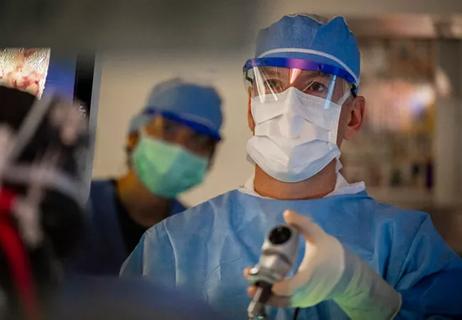
Next up for the program, according to Dr. Cass, is to begin performing fetoscopic endoluminal tracheal occlusion to treat fetuses with severe pulmonary hypoplasia due to congenital diaphragmatic hernia, and to provide treatment for twin-twin transfusion syndrome.
Giancarlo Mari, MD, a maternal-fetal medicine specialist with international expertise in fetoscopy and fetal treatment of twin-twin transfusion syndrome, joined the Fetal Care Center team in 2020, bringing complementary expertise that will further elevate Cleveland Clinic’s program.
In congenital diaphragmatic hernia, the protrusion of the abdominal viscera into the thoracic space impairs lung development. The condition can cause neonatal death due to pulmonary hypoplasia and pulmonary hypertension, or serious respiratory, gastrointestinal, orthopaedic and neurological problems in infants who are able to survive.
The FETO procedure entails blocking the fetal trachea using an endoluminally inserted inflatable and detachable balloon. The temporary obstruction causes retention of pulmonary secretions, resulting in lung tissue stretching and expansion. Observational studies and recently published randomized trials have shown that FETO performed early in the third trimester can significantly improve postnatal survival compared to expectant care in cases of severe diaphragmatic hernia (but not in cases of moderate herniation).
Advertisement
TTTS results from asymmetric placental apportionment, abnormal blood vessel connections and unequal blood circulation between fetuses in a monochorionic, diamnionic dual pregnancy. Potentially fatal complications occur in both the blood-donor twin (anemia, oliguria, oligohydramnios and a diminished or absent bladder) and the blood-recipient twin (polyhydramnios, an enlarged bladder, hydrops and heart failure).
Prenatal interventions to treat TTTS include fetoscopic selective laser ablation to halt blood-sharing between the donor and recipient; amnioreduction to remove excess fluid from the recipient twin; and, in cases where the growth-restricted donor twin is unlikely to survive, selective umbilical cord occlusion to stop blood flow, thereby improving the prospects for the at-risk co-twin.
“I’m very pleased with our program’s progress and am excited about adding these new capabilities to save lives and reduce the occurrence of lifelong disabilities,” Dr. Cass said.
Advertisement
Advertisement

Strong patient communication can help clinicians choose the best treatment option
ctDNA should be incorporated into care to help stratify risk pre-operatively and for post-operative surveillance

The importance of raising awareness and taking steps to mitigate these occurrences
New research indicates feasibility and helps identify which patients could benefit

Treating a patient after a complicated hernia repair led to surgical complications and chronic pain
Standardized and collaborative care improves liver transplantations
Fewer incisions and more control for surgeons

Caregiver collaboration and patient education remain critical
 Search