Locations:





How ophthalmologists should interpret and implement this notification
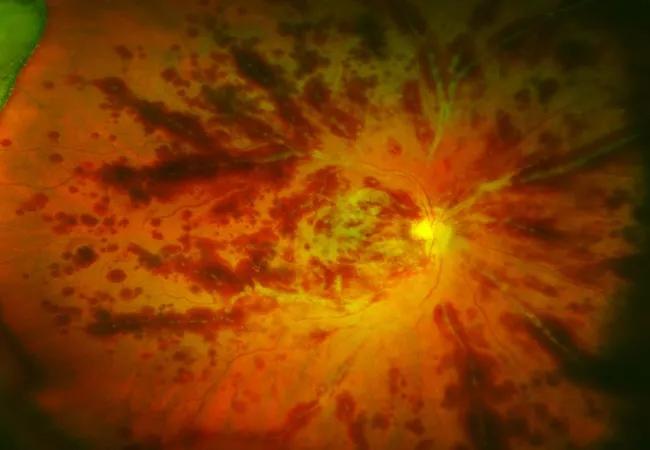
Image content: This image is available to view online.
View image online (https://assets.clevelandclinic.org/transform/d7b89e09-9dc7-4568-8a98-0989698cb05e/17-EYE-1335-Vancomycin-CQD_jpg)
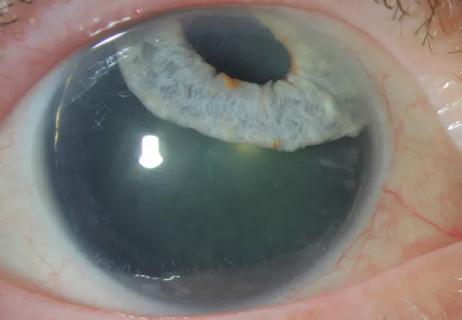
Wide view fundus photo of a right eye showing hemorrhagic occlusive retinal vasculitis (HORV). Despite treatment, this patient never regained vision beyond hand motion.
Advertisement
Cleveland Clinic is a non-profit academic medical center. Advertising on our site helps support our mission. We do not endorse non-Cleveland Clinic products or services. Policy
The U.S. Food and Drug Administration has issued a compounding risk warning against intraocular injections of vancomycin either alone or in combination with other drugs, after a new case of hemorrhagic occlusive retinal vasculitis (HORV) was reported.
The issue is complex, says Cleveland Clinic Cole Eye Institute cataracts specialist Jack Shao, MD, who notes that HORV is a rare condition, but can cause blindness.
“We have been aware of intraocular vancomycin’s risks since 2015 when HORV cases were first reported in association with cataract surgery,” Dr. Shao reports. “By 2016, many subspecialty groups assessed risks and benefits of the drug and warned physicians to avoid its use, and most ophthalmologists have reduced or stopped using intraocular vancomycin as prophylaxis.” All intraocular vancomycin is compounded by pharmacies, which are not FDA regulated.
However, some ophthalmologists do continue using intraocular vancomycin to prevent postoperative endophthalmitis, itself a feared and devastating, sight-threatening complication. These surgeons may consider vancomycin both effective and cost effective in preventing endophthalmitis, and find it more readily available than other agents.
Considering how dangerous HORV is, Dr. Shao and his Cleveland Clinic colleagues stopped using intraocular vancomycin for prophylaxis after cataracts surgery in 2016. Instead they use other intraocular antibiotics, including cefuroxime (a second-generation cephalosporin) or moxifloxacin (a fourth-generation fluoroquinolone).
Advertisement
“HORV is devastating, and rarely do patients recover good vision after this disease,” Dr. Shao notes. To prevent HORV and its devastating effects, he recommends:
“HORV is so rare that many of us will never see a case in our entire careers,” Dr. Shao notes. “But it is so serious that we must maintain a high level of suspicion, and if we do have suspicion, especially at the one-week mark, perform a full dilated exam.”
Advertisement
Advertisement
Early data shows risk is 73% higher in patients with lupus, 40% higher in patients with rheumatoid arthritis

Identifies weak spots in the cornea before shape change occurs
Study highlights the value of quantitative ultra-widefield angiography
Switching medications may decrease treatment burden and macular fluid

Interventions abound for active and stable phases of TED

Corneal imaging and interpretation play a major role
Cole Eye Institute imaging specialists are equal parts technician, artist and diagnostician

Effect of low-dose atropine and dual-focus contact lenses is unknown in patients with comorbid eye conditions
 Search