Locations:





How EMR integration of ‘6 Clicks’ tool can help transform rehab care
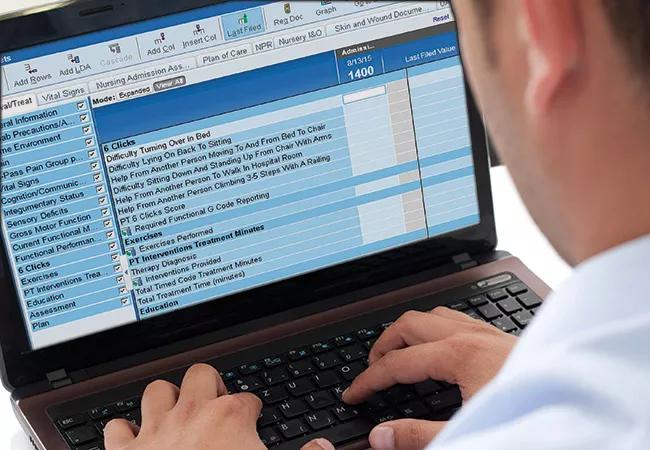
Image content: This image is available to view online.
View image online (https://assets.clevelandclinic.org/transform/ecfa117d-2b9a-457e-a76b-706ef0a36757/stilphen-650x450_jpg)
How EMR integration of ‘6 Clicks’ tool can help transform rehab care
By Mary Stilphen, PT, DPT
Advertisement
Cleveland Clinic is a non-profit academic medical center. Advertising on our site helps support our mission. We do not endorse non-Cleveland Clinic products or services. Policy
As part of its ongoing efforts to reduce healthcare costs and improve the quality of patient care, Cleveland Clinic has established the Clinical Transformation initiative, led by Chief Clinical Transformation Officer Michael Modic, MD.
The initiative’s intent is to develop and execute a system of integrated, highly coordinated, value-based treatment whose components include:
Dr. Modic has drawn the theoretical model for this transformative process from his experience as Chairman of Cleveland Clinic’s Neurological Institute and his oversight of its Department of Physical Medicine and Rehabilitation.
This theoretical model is meant to change the healthcare system’s focus from treating illness to restoring and sustaining health. That will require incorporation of the biopsychosocial model of medicine, which stresses a broadened, holistic conception of health defined by a patient’s physical, mental and sociological status. Rehabilitation is a vital component of the care transformation process.
Cleveland Clinic’s enterprisewide approach involves the precise tracking, collation and analysis of physical, psychological and cognitive functioning and environmental vectors that affect a person’s health. The ultimate goal is creation of a comprehensive, digitally captured patient phenotype that allows us to better understand the complex factors affecting health and to direct resources accordingly.
Advertisement
A recent but valuable addition to this growing data set is the 6 Clicks tool, a pair of electronic questionnaires administered by Cleveland Clinic physical therapists and occupational therapists to measure the functional status of patients in the acute care hospital. The tool is a short-form version of Boston University’s Activity Measure for Post- Acute Care™, developed and validated at Cleveland Clinic.
Hospitals are adept at measuring burden of illness with case mix index, but physical function is what drives the provision of most post-acute services.
Since its inception in 2011, 6 Clicks has been used to assess nearly 600,000 patients. It is a functional measurement tool designed for the hospital. It helps determine appropriate referrals for physical and/or occupational therapy, aids in discharge planning and improves allocation of treatment resources and personnel in the acute care hospital.
The 6 Clicks tool standardizes the assessment of hospitalized patients’ mobility and self-care abilities. Hospital patients in need of formal post-discharge care are scored on the following functional areas:
Basic mobility:
Daily activities:
In April 2015, we completed an enormous project that brought together Cleveland Clinic information technology experts and rehabilitation leaders with the goal of full integration of our 6 Clicks rehabilitation outcomes platforms into the enterprisewide electronic medical record (EMR).
Advertisement
To illustrate the order of magnitude of this effort, the 6 Clicks tool measuring a patient’s physical capabilities is but one of a dozen discrete biopsychosocial elements culled from the EMR. Just one of those elements involves data analysis of hundreds of patients and millions of data points.
The response to the biopsychosocial element/EMR integration from treating physicians and rehabilitation professionals has been overwhelmingly positive. Before long, physicians will be able to assess, at a glance, the variety of factors (e.g., family support, physical function, mood, financial resources) that truly determine health outcomes.
The result is that our providers are able to minimize the time they must spend typing and retrieving information from the computer and maximize their time interacting with patients. They can measure and manage the provision of rehab services from the emergency department through the acute care hospital and into every post-acute setting.
Ms. Stilphen is Senior Director, Rehabilitation Services, in the Department of Physical Medicine and Rehabilitation in Cleveland Clinic’s Neurological Institute.
Advertisement
Advertisement

New study advances understanding of patient-defined goals
Testing options and therapies are expanding for this poorly understood sleep disorder
Real-world claims data and tissue culture studies set the stage for randomized clinical testing
Digital subtraction angiography remains central to assessment of ‘benign’ PMSAH

Cleveland Clinic neuromuscular specialist shares insights on AI in his field and beyond
Findings challenge dogma that microglia are exclusively destructive regardless of location in brain
Neurology is especially well positioned for opportunities to enhance clinical care and medical training
New review distills insights from studies over the past decade
 Search