Locations:





Register now for the Sept. 11-12 CME event in Cleveland
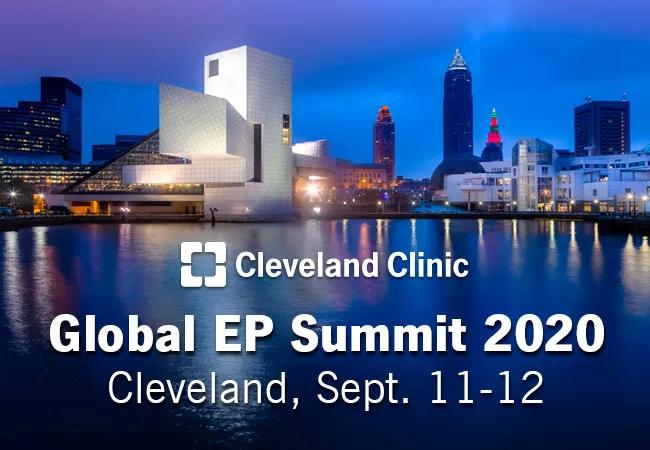
Image content: This image is available to view online.
View image online (https://assets.clevelandclinic.org/transform/041ff70d-e08b-4084-b322-99562048a467/20-HVI-1869561-CQD-2_jpg)
20-HVI-1869561-CQD-2
Electrophysiologists from across the U.S. and around the world will converge in Cleveland on Sept. 11-12, 2020, for a comprehensive review of the latest in electrophysiology (EP). Global EP Summit 2020, developed and directed by Cleveland Clinic, will be co-sponsored by the Heart Rhythm Society and held at the Hilton Cleveland Downtown.
Advertisement
Cleveland Clinic is a non-profit academic medical center. Advertising on our site helps support our mission. We do not endorse non-Cleveland Clinic products or services. Policy
“Like last year’s inaugural offering of this summit, this year’s event will connect cardiac electrophysiologists and allied health specialists who are eager to discuss EP research and what’s on the horizon for EP practice,” says course co-director Walid Saliba, MD, Director of Cleveland Clinic’s Electrophysiology Lab. “We want to bring together EP experts not just to discuss the newest developments, but to drive innovation and collaboration in our field worldwide.”
The CME-certified course boasts a prestigious international faculty, including 25 members of Cleveland Clinic’s Miller Family Heart, Vascular & Thoracic Institute. Guest faculty hail from leading medical centers across the U.S. as well as Canada, Croatia, France and Germany.
Over a day and a half (a full Friday plus Saturday morning), participants will attend sessions on:
There will be ample time for open discussion at the end of each session, and Friday’s agenda ends with a networking reception.
“Not only will participants learn the latest in ambulatory recording methods, catheter ablation procedures and stroke-prevention therapies, they will learn how to best appraise His-bundle pacing options and cardiac devices such as leadless pacemakers, subcutaneous ICDs and wearable defibrillators,” says course co-director Oussama Wazni, MD, MBA, Section Head of Electrophysiology at Cleveland Clinic.
Advertisement
“Everyone will leave with new information, guidance and tips they can use immediately in their practice,” Dr. Wazni adds. “This course should provide a valuable opportunity to stay current in light of the need to cancel some major society meetings earlier this year.”
In addition to providing a fresh take on EP fundamentals, presentations will offer innovative insights. Among the notable forward-looking segments:
“At the end of the Friday session, we will host a roundtable discussion on the future of EP, featuring faculty from Cleveland Clinic and many other leading U.S. centers, along with active audience participation,” says course co-director Khaldoun Tarakji, MD, MPH, Associate Section Head of Cardiac Electrophysiology at Cleveland Clinic.
And, reprising a favorite session from 2019, summit faculty and Cleveland Clinic fellows will educate and entertain attendees with a 90-minute “Physiology Made Fun with Cases” segment on Saturday morning.
The summit concludes on Saturday with a non-CME lunch session on novel, up-and-coming EP technology.
For more details and registration, visit ccfcme.org/globalep2020. Early-bird pricing ends Aug. 4.
This activity has been approved for AMA PRA Category 1 Credit™.
Advertisement
Advertisement
A sampling of outcome and volume data from our Heart & Vascular Institute
Concomitant AF ablation and LAA occlusion strongly endorsed during elective heart surgery
Large retrospective study supports its addition to BAV repair toolbox at expert centers
Young age, solid tumor, high uptake on PET and KRAS mutation signal risk, suggest need for lobectomy
Surprise findings argue for caution about testosterone use in men at risk for fracture
Residual AR related to severe preoperative AR increases risk of progression, need for reoperation

Findings support emphasis on markers of frailty related to, but not dependent on, age
Provides option for patients previously deemed anatomically unsuitable
 Search