Locations:





Novel program including in-bed cycling and cognitive exercises starts a day after aneurysm repair
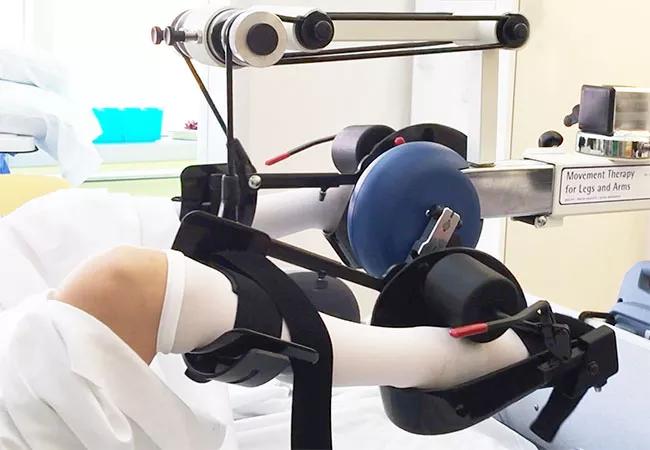
Image content: This image is available to view online.
View image online (https://assets.clevelandclinic.org/transform/0ab9af94-e8cd-4ec8-bb7b-976d4a052ed8/650x450-Early-Rehab-After-Aneurysmal-Subarachnoid-Hemorrhage_jpg)
650×450-Early-Rehab-After-Aneurysmal-Subarachnoid-Hemorrhage
Starting patients with aneurysmal subarachnoid hemorrhage (aSAH) on a comprehensive rehabilitation program the day after vessel repair was found to be safe and lead to multiple improved outcomes, according to a Cleveland Clinic pilot study being presented at the 2019 International Stroke Conference in Honolulu. Benefits included shorter length of neurologic ICU stay and better cognitive outcomes compared with control patients receiving standard care.
Advertisement
Cleveland Clinic is a non-profit academic medical center. Advertising on our site helps support our mission. We do not endorse non-Cleveland Clinic products or services. Policy
“Although early rehabilitation following ischemic stroke has recently become a major area of study, the same concept is more groundbreaking in the setting of aneurysmal subarachnoid hemorrhage,” says study leader Pravin George, DO, a neurocritical care specialist in Cleveland Clinic’s Cerebrovascular Center. “Our findings support growing evidence that early rehabilitation for these potentially devastating events can also be done safely and yield better outcomes.”
Patients with aSAH are traditionally placed on complete bed rest in a darkened, quiet room following aneurysm repair out of fear of hampering cerebral perfusion by being upright, re-rupturing the vessel from activity, dislodging cerebral drainage catheters or provoking cerebral vessel vasospasm. Vasospasm is the most feared complication of aSAH, as it often triggers stroke. But recent evidence has shown that mobilization may actually help reduce vasospasm, and inactivity is well known to degrade multiple body systems.
Dr. George’s study prospectively enrolled 20 patients who underwent endovascular embolization or surgical clipping to treat aSAH. Patients were randomized to either early rehabilitation or standard care. The rehabilitation program started the day after aneurysm repair and involved:
Advertisement
Trial outcomes included the following:
“It was surprising to find some of these dramatic differences in such a small study,” says Dr. George. “We were especially gratified to see the cognitive benefits, as cognitive impairment is frequently a major issue after a brain aneurysm and often severely impacts quality of life.”
Several other positive trends were observed in the early rehab group that did not reach statistical significance. Vasospasm occurred in just 1 of 10 patients in the early rehab group versus 5 of 10 patients in the control group. Occurrences of urinary tract infection and deep venous thrombosis (DVT) were also lower in the early rehab group. Dr. George notes that a study in a larger sample size is needed to determine if these trends prove to be significant.
The risk of DVT is especially high in patients with recent aSAH because of their prolonged immobility with standard care and the fear that using prophylactic medications could provoke cerebral bleeding. Showing that early exercise lowers DVT risk would be another especially important benefit, Dr. George says.
Advertisement
His group is now pursuing funding for a larger study with a similar design. In addition to randomizing patients with aSAH to either an early rehabilitation program or standard care following aneurysm repair, the new study proposes including EEG and transcranial Doppler monitoring during cycle ergometry to characterize cerebral blood flow during exercise and to assess vasospasm risk. They expect to enroll about 40 patients in each arm over three years.
This work builds on pioneering Cleveland Clinic-led research in early mobilization of patients in the neurological ICU from several years ago. That research, reported in Critical Care Medicine (2015;43:865-873) and recapped on Consult QD, assessed 377 patients with a variety of neurological conditions treated in an early rehabilitation program and compared them with 260 matched patients before the program was implemented. They found that early mobilization was safe and feasible and led to shorter hospital stays.
Based on the current study results, Dr. George concludes that “identifying benefits of early rehabilitation for some of our most severe cases [those with an aSAH] provides theoretical support for continuously pushing innovative clinical strategies of enhanced mobilization and early rehabilitation for patients with a broad spectrum of acute brain injuries.”
He anticipates that the current study will be published shortly.
Advertisement
Advertisement

New study advances understanding of patient-defined goals

Testing options and therapies are expanding for this poorly understood sleep disorder

Real-world claims data and tissue culture studies set the stage for randomized clinical testing
Digital subtraction angiography remains central to assessment of ‘benign’ PMSAH

Cleveland Clinic neuromuscular specialist shares insights on AI in his field and beyond

Findings challenge dogma that microglia are exclusively destructive regardless of location in brain

Neurology is especially well positioned for opportunities to enhance clinical care and medical training
New review distills insights from studies over the past decade
 Search