Locations:





Early repair can be better for patients
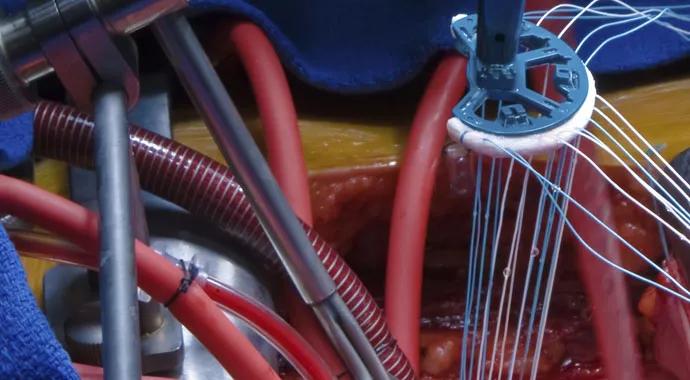
Image content: This image is available to view online.
View image online (https://assets.clevelandclinic.org/transform/84d66df3-dd1f-427b-8ad5-8604b5f9081a/MitralValve-690x380_jpg)
Early surgical repair of regurgitant mitral valves is safe, effective and can prevent symptoms from developing
Treating degenerative mitral valve (MV) disease earlier and with less-invasive techniques is more beneficial to patients than watchful waiting. So concludes a new analysis of more than 5,900 repair procedures for degenerative MV disease performed at Cleveland Clinic over 26 years. The study is published in the June 2015 Annals of Thoracic Surgery.
Advertisement
Cleveland Clinic is a non-profit academic medical center. Advertising on our site helps support our mission. We do not endorse non-Cleveland Clinic products or services. Policy
“An aggressive strategy is successful, safe and effective,” says Joseph Sabik III, MD, Chairman of Thoracic and Cardiovascular Surgery at Cleveland Clinic and the study’s corresponding author. “Less-invasive technology has enabled more patients to benefit from mitral valve repair before experiencing symptoms such as atrial fibrillation or heart failure.”
Dr. Sabik and colleagues reviewed the records of 5,902 patients who underwent MV repair for regurgitation at Cleveland Clinic from 1985 to 2011. They divided the study period into three segments — 1985 to 1997, 1997 to 2005, and 2005 to 2011 — and compared trends in patient characteristics, timing of intervention and surgical techniques.
They found that nearly twice as many patients treated from 2005 to 2011 were asymptomatic (NYHA Class I) compared with those treated from 1985 to 1997. Moreover, the patients from 2005 to 2011 were far less likely to have heart failure, atrial fibrillation or moderate or severe left ventricular dysfunction, suggesting a trend toward referral earlier in the disease course.
Additionally, the more recent patients were less likely to have comorbidities such as peripheral arterial disease, carotid disease, prior stroke or myocardial infarction, or chronic obstructive pulmonary disease.
Those treated in the later years were also discharged about two days sooner than those treated in the earlier years. This was attributed to fewer full sternotomies and increased use of less-invasive surgery.
Moreover, rates of in-hospital mortality and reoperation on the repaired valve were initially low and became progressively lower over time. Rates of residual regurgitation were minimal throughout the overall study period.
Advertisement
“We recommend that patients with severe mitral valve regurgitation undergo surgical evaluation, even if they have not developed symptoms,” says Dr. Sabik. “At this time, however, asymptomatic patients with severe regurgitation should be referred to high-volume centers of mitral repair such as Cleveland Clinic, where successful repair with no or minimal residual regurgitation and low mortality can be expected.”
In an invited commentary accompanying the study in Annals of Thoracic Surgery, James S. Gammie, MD, of the University of Maryland School of Medicine states that the study documents an important shift toward referral for MV repair earlier in the disease process, before the effects of mitral regurgitation compromise long-term outcomes.
“The authors’ institution is ahead of the national curve, where fewer than 10% (compared with 44% in this report) of referred patients are asymptomatic,” writes Dr. Gammie. He adds that the study serves as a “reminder that highly reliable and durable mitral repair is probably best achieved by surgeons with a dedicated subspecialization in mitral valve repair.”
Advertisement
Advertisement

A sampling of outcome and volume data from our Heart & Vascular Institute
Concomitant AF ablation and LAA occlusion strongly endorsed during elective heart surgery
Large retrospective study supports its addition to BAV repair toolbox at expert centers

Young age, solid tumor, high uptake on PET and KRAS mutation signal risk, suggest need for lobectomy
Surprise findings argue for caution about testosterone use in men at risk for fracture
Residual AR related to severe preoperative AR increases risk of progression, need for reoperation

Findings support emphasis on markers of frailty related to, but not dependent on, age
Provides option for patients previously deemed anatomically unsuitable
 Search