Locations:





Save the date — Oct. 19!
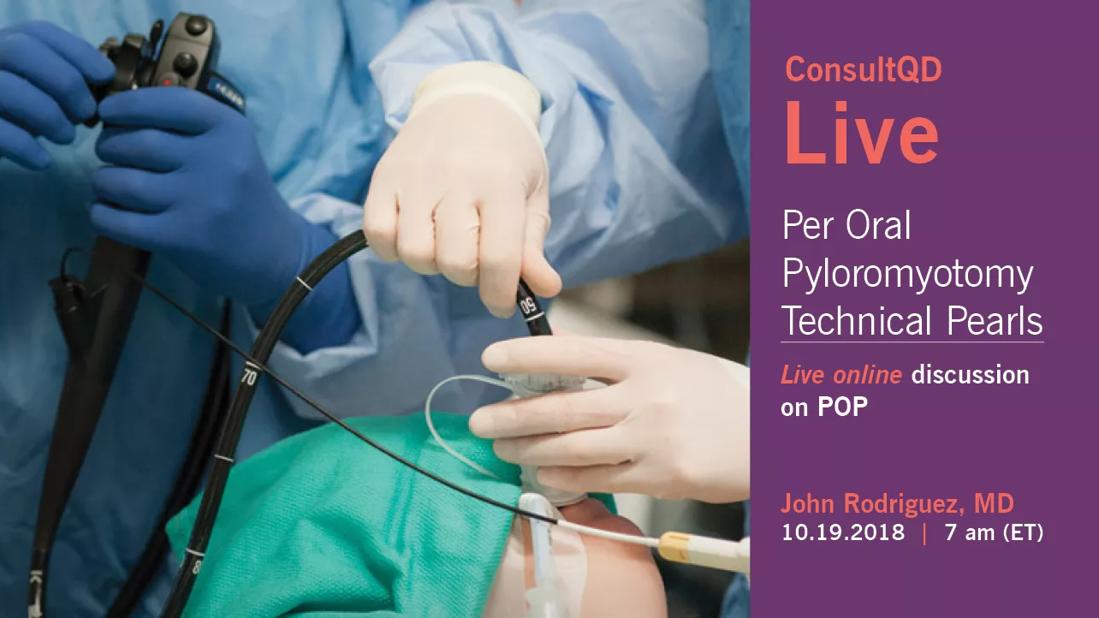
Image content: This image is available to view online.
View image online (https://assets.clevelandclinic.org/transform/80f72eee-dc95-478b-acf7-13ac82e766eb/18-DDI-5692-Oral-Pyloromyotomy-Consult-QD-Twitter-Post_jpg)
18-DDI-5692 Oral Pyloromyotomy Consult QD Twitter Post
On Friday, Oct. 19 at 7 a.m. (ET), John Rodriguez, MD, will host a live presentation on per oral pyloromyotomy (POP) – an innovative technique for treating gastroparesis.
Advertisement
Cleveland Clinic is a non-profit academic medical center. Advertising on our site helps support our mission. We do not endorse non-Cleveland Clinic products or services. Policy
Gastroparesis, a chronic condition that affects five million people nationwide, is painful for patients and challenging for physicians: Until recently, medical therapies were limited in their efficacy and associated with complications. “Gastroparesis is a difficult condition to treat because there is no cure and patients often have many coexisting conditions,” says Dr. Rodriguez, Director of Surgical Endoscopy, Advanced Laparoscopic and Bariatric Surgery at Cleveland Clinic. “And when it comes to surgery, no one treatment is considered the gold standard.”
POP is proving to be an effective endoscopic alternative to surgical pyloroplasty or pylormyotomy. Cleveland Clinic’s Digestive Disease & Surgery Institute has been early adopter and innovator in using this technique, moving the surgical site to the lesser curvature of the stomach and creating a shorter tunnel to the duodenum than conventional pyloroplasty or pylormyotomy. POP is less invasive and has a “shorter operative time and is easier to perform, with a lower risk of complications,” says Dr. Rodriguez. “This procedure has dramatically changed our practice at Cleveland Clinic, and has become our first-line treatment option for medically refractive gastroparesis in well-selected patients.”
Cleveland Clinic conducted a study of 100 gastroparesis patients treated with POP in 2016 and 2017. The study cohort was 85 percent female with a mean age of 45: 56 percent with idiopathic gastroparesis, 21 percent with diabetic gastroparesis, 19 percent with postsurgical gastroparesis and four percent with another cause. The majority of the patients (67 percent) had been treated with endoscopic or surgical interventions.
Advertisement
The POP procedure produced statistically significant objective and subjective improvements in gastroparesis symptoms at 12 weeks following treatment. The overall GCSI improved from a preoperative mean of 3.82 to 2.54. Among the patients with postoperative GES available, 78 percent had objectively better four-hour emptying with a mean improvement in retention by 23.6 percent. Ten patients did have complications, including one diagnostic laparoscopy and two cases of gastrointestinal bleeding. But overall, “the procedure is very safe,” says Dr. Rodriguez, “and there were no procedure-related adverse events, including gastric or duodenal ulcer, intraluminal hemorrhage or gastric dumping syndrome.”
The Oct. 19 presentation will include a video of a POP procedure and a live Q&A session. Dr. Rodriguez will provide a detailed, step-by-step explanation of the procedure and answer questions so that participants will be able to incorporate POP into their practice.
The case presented will be a 37-year-old woman diagnosed in 2013 with medical refractory gastroparesis. Medical therapy has been ineffective and she has lost 30 pounds since her disease onset; her difficulty with oral intake is so severe that she has been going every week to the emergency room for hydration. Her gastroparesis cardinal symptom index is 35 (maximum is 45).
After an evaluation that included an upper endoscopy which revealed normal anatomy, a gastric emptying study and a wireless motility capsule and a discussion of treatment options, we agreed with the patient that POP was the next best step in her management.
Advertisement
Register for the event and submit questions in advance.
Cleveland Clinic will be offering a continuing series of live educational presentations on new developments in medical practice. Watch this space for more information.
Advertisement
Advertisement

Strong patient communication can help clinicians choose the best treatment option
ctDNA should be incorporated into care to help stratify risk pre-operatively and for post-operative surveillance

The importance of raising awareness and taking steps to mitigate these occurrences
New research indicates feasibility and helps identify which patients could benefit
Treating a patient after a complicated hernia repair led to surgical complications and chronic pain
Standardized and collaborative care improves liver transplantations
Fewer incisions and more control for surgeons

Caregiver collaboration and patient education remain critical
 Search