Locations:





A three-step plan aimed at strengthening the institute’s infrastructure includes a renewed focus on mentorship
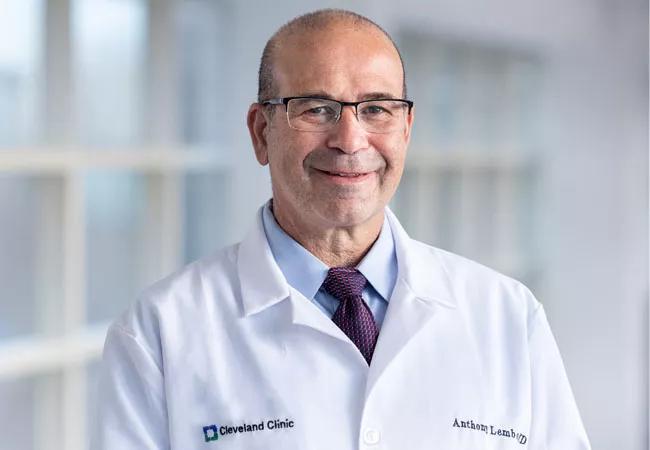
Image content: This image is available to view online.
View image online (https://assets.clevelandclinic.org/transform/8a9d159d-b592-4df0-99a8-c63f6213fb3a/Lembo-650x450-1_jpg)
DDI 774058 Viars 04-05-23
Anthony Lembo, MD, has been named Director of Research for Cleveland Clinic’s Digestive Disease & Surgery Institute. Dr. Lembo will work to create a state-of-the-art research center with the goal of elevating it to a global leader in clinical and translational research. He joins Cleveland Clinic after acting in a similar role, Professor of Medicine and Director of Clinical Research, at Harvard Medical School’s Beth Israel Deaconess Medical Center (BIDMC).
Advertisement
Cleveland Clinic is a non-profit academic medical center. Advertising on our site helps support our mission. We do not endorse non-Cleveland Clinic products or services. Policy
Dr. Lembo earned his medical degree from Tufts University School of Medicine and completed his residency at the University of California, Los Angeles Medical Center. His research interests focus on management and treatment options for irritable bowel syndrome and chronic constipation, and he also studies the placebo response. He has been published in several journals and has been named to several national and international leadership positions.
In his new role, Dr. Lembo plans on focusing on three major steps: 1) Create infrastructure to improve efficiency, quality and productivity in all aspects and phases of clinical trials; 2) Integrate more fully with Lerner Research Institute to increase translational research; and 3) establish educational and mentorship research programs.
“One of the aspects of research I would like to bring a renewed focus on is the Phase I period of our trials,” he says. “There is a real opportunity to get involved with more Phase I trials. Certainly, the later phases of trials are exciting, but Phase I is where we get into the nuts and bolts of whether a drug treatment works.” Dr. Lembo notes that many Phase I trials are done in private facilities, but there is a renewed interest to go back to academic centers where many more resources are available. He believes Cleveland Clinic is well-positioned for this as an attractive institution with its wealth of available assets.
Another priority is incorporating other Cleveland Clinic institutes, like Lerner Research Institute, into the research process. The reasons for this are two-fold. “Not only can we increase patient enrollment by collaborating with the other institutes, but we can also increase patient diversity,” explains Dr. Lembo. “As researchers are considering sites, patient diversity is now becoming a major aspect of the decision process. We don’t want studies that are made up of 98% Caucasians — that’s not representative of the U.S., and there is a desire to choose sites that are representative of the population as a whole. This doesn’t just mean the types of patients, but it’s also the disease states and the broader population as a whole. So Cleveland Clinic, with its institutes and global presence, can really act as a type of one-stop shop for people.”
Advertisement
One of Dr. Lembo’s other interests is to create and expand mentorship programs at the Digestive Disease & Surgery Institute. He believes mentoring has a positive impact on productivity, promotion and retention and career satisfaction. “The benefits are not just exclusive to the mentee though — mentors also gain from these relationships,” says Dr. Lembo.
While his resume and accomplishments are extensive, he says that the work he is most proud of is his work with mentees. “When I think about what’s important to me in regard to legacy, I wouldn’t point to any of the papers I’ve published,” he says. “Rather what I’m most proud of is the people I’ve helped train over the years and seeing their accomplishments and how they’re building their own legacy. I’ve had several mentors who have provided guidance and advice to me throughout my career, and I hope I can provide the same level of assistance to my mentees that I was afforded.”
To help build these programs, Dr. Lembo plans to create a network of mentors within the institute with a wide range of expertise and backgrounds. Each fellow and new faculty member would be connected to one or more mentors in their area of interest. Additionally, he would like to create a program for mentors to help train them so that they’re able to provide their mentees with appropriate guidance. In addition to the training program, he believes it’s also important to create advisory committees in each mentee’s field for further advice and input. On the mentee side, he plans to create an education program in clinical research for fellows and new staff.
Advertisement
“Cleveland Clinic is one of the most respected institutions in the world, so it’s a great opportunity to work in such a highly collaborative environment,” says Dr. Lembo. “The resources here are unparalleled, and I’m excited to continue the kind of work that I was doing in Boston on a much bigger scale. My goal has always been to help impact careers and increase research in ways to better help our patients, and that’s something I’m excited about accomplishing here.”
Advertisement
Advertisement

Strong patient communication can help clinicians choose the best treatment option
ctDNA should be incorporated into care to help stratify risk pre-operatively and for post-operative surveillance

The importance of raising awareness and taking steps to mitigate these occurrences
New research indicates feasibility and helps identify which patients could benefit
Treating a patient after a complicated hernia repair led to surgical complications and chronic pain
Standardized and collaborative care improves liver transplantations
Fewer incisions and more control for surgeons

Caregiver collaboration and patient education remain critical
 Search