Locations:





At four months, progressive functional improvements haven't plateaued
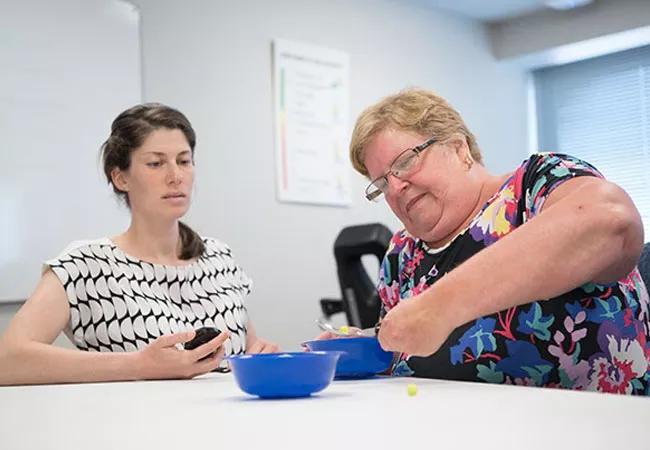
Image content: This image is available to view online.
View image online (https://assets.clevelandclinic.org/transform/676147bd-b703-41ff-9b30-4cf9003e1e02/17-NEU-4061-Machado-650x450_jpg)
17-NEU-4061-Machado-650×450
The first patient to ever undergo deep brain stimulation (DBS) to restore motor function following hemiparesis after ischemic stroke has experienced strong and steady functional improvements in the first four months of management pairing DBS with rehabilitative therapy.
Advertisement
Cleveland Clinic is a non-profit academic medical center. Advertising on our site helps support our mission. We do not endorse non-Cleveland Clinic products or services. Policy
That’s the word from Cleveland Clinic neurosurgeon Andre Machado, MD, PhD, who is overseeing the patient’s care after surgically implanting a DBS electrode in her cerebellum in a milestone operation at Cleveland Clinic in December 2016, as detailed here.
“Within a few weeks of when the DBS device was turned on earlier this year, the patient reported she could move her affected arm in ways she had not been able to since her stroke,” says Dr. Machado, Chairman of Cleveland Clinic’s Neurological Institute. “And her progress has been steady — week after week, month after month, her function continues to improve. The improvement has been more than we expected.”
The patient is the first in an FDA-approved, first-in-human clinical trial of DBS for stroke recovery being conducted at Cleveland Clinic with funding support from the National Institutes of Health’s Brain Research through Advancing Innovative Neurotechnologies (BRAIN) initiative.
The researchers, led by Dr. Machado and neuroscientist Kenneth Baker, PhD, plan to ultimately enroll 12 patients in the study. A second enrollee has undergone surgery for DBS electrode implantation but has not yet completed initial physical rehabilitative therapy with stimulation turned on.
Candidates for the trial are patients who have persistent, severe residual hemiparesis from an ischemic stroke 12 to 24 months earlier in spite of rehabilitative therapy. “These are patients with chronic stroke who have failed to improve significantly after training with physical and occupational therapy,” says Dr. Machado. “So if we see a significant effect after the DBS surgery, we have reason to believe it’s the effect of the DBS plus rehabilitative therapy rather than of therapy alone. That’s the hypothesis of our trial — that DBS targeting the dentate nucleus of the cerebellum can allow these patients to regain more function from therapy than they could with therapy alone.”
Advertisement
The first patient has now completed the trial’s initial protocol, as follows (“therapy” below refers to two 90-minute sessions of combined physical and occupation therapy each week):
The protocol also calls for one month of slowly weaning off the DBS device, which the first patient has not yet done.
The therapy regimen used focuses on repetitive task practice and is the gold standard for upper extremity rehabilitation, says Anson Rosenfeldt, PT, DPT, one of two therapists working with patients in the trial. “Our protocol calls for patients to repeat an activity 70 to 100 times in one session,” she notes. “We’re really pushing the number of repetitions and challenging patients to move their arm and hand in different ways.”
The biggest difference from therapy regimens used for other patients with hemiplegia from stroke is that compensation from the unaffected side is strictly discouraged. “We want to challenge the patient’s brain in new ways to promote lasting change,” says Rosenfeldt, who is shown with the patient in the photo at the top of this post.
Advertisement
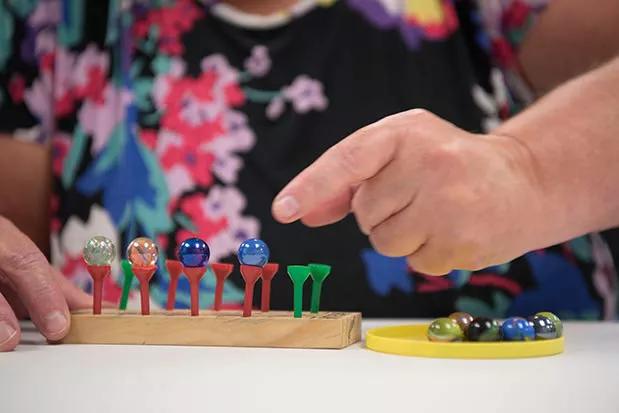
Image content: This image is available to view online.
View image online (https://assets.clevelandclinic.org/transform/78e02339-2866-42f6-9212-c2ca5c32a614/17-NEU-4061-Machado-inset_jpg)
Here the patient performs one of the many tasks she was unable to do with her affected arm prior to DBS and physical training.
For the trial’s first patient, those efforts are paying off. In addition to progressive improvements in her scores on a multitude of objective tests of arm and hand function, the patient reports that she is now able to use her affected hand while cooking and to play games with her grandchildren. She also performs a host of daily tasks more efficiently, such as folding laundry.
“After four months of DBS plus therapy, this patient’s function has not plateaued,” says Dr. Machado. “We haven’t yet found the limits of how much she can improve. This makes us hopeful that this strategy will help other patients too.”
As a result of this continuing progress, the team is revising its study design to allow patients an opportunity to continue concurrent stimulation and therapy longer than the initially planned four-month window.
“Many questions remain,” Dr. Machado notes, including whether ongoing stimulation is needed to preserve functional improvements or if patients may maintain improvements gained after a limited period of stimulation and physical training. “We look forward to learning much more as this trial continues.”
One thing that’s certain is that more options are needed for this population. “About half of chronic stroke patients have a residual neurological deficit severe enough to require assistance with their ADLs, even after weeks of physical and occupational therapy,” Dr. Machado observes. “We need a tool that enhances the effects of therapy alone. This first patient gives us hope that help may be on the way.”
Advertisement
Advertisement
New study advances understanding of patient-defined goals
Testing options and therapies are expanding for this poorly understood sleep disorder
Real-world claims data and tissue culture studies set the stage for randomized clinical testing
Digital subtraction angiography remains central to assessment of ‘benign’ PMSAH

Cleveland Clinic neuromuscular specialist shares insights on AI in his field and beyond
Findings challenge dogma that microglia are exclusively destructive regardless of location in brain
Neurology is especially well positioned for opportunities to enhance clinical care and medical training
New review distills insights from studies over the past decade
 Search