Locations:





New director to lead multidisciplinary team
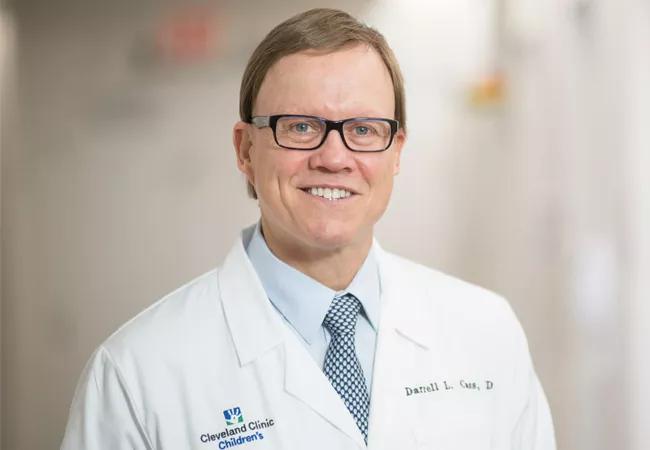
Image content: This image is available to view online.
View image online (https://assets.clevelandclinic.org/transform/125d46bb-daa3-4b09-877d-99ace31056a9/17-DDI-4175-Dr-Cass-CQD_jpg)
17-DDI-4175-Dr-Cass-CQD
After founding and then directing the Fetal Center at Texas Children’s Hospital for 16 years, Darrell Cass, MD, joined Cleveland Clinic in October 2017. His mission: to establish Cleveland Clinic as a global leader in fetal surgery and provide a blueprint for future sites within the network.
Advertisement
Cleveland Clinic is a non-profit academic medical center. Advertising on our site helps support our mission. We do not endorse non-Cleveland Clinic products or services. Policy
Here, Dr. Cass answers questions about this calling, the expertise he brings to the task and how he foresees the center developing.
Q: Dr. Cass, what drew you to Cleveland Clinic?
A: My attraction to Cleveland Clinic is natural! It is a leading global healthcare institution, with an international reputation for excellence in many adult specialties and surgical programs. It seemed like an amazing opportunity to come here to help develop a full-service fetal health program that could build on these exceptional programs.
Q: What are the most significant advances in fetal surgery that you have pioneered or advanced and will bring to Cleveland Clinic?
A: While working in Houston, I had opportunity to work with a team that helped advance the care of fetuses with fetal lung malformations (often called CCAM), sacrococcygeal teratomas, congenital diaphragm hernia, and other anomalies. With advances in imaging capabilities we learned to risk-stratify fetuses with these disorders to better determine when intervention is needed. Now, with carefully timed and expert operations, a fetus that would have died can be saved and expected to develop normally. I am one of just a few surgeons in the world to have performed successful fetal surgery for giant lung malformations, or teratomata, and I am hopeful we can develop those programs here as well.
In Houston, we also advanced the North American experience in the fetal treatment for diaphragmatic hernia using fetal endoscopic tracheal occlusion (FETO) — tracheal balloon placement to enhance fetal lung development — something I want to bring to Cleveland Clinic.
Advertisement
We will also be performing in utero interventions for myelomeningocele (spina bifida), which will significantly reduce some of the disability these children face. In the past two decades, these interventions have gone from experimental to now being the standard of care.
I have also helped to advance use of the ex-utero intrapartum treatment (EXIT) procedure to manage fetuses with airway obstruction or large lung malformations to help stabilize them during their transition from fetal to neonatal life. These are tricky but effective procedures which are performed to optimize outcomes for fetuses with rare malformations.
Q: What changes in the field do you see on the horizon and what role will Cleveland Clinic play in bringing these to the OR?
A: I foresee that we will be able to replace many open fetal surgery procedures with less invasive approaches. For example, right now, fetoscopic surgery to repair myelomeningocele is in the experimental stages, but I believe leveraging Cleveland Clinic’s outstanding expertise in minimally invasive surgery and robotics will enable us to achieve mastery with these approaches.
Q: Would you describe the core members of the fetal health team at Cleveland Clinic and how you will develop the program?
A: What’s really cool is that our program will involve so many different disciplines working together as a team, including those in maternal fetal medicine, cardiology and radiology, among others. We will bring in a few new physicians with particular expertise that enhance our capabilities, but our primary focus is to train our existing staff to perform successful interventions.
Advertisement
I’m very excited to be at Cleveland Clinic. There is a baseline humility here among the specialists — humble giants who do great things but are also down to earth. I want to learn from them and leverage their talents to build a world-class international program.
Advertisement
Advertisement

Strong patient communication can help clinicians choose the best treatment option
ctDNA should be incorporated into care to help stratify risk pre-operatively and for post-operative surveillance

The importance of raising awareness and taking steps to mitigate these occurrences
New research indicates feasibility and helps identify which patients could benefit
Treating a patient after a complicated hernia repair led to surgical complications and chronic pain
Standardized and collaborative care improves liver transplantations
Fewer incisions and more control for surgeons

Caregiver collaboration and patient education remain critical
 Search