Locations:





STOP AF First trial finds pulmonary vein isolation compares favorably to antiarrhythmic drugs
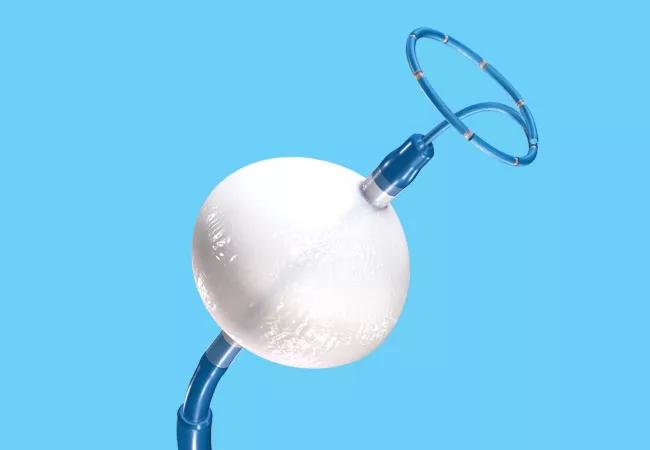
Image content: This image is available to view online.
View image online (https://assets.clevelandclinic.org/transform/b6ef667b-531e-4294-b75a-c2bca7585d5d/20-HVI-1951031_cryoballoon-ablation-device_650x450_jpg)
20-HVI-1951031_cryoballoon-ablation-device_650x450
Initially treating symptomatic paroxysmal atrial fibrillation (AF) with cryoballoon ablation to isolate the pulmonary vein is more effective in maintaining freedom from arrhythmias than antiarrhythmic drug therapy and entails a low risk of complications.
Advertisement
Cleveland Clinic is a non-profit academic medical center. Advertising on our site helps support our mission. We do not endorse non-Cleveland Clinic products or services. Policy
So conclude multicenter investigators with the randomized controlled STOP AF First trial (NCT03118518), whose primary results were presented August 29 as a late-breaking clinical trial at the virtual European Society of Cardiology Congress 2020. [Editor’s note: The study was since published in full in the New England Journal of Medicine: nejm.org/doi/full/10.1056/NEJMoa2029554.]
“Improvements in the safety and efficacy of cryoballoon catheter ablation in recent years have increased interest in this therapy for atrial fibrillation,” says the study’s national principal investigator, Oussama Wazni, MD, Section Head of Cardiac Electrophysiology and Pacing at Cleveland Clinic, who presented the findings. “This multicenter trial provides good evidence that it is a reasonable first-line option.”
Cryoballoon catheter ablation is FDA-approved for treating drug-refractory recurrent, symptomatic paroxysmal and persistent atrial fibrillation. While good evidence exists for the role of catheter ablation as a second-line treatment, few randomized controlled trials have evaluated it — particularly cryoballoon catheter ablation — as first-line therapy. Initial trials of radiofrequency catheter ablation have found that it confers a modest benefit compared with antiarrhythmic drug therapy.
“More effective treatment is an ongoing imperative, since atrial fibrillation becomes harder to control as it progresses and late disease is associated with worse outcomes,” notes Dr. Wazni. “Earlier intervention with catheter ablation may improve long-term efficacy and prevent disease progression.”
Advertisement
The prospective STOP AF First trial was conducted at 24 U.S. sites with 203 patients included in the final analysis, all of whom had been randomized to pulmonary vein isolation with cryoballoon ablation (n = 104) or to antiarrhythmic drug (AAD) therapy (n = 99). All subjects had symptomatic paroxysmal AF and were drug-naïve (i.e., < 7 days on an AAD).
Monitoring was with 12-lead ECG at baseline and at one, three, six and 12 months. Subjects also underwent 24-hour continuous ambulatory ECG monitoring at six and 12 months, along with patient-activated transtelephonic ECG monitoring weekly and when symptomatic, starting at month 3.
Efficacy. The primary efficacy endpoint was treatment success at 12 months. Treatment failure was defined as any of the following:
Freedom from primary efficacy failure at 12 months was achieved by 75% of patients (95% CI, 65% to 82%) in the cryoballoon ablation group versus 45% of patients (95% CI, 35% to 55%) in the AAD group (P < 0.0001 for the difference).
The following primary efficacy failures occurred in the cryoballoon ablation group (in 26 of 104 patients):
Advertisement
The following primary efficacy failures occurred in the AAD group (in 51 of 99 patients):
Safety. The primary safety endpoint for cryoballoon ablation was a composite of prespecified procedure- and system-related serious adverse events, with a prespecified performance goal of less than 12% incidence.
Only two patients (1.9%; P < 0.0001 compared with the prespecified performance goal) in the cryoballoon ablation arm had a serious adverse event: one developed a significant pericardial effusion within 30 days, and one had a myocardial infarction within seven days. Additionally, a patient in the AAD arm had a major vascular complication following a cryoballoon ablation.
According to Dr. Wazni, this prospective randomized trial provides good evidence to support cryoballoon ablation for pulmonary vein isolation as initial therapy for paroxysmal symptomatic AF.
“Our study found that this catheter intervention is safe and effective for symptomatic paroxysmal atrial fibrillation, without the requirement that patients be drug-refractory,” he concludes. “If approved for first-line use, it could provide an important therapy option in this setting.”
The STOP AF First trial was funded by Medtronic.
Image at top courtesy of Medtronic
Advertisement
Advertisement
A sampling of outcome and volume data from our Heart & Vascular Institute
Concomitant AF ablation and LAA occlusion strongly endorsed during elective heart surgery
Large retrospective study supports its addition to BAV repair toolbox at expert centers
Young age, solid tumor, high uptake on PET and KRAS mutation signal risk, suggest need for lobectomy
Surprise findings argue for caution about testosterone use in men at risk for fracture
Residual AR related to severe preoperative AR increases risk of progression, need for reoperation

Findings support emphasis on markers of frailty related to, but not dependent on, age
Provides option for patients previously deemed anatomically unsuitable
 Search