Locations:





Tiered supply cart saves time and reduces waste
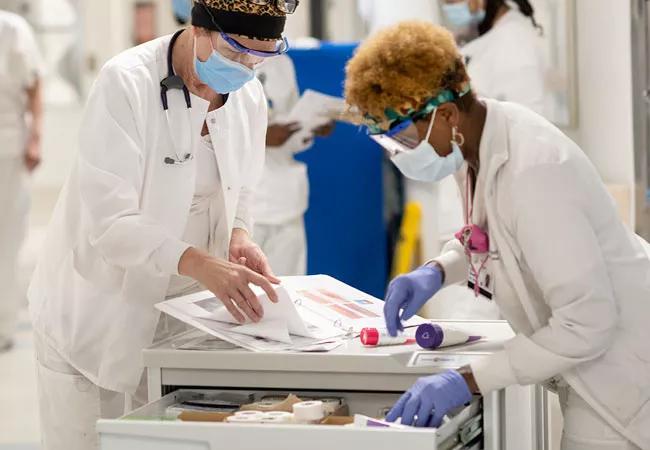
Image content: This image is available to view online.
View image online (https://assets.clevelandclinic.org/transform/3498e1c1-9c08-486b-909a-1f9da3b31dfb/21-NUR-2113624-Unit-basedCouncilEuclid-woundCart-CQD_650x450_jpg)
medical-surgical wound cart
Medical supply waste plagues the U.S. healthcare system. Hospitals spend approximately $25.4 billion more a year on supply chain than is necessary, according to a study by Navigant Consulting Inc. Last year, a unit-based council on the 8th floor medical-surgical unit at Cleveland Clinic Euclid Hospital addressed supply waste at the local level with a project related to wound care.
Advertisement
Cleveland Clinic is a non-profit academic medical center. Advertising on our site helps support our mission. We do not endorse non-Cleveland Clinic products or services. Policy
“We wanted to reduce waste that occurs when nurses bring daily dressing supplies into a patient’s room,” says Justin Wolske, RN, a clinical nurse on the 31-bed med-surg unit. “Nurses would often grab two or three items when they only needed one. It adds up.” When patients are discharged, unused supplies such as medical tape, dry gauze and alginate dressings are thrown away.
Working in collaboration with Katie Wilhelm, BSN, RN, WOCN, a wound, ostomy and continence nurse at Euclid Hospital, the unit-based council developed a wound care cart to organize all the necessary supplies in one convenient place and decrease waste.
The wheeled cart includes four drawers, each containing the supplies that are required for stage 1 through stage 4 pressure injuries. For instance, the top drawer (stage 1) includes tools for measuring pressure injuries, adhesives, barrier creams and other supplies. The bottom drawer (stage 4) is stocked with items such as bulky packing dressing, elastic bandages, saline rinses and wound spray. Nurses move the cart just outside of the patient room and carry in the supplies they require.
“The convenience is amazing,” says Judy Drew, RN, a clinical nurse on the med-surg unit. “All the supplies are right there for you. We’ve really decreased supply use because people aren’t bringing all kinds of extra things into the room when what you need is readily available.”
Nurses are responsible for cleaning and restocking the cart after use, then returning it to the supply room for storage.
Advertisement
There’s another component to the wound care carts that’s equally as useful as the supplies themselves – resource binders. Wilhelm compiled materials for the binders, including the following:
“Having guidelines and cart drawers with most products on hand allows for efficient nursing interventions,” says Wilhelm. “I believe it has empowered the staff to be comfortable initiating appropriate wound care for new patients as well, and that is so important.”
The wound cart has been particularly helpful during the COVID-19 pandemic. “We use the buddy system when there’s an isolation room,” says Drew. “If one nurse is in the room, another can stand outside and easily hand the nurse supplies from the cart without wasting time searching for supplies.”
Wilhelm adds that the cart impacts patients, too, beyond their physical care. “When they see confident nurses deliver quality care, they ideally become more comfortable and place more trust in the bedside staff,” she says. “Patients need to feel confident in their care providers for the best patient experience.”
Advertisement
Advertisement

Nurses play key role in comprehensive lifetime treatment program
Customized bots improve speed, efficiency by streamlining daily clinical, clerical tasks

Nurses play pivotal role in patients’ ability to recover in the comfort of their own homes
New protocol reduces costs, increases patient and caregiver satisfaction

Advocating for patient safety is imperative in fast-paced surgical settings

M-Power program improves the perinatal experience for people who have survived abuse

Advice for those pursuing a WOC nursing career

Veteran nurse shares his experience as a caregiver and community volunteer
 Search