Locations:





 Search
The nurses helped caregivers with cardiac patients
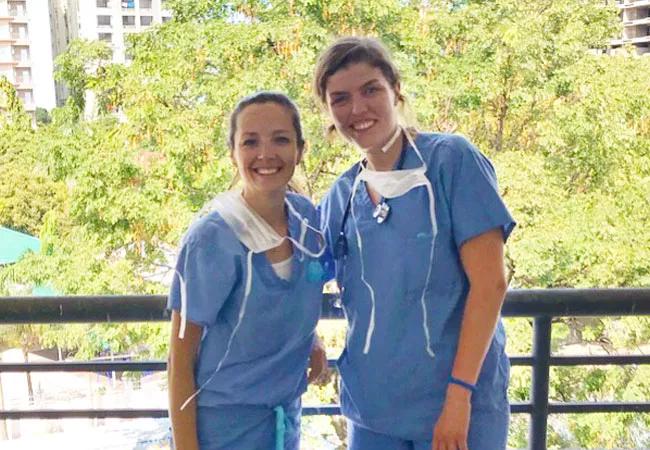
Image content: This image is available to view online.
View image online (https://assets.clevelandclinic.org/transform/2532cfea-a3a0-4150-9028-f0aad4ab9022/19-NUR-5055_CQD_Nurse-Africa_650x450_Hero-002_jpg)
19-NUR-5055_CQD_Nurse-Africa_650x450_Hero (002)
Pictured while in Tanzania to provide heart surgery care are nurses Irina Kowaliuk (left) and Alison Neimes.
Advertisement
Cleveland Clinic is a non-profit academic medical center. Advertising on our site helps support our mission. We do not endorse non-Cleveland Clinic products or services. Policy
For a week in August, nine healthcare providers from Cleveland Clinic’s main campus traveled more than 8,100 miles to Dar es Salaam, Tanzania, on a medical mission trip. The purpose of the trip, organized by congenital interventionist Joanna Ghobrial, MD, of Cleveland Clinic’s Heart & Vascular Institute, was to teach and perform coronary, valvular and congenital cardiac catheter interventions and surgeries at the 103-bed Jakaya Kikwete Cardiac Institute.
Among the volunteers were two clinical nurses from the coronary ICU, Irina Kowaliuk, BSN, RN, CCRN and Alison Neimes, BSN, RN, CCRN. “Irina and Alison were indispensable for this trip,” says Dr. Ghobrial. “One of the most important factors in cardiac interventions, whether surgical or catheter-based, is after-care. As ICU nurses, they both had a superb skill set and the desire and ability to transfer their knowledge base to their counterparts in Jakaya Kikwete Cardiac Institute.”
The trip to sub-Saharan Africa was the first medical mission experience for both nurses. “I’ve done other mission trips before and really enjoyed them, but never on the medical side,” says Kowaliuk. “It’s something I always had the desire to do, and this was the perfect opportunity.”
Prior to going to Tanzania, physicians from Cleveland Clinic and Jakaya Kikwete Cardiac Institute worked hand-in-hand to select patients for procedures. In the operating room, physicians performed several open heart surgeries to close large atrial and ventricular septal defects and repair tetralogy of Fallot. The main procedures in the catheterization lab included repair of atrial septal defects and ventricular septal defects with closure devices.
Advertisement
Although Kowaliuk and Neimes specialize in coronary ICU nursing in their home hospital, while in Tanzania they “did a little of everything,” says Neimes. This included organizing equipment for surgeries and procedures, rounding with physicians in the critical care unit, changing wound dressings and educating nurses on how to care for post-procedure patients.
One contribution the nurses are particularly proud of is development of a nursing protocol for caring for post-femoral catheterization procedure patients. “We took Cleveland Clinic’s protocol and adapted it to their resources to make something they could use,” says Neimes. The policy includes information on removing a femoral sheath, monitoring patients, checking activated clotting time (ACT) and more. Kowaliuk and Neimes did one-on-one teaching with nurses in the ICU unit, then placed the protocol on the computer in the ICU for later reference.
The mission trip afforded plenty of opportunities for teaching healthcare providers at Jakaya Kikwete Cardiac Institute, which opened in 2015. Although the hospital has much of the same state-of-the-art equipment as many U.S. hospitals, the caregivers don’t have the same experience or training on some cardiac procedures and surgeries.
For instance, one 16-year-old girl who was prepped for a valve repair went into cardiac tamponade during the procedure. The healthcare team from Cleveland Clinic taught the Tanzanian providers how to handle the complication. On the nursing side, Kowaliuk explained what pericardial drains are used for and how to monitor them. Later, she taught nurses in the post-procedure ICU how to care for the patient.
Advertisement
One of the biggest challenges to teaching the nurses in Tanzania was communication. The country’s two primary languages are Swahili and English, and although most of the nurses spoke English, Kowaliuk and Neimes weren’t always completely sure that their messages were being received and understood. “The nurses were kind, open and hospitable, but it was tricky to figure out the best way to teach them,” says Kowaliuk. She believes if she spent more time there – and had more opportunities to repeat the skills she taught – then communication would’ve become easier.
While the nurses provided invaluable advice to their peers in Tanzania, they also learned from the experience. “I grew exponentially as a nurse and a person,” says Neimes.
Both nurses have a new-found appreciation for the resources available to them at Cleveland Clinic. “We pretty much have everything at our fingertips,” says Neimes. But she adds that working with fewer resources at Jakaya Kikwete Cardiac Institute helped hone her basic nursing skills. “You realize you can do the same good quality nursing without a lot of [bells and whistles],” she says. “You are able to focus on doing patient assessments and to rely on your critical-thinking a lot more.”
This return to the basics has helped Neimes become a better nurse on the coronary ICU at Cleveland Clinic. She also says that caring for patients who may not speak your same language helped improve her bedside communication skills.
“Going to a country like Tanzania was so humbling,” adds Kowaliuk. “It makes you realize the things you take for granted every single day.” Simple things, like alcohol swabs and IV flushes, which the hospital in Tanzania didn’t have. Or gloves, which were available in one size.
Advertisement
The whirlwind week that Kowaliuk and Neimes spent in Tanzania was eye-opening and fulfilling. Both nurses now have the “mission bug” and plan to participate in future medical mission trips. And they encourage others to do the same.
“Step out of your comfort zone, and do it!” says Neimes. “You will learn a lot about nursing in general in other countries, but you will also learn about yourself as a nurse. You will become a better nurse and a better person.”
Advertisement
Advertisement
Nurses play key role in comprehensive lifetime treatment program
Customized bots improve speed, efficiency by streamlining daily clinical, clerical tasks
Nurses play pivotal role in patients’ ability to recover in the comfort of their own homes
New protocol reduces costs, increases patient and caregiver satisfaction
Advocating for patient safety is imperative in fast-paced surgical settings
M-Power program improves the perinatal experience for people who have survived abuse

Advice for those pursuing a WOC nursing career
Veteran nurse shares his experience as a caregiver and community volunteer