Locations:





Base decision on physiology, not angiography, expert advises
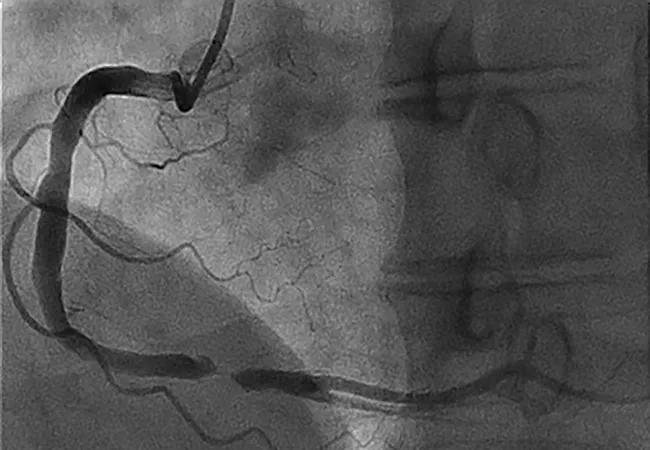
Image content: This image is available to view online.
View image online (https://assets.clevelandclinic.org/transform/ba6b7de2-29e5-418a-b0da-29c1926fba5f/Khatri-hero-650x450_jpg)
Khatri hero 650×450
Coronary chronic total occlusion (CTO), defined as TIMI 0 flow for more than three months, is seen on nearly one-third of routine coronary angiograms. Despite the prevailing opinion that CTO is benign, experts in CTO management disagree.
Advertisement
Cleveland Clinic is a non-profit academic medical center. Advertising on our site helps support our mission. We do not endorse non-Cleveland Clinic products or services. Policy
“It’s traditionally taught that if a lesion is closed, it can’t get worse,” says Cleveland Clinic interventional cardiologist Jaikirshan Khatri, MD. “But physiologically, CTO is associated with significant ischemic burden. When used judiciously in conjunction with non-CTO percutaneous coronary intervention (PCI), bypass surgery and optimal medical therapy, PCI for CTO can improve outcomes for patients with coronary artery disease.”
That’s a key message of an update on coronary CTO management that Dr. Khatri recently published with two Cleveland Clinic colleagues in a December 2017 supplement to Cleveland Clinic Journal of Medicine.
The new paper outlines several of the clinical benefits of CTO PCI:
In patients with patent but stenotic coronary arteries, it is known that physiologically driven decisions to revascularize can produce superior clinical results, Dr. Khatri observes.
Advertisement
“There is an ischemic burden threshold beyond which revascularization is superior to optimal medical therapy,” he explains. “In this setting, we know that CTO is associated with ischemic burden. Patients with symptoms related to CTO represent a subset of patients with incomplete revascularization. In this way, CTOs are similar to borderline lesions. But while we treat borderline lesions, we have traditionally tended to not treat CTOs.”
Anatomic considerations alone are insufficient in determining whether to proceed with PCI, Dr. Khatri says.
“We know from traditional angiography that eyeballing an estimate isn’t helpful in borderline blockages,” he notes. “We need to obtain a measurement of the blockage to direct our decision.” This is where fractional flow reserve (FFR) is useful for informing the risk-benefit analysis of PCI versus medical treatment, he adds. “The lower an FFR value is below 0.8, the greater the benefit of PCI. The higher the value above 0.8, the greater the benefit of medical therapy. All CTOs have a value less than 0.8 independent of the size and quality of collaterals supplying the distal vessel.”
Noninvasive assessment of ischemic burden can also be conducted with myocardial perfusion imaging, he points out. In CTO, ischemia greater than 12.5 percent is predictive of significant improvement in symptoms after intervention.
Dr. Khatri and colleagues provide a helpful algorithm for determining the need for and method of coronary revascularization in patients with CTO in the following figure from their recent Cleveland Clinic Journal of Medicine review.
Advertisement
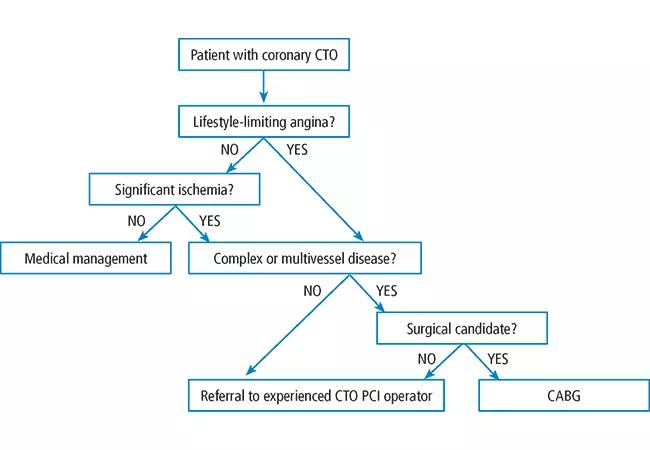
Image content: This image is available to view online.
View image online (https://assets.clevelandclinic.org/transform/f4ec43db-0ff8-4563-9ae0-98693b80ea21/Khatri-inset650x450_jpg)
Figure. An algorithmic approach to determining the need for and method of coronary revascularization in patients with coronary CTO. Reprinted, with permission, from Khatri et al., Cleveland Clinic Journal of Medicine (2017;84[suppl 3]:27-38).
The difficulty of performing CTO PCI has discouraged many operators from attempting it. As a result, Dr. Khatri and colleagues note in their review, the volume of CTO PCIs is less than 5 percent of total PCIs performed in the U.S. — and success rates remain low, at 59 percent.
But the combination of operator experience, improved technology and widespread adoption of a hybrid algorithm for the procedure published by Brilakis and colleagues in 2012 has improved results. High-volume centers now report procedural success rates as high as 92.9 percent.
“There is a strong correlation between a center’s CTO PCI volume and CTO PCI success rates,” says Dr. Khatri. “CTO PCI success remains heavily dependent on operator expertise, as a steep and long learning curve is involved.”
The unique technical aspects of CTO PCI, such as retrograde and subintimal guidewire tracking, have accelerated procedural success but can be associated with higher rates of adverse cardiac events compared with traditional antegrade and intraluminal guidewire tracking. “This makes it a difficult procedure that should be reserved for experienced operators,” Dr. Khatri says.
At Cleveland Clinic, where several cardiologists collectively perform more than 100 CTO PCIs per year, the overall safety of the procedure is enhanced by use of bilateral radial artery access.
Advertisement
“The Achilles’ heel of PCI is a 1-in-1,000 chance of a life-threatening bleed with femoral access,” Dr. Khatri notes. “But the risk of a life-threatening bleed is substantially reduced when operators go through the wrist.”
He and his colleagues are researching several techniques to simplify, shorten and improve CTO PCI. “We hope to get the technique and technology good enough that it becomes a routine procedure with high safety and success rates,” he explains.
Image at top reprinted, with permission, from Khatri et al., Cleveland Clinic Journal of Medicine (2017;84[suppl 3]:27-38).
Advertisement
Advertisement

A sampling of outcome and volume data from our Heart & Vascular Institute
Concomitant AF ablation and LAA occlusion strongly endorsed during elective heart surgery
Large retrospective study supports its addition to BAV repair toolbox at expert centers
Young age, solid tumor, high uptake on PET and KRAS mutation signal risk, suggest need for lobectomy
Surprise findings argue for caution about testosterone use in men at risk for fracture
Residual AR related to severe preoperative AR increases risk of progression, need for reoperation

Findings support emphasis on markers of frailty related to, but not dependent on, age
Provides option for patients previously deemed anatomically unsuitable
 Search