Locations:





Investigational Carillon device benefits heart failure patients with functional mitral regurgitation
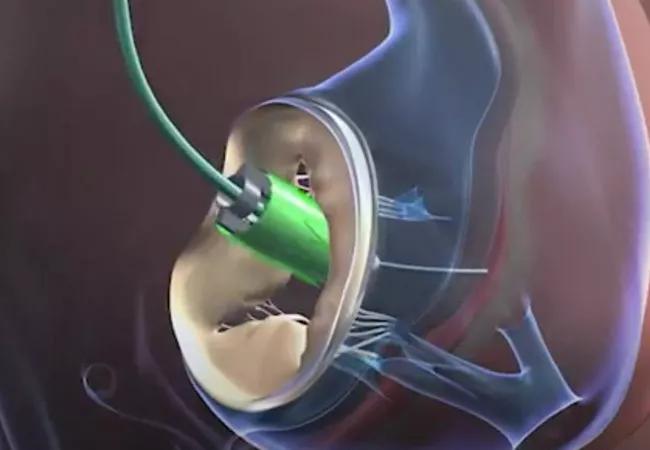
Image content: This image is available to view online.
View image online (https://assets.clevelandclinic.org/transform/da117db8-e3e5-4e4c-b554-760efd2ed472/percutaneous-mitral-valve-procedure_650x450-1_jpg)
percutaneous-mitral-valve-procedure_650x450
Transvenous mitral annuloplasty with the investigational Carillon® Mitral Contour System® significantly reduces both mitral regurgitant and left ventricular (LV) volumes in patients with functional mitral regurgitation (FMR) associated with heart failure. So finds the first sham-controlled, blinded, randomized trial of a percutaneous heart valve therapy. Recently published in JACC: Heart Failure (2019 Sep 7 [Epub ahead of print]), the REDUCE-FMR trial offers a preliminary but promising look at the future of percutaneous mitral valve therapies.
Advertisement
Cleveland Clinic is a non-profit academic medical center. Advertising on our site helps support our mission. We do not endorse non-Cleveland Clinic products or services. Policy
“Though this was a small group, the results are encouraging,” says co-author Wael Jaber, MD, a cardiologist in Cleveland Clinic’s Section of Cardiovascular Imaging. “The reduction in mitral regurgitation is significant on its own, but coupled with the positive remodeling that patients experienced, we see evidence toward a new option for patients whose prognosis was typically poor.”
The study cohort included 120 patients from Australia, New Zealand and Europe who were randomly assigned at a 3:1 ratio to treatment (n = 87) or sham (n = 33) groups. All patients had 2+ mitral regurgitation, New York Heart Association class II symptoms or greater, LV end-diastolic diameter greater than 55 mm and LV ejection fraction less than 50%. All had received optimal medical therapy for at least three months.
The Cleveland Clinic Coordinating Center for Clinical Research (C5Research), an academic research organization that plans, coordinates and manages multicenter clinical trials, provided core laboratory support for the study.
The trial’s intention-to-treat analysis met its primary endpoint of change in mitral regurgitant volume at one year as measured by quantitative echocardiography. Mitral regurgitant volume decreased by 7.1 mL/beat in the treatment group, whereas it increased by 3.3 mL/beat in the sham group (P = 0.049). Patients who received the Carillon device also experienced a statistically significant reduction in both end-diastolic and end-systolic LV volumes compared with the sham group (10.4-mL decrease vs. 6.5-mL increase and 6.2-mL decrease vs. 6.1-mL increase, respectively). LV remodeling is consistently associated with mortality benefit.
Advertisement
Device implantation involves placement of the Carillon in the coronary sinus via transjugular access. The device cinches the mitral annulus by anchoring in the great cardiac vein and coronary sinus.
MitraClip™, the percutaneous therapy recently approved for use in heart failure patients with FMR based on results of the COAPT trial, requires transseptal puncture and experienced operators certified in use of the device. “Most of the procedures in REDUCE-FMR were performed at centers previously unfamiliar with the technology, and implantation does not require transseptal puncture,” says study co-author Paul Cremer, MD, a cardiologist in Cleveland Clinic’s Section of Cardiovascular Imaging. “In addition, if necessary, Carillon leaves the door open for future leaflet therapies, be they surgical or percutaneous.”
While REDUCE-FMR wasn’t powered to evaluate clinical endpoints, the currently enrolling CARILLON trial (NCT03142152) will evaluate the device for impact on mortality and hospitalization in patients with FMR. C5Research is coordinating the multicenter trial, and three Cleveland Clinic staff — Samir Kapadia, MD, Chair of Cardiovascular Medicine; A. Marc Gillinov, MD, Chair of Thoracic and Cardiovascular Surgery; and heart failure cardiologist Randall Starling, MD, MPH — are co-principal investigators.
COAPT found that implantation of MitraClip significantly reduces hospitalization and all-cause mortality compared with medical therapy alone in patients with heart failure and moderate-to-severe or severe secondary mitral regurgitation who remain symptomatic despite optimal medical therapy. CARILLON will evaluate the same endpoints in a sham-controlled study of similar patients.
Advertisement
“COAPT gave us MitraClip for this population,” says Dr. Kapadia, COAPT co-author and steering committee member. “It remains to be seen whether CARILLON will give us another option for patients in whom optimal medical therapy is insufficient.”
Advertisement
Advertisement

A sampling of outcome and volume data from our Heart & Vascular Institute
Concomitant AF ablation and LAA occlusion strongly endorsed during elective heart surgery
Large retrospective study supports its addition to BAV repair toolbox at expert centers

Young age, solid tumor, high uptake on PET and KRAS mutation signal risk, suggest need for lobectomy
Surprise findings argue for caution about testosterone use in men at risk for fracture
Residual AR related to severe preoperative AR increases risk of progression, need for reoperation

Findings support emphasis on markers of frailty related to, but not dependent on, age
Provides option for patients previously deemed anatomically unsuitable
 Search