Locations:





 Search
A call for more collaboration
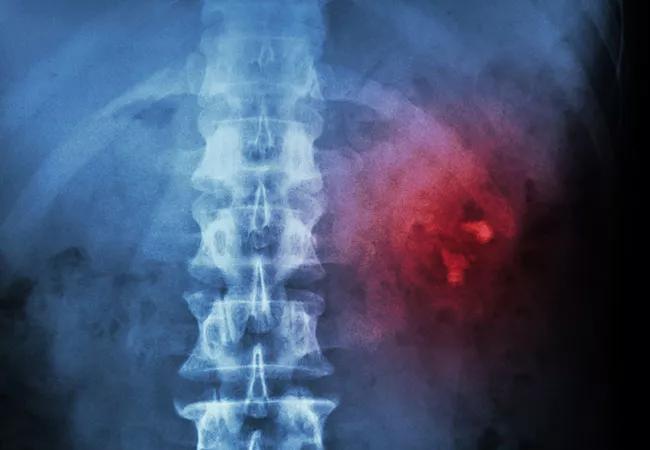
Image content: This image is available to view online.
View image online (https://assets.clevelandclinic.org/transform/25353956-0cd1-4463-a7e2-7d911848296e/650x450-Kidney-Stones_jpg)
650×450-Kidney-Stones
Heightened interest in microbiome-associated urinary stone disease (USD) in the last several years has led to new investigations in laboratories around the world.
Advertisement
Cleveland Clinic is a non-profit academic medical center. Advertising on our site helps support our mission. We do not endorse non-Cleveland Clinic products or services. Policy
Aaron Miller, PhD, who leads the Stones Translational Research Laboratory at Cleveland Clinic’s Lerner Research Institute, has published extensively on this topic.
In a consensus paper soon to be published in Nature Reviews Urology, Dr. Miller and collaborators set out to identify consistent risk factors or bacteria associated with microbiome-associated USD to understand how specific factors may play a pathogenic or protective role in the context of the disease.
To better understand potential associations, the team analyzed all of the published clinical data from microbiome-wide association studies (MWAS) involving USD. Interestingly, the data were inconclusive — they were not able to show that sex, history of USD or frequency of antibiotic use, as examples, played a predictive role.
Rather, the most significant driver of variables among the studies was the lab where the data originated.
Dr. Miller remarks that this underscores the need to better define what has been published and standardize workflow and processes for future investigations.
Dr. Miller and his team then led outreach efforts to other research teams involved in MWAS of microbiome-associated USD, which eventually culminated in an international consortium to develop guidelines. The scientists worked together to create standardized protocols on everything from initial sample collection and storage to DNA extraction, sequencing and data analysis.
“Our goal was to establish a better foundation in conducting this work to create biologically meaningful interpretations down the road,” he says.
Advertisement
Standardizing the process also serves as a blueprint for other labs to conduct this type of work, even if they do not have direct expertise. “Clinically, this is important because it increases sample size and broadens geographic regions and patient populations to further refine these sorts of analyses and interpretations,” asserts Dr. Miller.
Last year, Dr. Miller and his collaborators published a study in Scientific Reports that validates the claim that antibiotics influence a long-term shift in the microbiome that may increase the risk for USD. They also established the urinary tract microbiome — and not the gut microbiome — as a pathogenic target for USD.
These contributions, and others of their kind, are changing the landscape of microbiome research across the fields of urology and nephrology. There is early interest in exploring this work in the context of benign prostatic hyperplasia, chronic pelvic pain and a number of other conditions.
Ultimately, the recent review recognizes the breadth of research that has already been published within the field, aims to create continuity for how it’s being approached and breaks down the silos that contribute to a lack of uniformity in the work.
“We can’t really advance the science in microbiome if everyone is producing their own individual set of interpretations,” says Dr. Miller. “There needs to be a team-based approach to this work, and that is exactly the direction in which we are headed.”
Advertisement
Advertisement

Clinicians should individualize dosing practices based on patient risk factors and preferences
Pioneering and refining the approach in pyeloplasty, nephrectomy and more
Fully-automated process uses preop CT, baseline GFR to estimate post-nephrectomy renal function
Could mean earlier treatment, but also could have negative effects

Unlike earlier pills, new drugs do not cause liver toxicity
Male factors play a role in about half of all infertility cases, yet men often are not evaluated
Surgeons choreograph nearly simultaneous procedures, sharing one robot between two patients

Identifying barriers in the renal genetic assessment of Black patients