Locations:





From a care path to boxing biomechanics and beyond
Image content: This image is available to view online.
View image online (https://assets.clevelandclinic.org/transform/c77f6f58-ef8e-4ad1-aa4e-8892955ed758/690x380-Alberts_jpg)
690×380-Alberts
By Jay Alberts, PhD
Advertisement
Cleveland Clinic is a non-profit academic medical center. Advertising on our site helps support our mission. We do not endorse non-Cleveland Clinic products or services. Policy
Neuroscientists in training would be hard pressed to find an area of contemporary neurologic research and practice as dynamic as concussion detection and management. That’s particularly the case at Cleveland Clinic, where our Concussion Center, together with collaborating departments and institutes across the health system, is advancing understanding of concussion on an abundance of fronts.
Here’s a quick survey of four recent developments across various areas of our concussion research and clinical activity.
We are currently implementing the Cleveland Clinic Concussion Care Path, a comprehensive evidence-based road map to guide clinicians in the management of suspected concussion from initial assessment through long-term follow-up. This tool is one in a series of disease-specific Cleveland Clinic care paths designed to improve the value of care by reducing needless and costly variability while maintaining or improving patient outcomes.
In contrast to practice guidelines, these care paths are built on top of guidelines to demonstrate how guidelines can be best implemented and made operational. They share several elements in common:
Advertisement
Development of the Concussion Care Path has involved close collaboration with Cleveland Clinic’s Emergency Services Institute, particularly around efforts to make the Cleveland Clinic-developed C3Logix™ app available in emergency settings for consistent data collection and concussion assessment.
The C3Logix app, which was first developed for use in athletes, takes advantage of the gyroscope and accelerator within the iPad® 2 to measure motion and acceleration. It works by collecting position and time-series data, along with linear and acceleration data, to assess postural stability and concussion symptoms while an athlete performs balance tests. The app also assesses cognitive measures through tasks performed on the iPad screen (Figure 1).
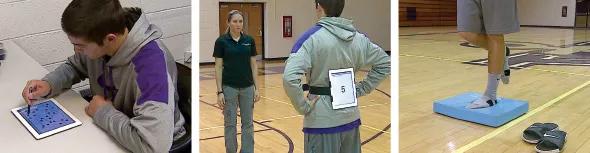
Image content: This image is available to view online.
View image online (https://assets.clevelandclinic.org/transform/a873ed2c-4645-42ef-85cc-e54715817f68/Alberts-Inset-1_jpg)
Figure 1. The C3Logix app assesses postural stability and concussion symptoms during balance tests and also assesses cognitive measures through tasks performed on the iPad screen.
Once an athlete undergoes a 15-minute baseline testing session, the app can be deployed by an athletic trainer immediately following a head injury during play to compare results with the athlete’s baseline measures and guide concussion assessment and management.
While the C3Logix app has been used for baseline testing among thousands of high school and college athletes over more than two years, expansion of its use in emergency rooms through our Emergency Services Institute is allowing us to broaden our data-collection efforts into a concussion registry to yield important insights for clinical practice and to generate research questions.
Advertisement
Cleveland Clinic is looking to help meet burgeoning demand for improved concussion assessment by commercializing the C3Logix app through a spinoff company called iComet Technologies, which has made the app available to athletic trainers and clinicians through the business-to-business app market.
We have been pilot testing the app’s use by the athletics program of a rural school district in Rock Valley, Iowa, to assess its utility in a community with few athletic trainers and no physicians who specialize in concussion. This collaboration is a step toward our goal of making the app usable by schools and providers across the country, ideally in conjunction with the Concussion Care Path.
The C3Logix app research group is in the process of publishing initial results on the app’s use by Northeast Ohio school teams. Among the notable findings is a substantial increase in the number of concussed athletes referred for and completing physical therapy.
Meanwhile, Concussion Center researchers have joined with colleagues from Cleveland Clinic Lou Ruvo Center for Brain Health to combine — for the first time — imaging studies, behavioral assessment and evaluation of impact dynamics to study the acute effects of head impacts in combat sports. The investigation, which we call the Boxing Biomechanics Study, aims to pinpoint the dose of impact to the head that produces brain changes linked to neurodegenerative disease.
We began the Boxing Biomechanics Study in 2013 and plan to report results later this year. We have enrolled five boxers and mixed martial artists in Las Vegas, all of whom have undergone a baseline brain MRI and a baseline assessment of motor and cognitive functions via the C3Logix app. They then take part in a sparring session wearing the Cleveland Clinic Intelligent Mouthguard (Figure 2), equipped with sensors that measure linear and rotational head movement, to capture head impact data in real time. These data are compared with neurological and motor test results from after the sparring session to drive a computer-based brain model that helps diagnose and pinpoint brain injuries. Immediately after the session, the fighters undergo a post-sparring C3Logix assessment and brain MRI.
Advertisement
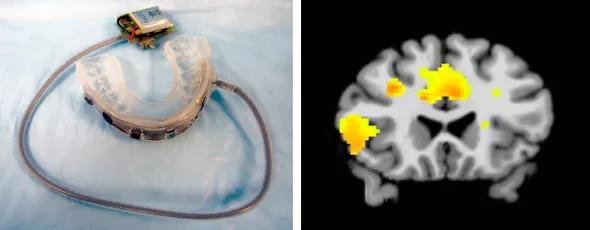
Image content: This image is available to view online.
View image online (https://assets.clevelandclinic.org/transform/389545ef-efec-44e3-a4c7-a06bb5d863eb/Alberts-Inset-2_jpg)
Figure 2. The Boxing Biomechanics Study combines brain MRIs (left) immediately before and after a sparring session with real-time measurement of head impact dynamics captured by the Cleveland Clinic Intelligent Mouthguard (right) during the session.
Our aim is to assess and refine this three-pronged data-gathering approach to build toward prospective longitudinal studies involving large numbers of athletes tracked over years or decades. The aim is to create a comprehensive, “one stop” data collection strategy for quantifying the dose of head impact causing neurodegenerative changes.
This investigation complements the Lou Ruvo Center’s Professional Fighters Brain Health Study, which is using annual brain MRIs and other tests in hundreds of professional fighters to examine the cumulative effect of repetitive brain injuries in real time and assess the earliest, most subtle signs of brain injury that correlate with impaired cognition and functioning.
Dr. Alberts is Director of the Concussion Center in Cleveland Clinic’s Neurological Institute.
Advertisement
Advertisement

New study advances understanding of patient-defined goals
Testing options and therapies are expanding for this poorly understood sleep disorder
Real-world claims data and tissue culture studies set the stage for randomized clinical testing
Digital subtraction angiography remains central to assessment of ‘benign’ PMSAH

Cleveland Clinic neuromuscular specialist shares insights on AI in his field and beyond
Findings challenge dogma that microglia are exclusively destructive regardless of location in brain
Neurology is especially well positioned for opportunities to enhance clinical care and medical training
New review distills insights from studies over the past decade
 Search