Locations:





Program provides care for the caregivers
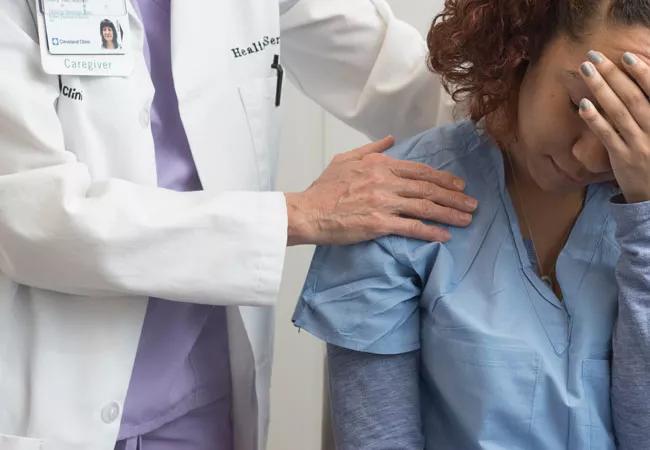
Image content: This image is available to view online.
View image online (https://assets.clevelandclinic.org/transform/fbd4b437-84d5-4ca3-9039-236cbca46451/lavendar_650x450_jpg)
lavendar_650x450
Nurses are familiar with – and many have participated in – Code Blue events to provide resuscitation or immediate medical attention to a patient in need. Hospitals have adopted other color-coded designations, too, for events ranging from bomb threats to child abductions. In 2009, a partnership between holistic nurses and chaplains at Cleveland Clinic led to the first Code Lavender initiative.
Advertisement
Cleveland Clinic is a non-profit academic medical center. Advertising on our site helps support our mission. We do not endorse non-Cleveland Clinic products or services. Policy
“A Code Lavender provides holistic rapid response to emotionally stressful events,” explains Barb Picciano, BSN, RN, HN-BC, Manager of Healing Services. “A trained team responds in the moment when something happens and supports folks emotionally.” The program has grown, with a Code Lavender team of four holistic nurses and 10 chaplains from Cleveland Clinic’s main campus helping more than 1,100 people so far this year. The team is part of the Spiritual Care Department led by the Reverend Amy Greene, DMin.
Code Lavender is available to all patients, families and healthcare providers at Cleveland Clinic, though nearly all of the codes have been called to support the latter. The team responds to an average of three to four Code Lavender events monthly, with triggers varying from the unexpected death of a fellow staff member to the emotional after effects of assisting with a Code Blue event.
In 2012, Picciano’s team executed its largest Code Lavender event. Following shootings at Chardon High School in Northeast Ohio, the team provided an enterprisewide Code Lavender for the entire staff of Cleveland Clinic’s Hillcrest Hospital. Several victims of the shooting were transported to Hillcrest, and many staff there had children enrolled at Chardon High. The team served more than 500 employees in a 72-hour time period.
“We are Band-Aid® therapy. We come in when an event happens, ideally within a half hour of the call,” says Picciano. “Our team of holistic nurses and chaplains offers care in the moment, then partners with our Employee Assistance Program and the Wellness Center to provide long-term assistance.”
Advertisement
Because emotional distress affects everyone so differently, the Code Lavender team utilizes a variety of modalities. These include:
Code Lavender is currently offered at Cleveland Clinic’s main campus, Hillcrest Hospital, Fairview Hospital, Medina Hospital and Euclid Hospital. Picciano is working with South Pointe Hospital, Marymount Hospital and Ashtabula County Medical Center to adopt the program.
While there is no “one-size-fits-all” approach to Code Lavender events, they often have similar elements. Caregivers wear either white lab coats stitched with “Healing Services” or lavender scrubs and carry a lavender storage bin containing supplies to the site. When they arrive on a hospital unit, team members introduce themselves, explain their services and why they were called, and hand out Code Lavender wristbands that serve to remind the healthcare providers that they are being cared for.
Each team member offers services within his or her scope of practice, such as spiritual support from a chaplain or light massage from a nurse. The team sets up one-on-one stations in break rooms for privacy and also walks around the unit offering on-the-floor help. In addition, the team provides information on preventive and ongoing support and hands out things such as aromatherapy inhalers, healthy snacks and water.
Advertisement
Picciano offers the following advice for other healthcare organizations that would like to implement Code Lavender:
The patience of Picciano and her team has ultimately led to a successful Code Lavender program at Cleveland Clinic. As she said in an article in Beginnings magazine, published by the American Holistic Nurses Association, “In a facility that encounters some of the highest acuity patients in the country, we find that Code Lavender provides holistic, rapid response to emotional events in a much needed, appreciated and holistic model of care for our caregivers.”
Advertisement
Advertisement
Nurses play key role in comprehensive lifetime treatment program
Customized bots improve speed, efficiency by streamlining daily clinical, clerical tasks

Nurses play pivotal role in patients’ ability to recover in the comfort of their own homes
New protocol reduces costs, increases patient and caregiver satisfaction

Advocating for patient safety is imperative in fast-paced surgical settings

M-Power program improves the perinatal experience for people who have survived abuse

Advice for those pursuing a WOC nursing career

Veteran nurse shares his experience as a caregiver and community volunteer
 Search