Locations:





Implants can reverse disease state, replace injections
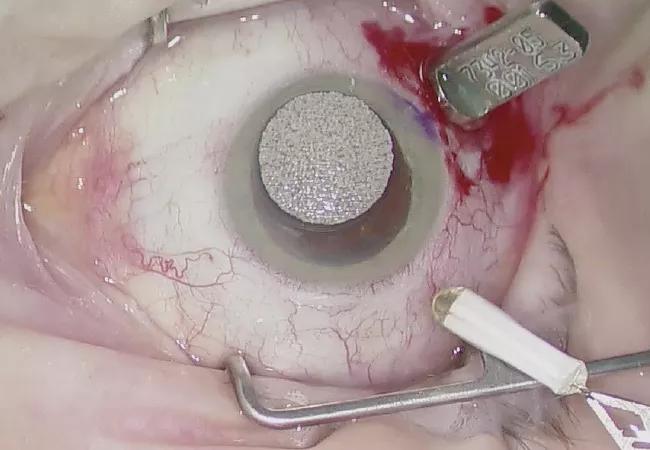
Image content: This image is available to view online.
View image online (https://assets.clevelandclinic.org/transform/59d6d87e-021e-4138-9b30-5dcaa1ac7fb6/16-EYE-802-Neurotech-CQD-650x450_jpg)
16-EYE-802-Neurotech-CQD-650×450
New ocular implants being studied at Cleveland Clinic Cole Eye Institute to treat a variety of eye conditions have the potential to lessen the burden of frequent injections and office visits through long-acting drug delivery.
Advertisement
Cleveland Clinic is a non-profit academic medical center. Advertising on our site helps support our mission. We do not endorse non-Cleveland Clinic products or services. Policy
Age-related macular degeneration (AMD) is the most common cause of blindness in people over age 55. While there is no cure, current therapies include routine anti-vascular endothelial growth factor (anti-VEGF) intravitreal injections. These injections can dramatically improve visual outcomes in patients, but improvement depends on frequent office visits and close monitoring. Ocular implants are being studied as a viable alternative to these injections.
Rishi Singh, MD, a surgeon in Cole Eye Institute, performed the first implant in Ohio of a device that releases an anti-VEGF medication for the treatment of AMD, and could be used for other diseases such as diabetic retinopathy and retinopathy of prematurity.

Image content: This image is available to view online.
View image online (https://assets.clevelandclinic.org/transform/bd94bc82-4ab2-46bd-845a-c6302e0b49d8/jan2015-subscribe-cqdpulse3_jpg)
Cleveland Clinic is one of 38 sites – and the only site in Ohio – in a Phase 1 and 2 clinical study evaluating Neurotech’s encapsulated cell technology (ECT) in patients with macular degeneration and AMD. The implant enables continuous production of anti-platelet-derived growth factor (anti-PDGF) and anti-vascular endothelial growth factor (anti-VEGF) proteins to the eye.
The ECT implant is inserted into the vitreous through a single incision and sutured in place in a 20-minute outpatient procedure. The implant’s semi-permeable exterior allows for long-term, continuous targeted delivery of single and combination medications.
Cole Eye Institute also is involved in the LADDER study, a Phase 2 multi-center study of the efficacy and safety of Genentech’s Ranibizumab Port Delivery System (RPDS) for the sustained delivery of ranibizumab in wet AMD patients. The refillable device delivers therapeutic concentrations of ranibizumab into the vitreous over an extended time period.
Advertisement
The Genentech study will focus on the device to more definitively evaluate its efficacy, as well as the refill interval between doses, with a target of at least four to six months between refills.
Dr. Singh says this new therapy will have a huge impact on how many patients with these conditions are treated.
“This can give the patient the best possible outcome of treatment without the burden of monthly visits. There is definitely a need for it,” Dr. Singh says. “Some patients have received seven years of injections since their inception, and some of these technologies will help them stop needing to come in for monthly evaluations and treatments.”
Dr. Singh implanted the device in a patient with macular degeneration with three years of injections in her history. Her disease progressed to the point where she relied on others to make it to monthly appointments. “This was a huge social burden for her and sometimes she couldn’t come and be evaluated as frequently as she needed,” Dr. Singh says.
Dr. Singh says Cole Eye Institute’s clinical research division is a pioneer in attracting large clinical trials that uniquely modify and treat diseases. His work in attracting clinical trials geared toward conditions like diabetic retinopathy, AMD and retinal vein occlusion speaks to the mission of the Cole Eye Institute “to preserve sight and provide successful outcomes for patients with complex problems.”
Advertisement
Advertisement
Early data shows risk is 73% higher in patients with lupus, 40% higher in patients with rheumatoid arthritis

Identifies weak spots in the cornea before shape change occurs

Study highlights the value of quantitative ultra-widefield angiography
Switching medications may decrease treatment burden and macular fluid

Interventions abound for active and stable phases of TED
Corneal imaging and interpretation play a major role
Cole Eye Institute imaging specialists are equal parts technician, artist and diagnostician

Effect of low-dose atropine and dual-focus contact lenses is unknown in patients with comorbid eye conditions
 Search