Locations:





Patient doing well, stimulation to start in coming weeks
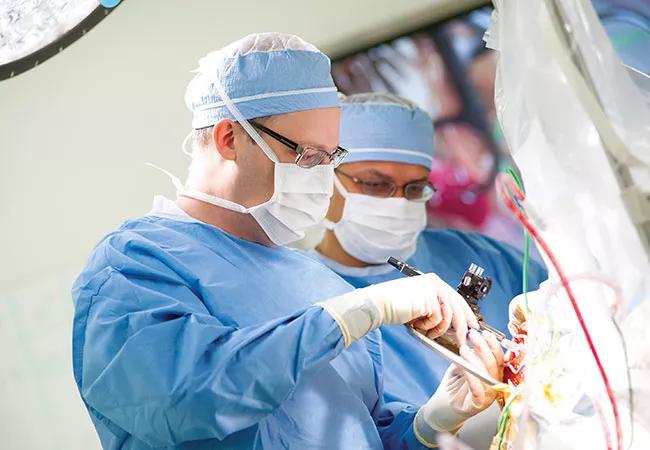
Image content: This image is available to view online.
View image online (https://assets.clevelandclinic.org/transform/af2bb775-8ade-4820-ba70-272dd42d8565/Twitter-170104-17-NEU-504-Machado-650x450_jpg)
twitter-170104-17-neu-504-machado-650×450
Cleveland Clinic has performed the first deep brain stimulation (DBS) surgery in a patient for the purpose of restoring motor function following ischemic stroke.
Advertisement
Cleveland Clinic is a non-profit academic medical center. Advertising on our site helps support our mission. We do not endorse non-Cleveland Clinic products or services. Policy
During a six-hour procedure on Dec. 19, 2016, a team led by Andre Machado, MD, PhD, implanted DBS electrodes in the cerebellum of the patient, who has severe post-stroke residual hemiparesis despite previous physical therapy. The patient has been discharged home feeling well and in stable condition.
Over the next few weeks, following adequate healing and recovery from the brain surgery, the patient will undergo physical therapy. After a few weeks of rehabilitation, the DBS device connected to the implanted electrodes will be turned on as the patient continues physical therapy. The patient will be monitored and evaluated regularly to determine whether and how DBS can enhance the effects of physical therapy.
The first-in-human operation is the initial case in an NIH-supported Cleveland Clinic trial of DBS for stroke recovery detailed previously on Consult QD.
“If this research succeeds, it is a new hope for patients who have remained paralyzed after a stroke,” says Dr. Machado, Chairman of Cleveland Clinic’s Neurological Institute and a neurosurgeon specializing in neuromodulation. “It is an opportunity to allow our patients to rehabilitate and gain function and independence. Our knowledge to date shows that deep brain stimulation can help the brain reorganize and adapt beyond what physical therapy alone can do. Our study’s goal is to boost rehabilitation outcomes beyond what physical therapy alone could achieve.”
More details about this initial case in the trial are available in a new Time magazine feature. Dr. Machado (shown in the foreground of the above photo) discusses the trial’s rationale and goals in this short Consult QD video.
Advertisement
Advertisement

New study advances understanding of patient-defined goals
Testing options and therapies are expanding for this poorly understood sleep disorder
Real-world claims data and tissue culture studies set the stage for randomized clinical testing
Digital subtraction angiography remains central to assessment of ‘benign’ PMSAH

Cleveland Clinic neuromuscular specialist shares insights on AI in his field and beyond
Findings challenge dogma that microglia are exclusively destructive regardless of location in brain
Neurology is especially well positioned for opportunities to enhance clinical care and medical training
New review distills insights from studies over the past decade
 Search